


Finding the Right ABA Therapy Support in Your Community
Searching for “ABA therapy near me” is a common first step for parents seeking help for their children with autism and other developmental challenges. Here’s a quick guide to finding local ABA therapy:
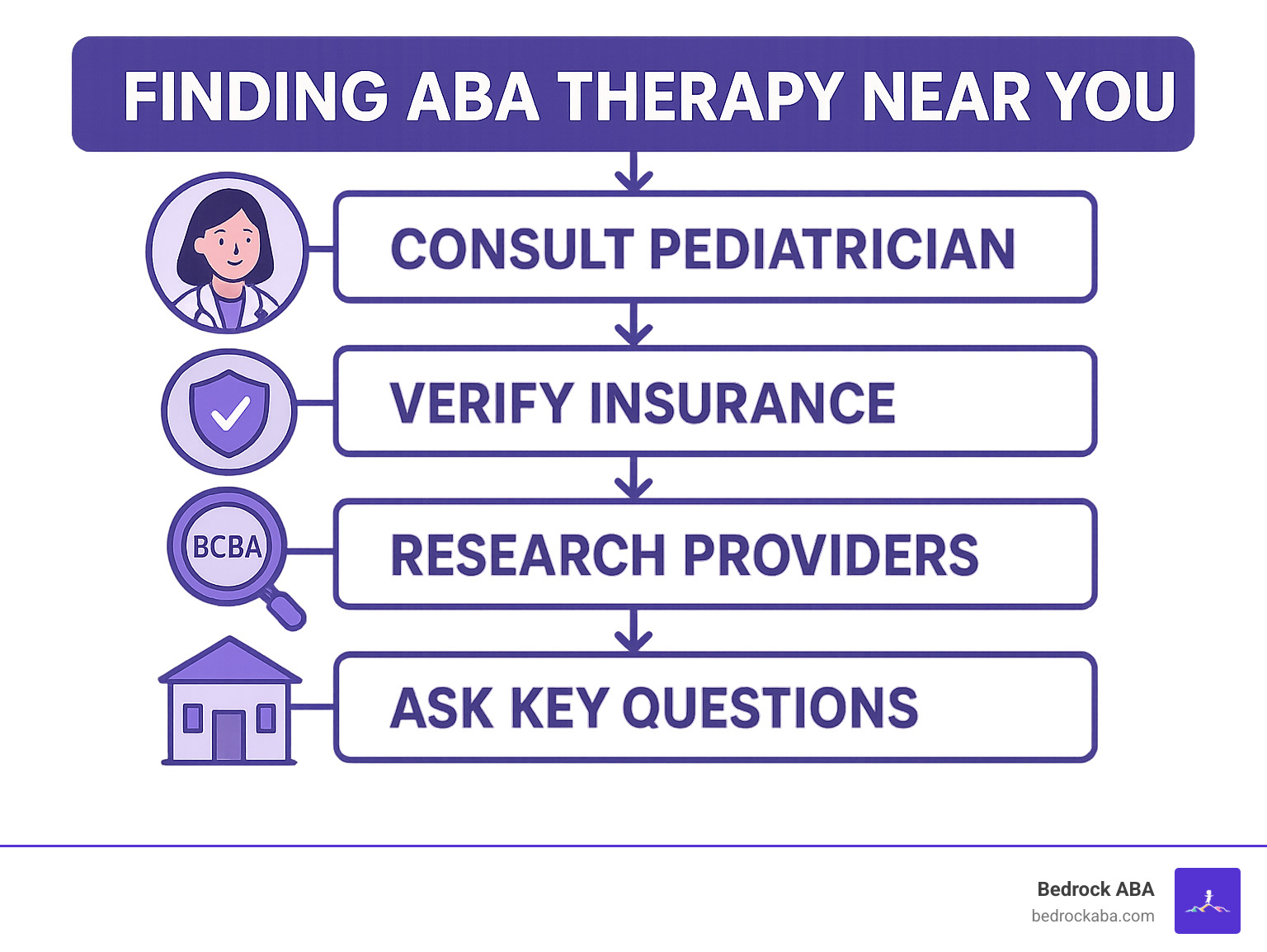
Quick Guide to Finding ABA Therapy Near You:
- Start with your pediatrician for trusted local referrals
- Check your insurance provider’s directory for covered therapists
- Look for Board Certified Behavior Analysts (BCBAs)
- Visit centers in person to see if they’re a good fit
- Ask about individualized treatment plans and family involvement
- Verify insurance coverage before starting services
Recognized by the US Surgeon General and the American Psychological Association, Applied Behavior Analysis (ABA) is an evidence-based best practice treatment for children with autism. Research shows it can significantly improve communication, social, and daily living skills.
Finding quality ABA services doesn’t have to be overwhelming. As one parent shared: “Watching our daughter thrive—calling us ‘Mom’ and ‘Dad’ for the first time, successfully potty training, and having conversations—was nothing short of a miracle.”
I’m Mayer Kulefsky, director of operations at Bedrock ABA. I’ve seen how the right local provider can transform lives through personalized care, and I’ve helped expand our ABA therapy near me services in states like Utah and North Carolina.
Basic aba therapy near me terms:
Understanding ABA Therapy: What It Is and How It Helps

When parents search for “aba therapy near me,” they’re looking for hope. Applied Behavior Analysis (ABA) is a proven, science-based approach that helps children grow and thrive. ABA helps us understand the “why” behind behaviors by looking at what happens before and after them. This allows us to support children in learning new, helpful skills.
The core of ABA is positive reinforcement—celebrating every success to encourage learning and build confidence. It’s also highly individualized; we design each program around your child’s unique strengths and needs, often making therapy feel like play.
The A-B-C (Antecedent-Behavior-Consequence) model is key. We analyze what triggers a behavior (Antecedent) and what follows it (Consequence) to understand its purpose. By adjusting the antecedent or consequence, we can encourage positive behavioral changes. Learn more about this life-changing approach in our guide, more info about what ABA therapy is.
What is Applied Behavior Analysis (ABA)?
Applied Behavior Analysis is the science of learning and behavior, recognized as an evidence-based best practice treatment. ABA focuses on two main goals: increasing helpful skills (like communication and social interaction) and reducing challenging behaviors that hinder learning.
Therapy is goal-oriented, with clear, measurable objectives. We build skills step-by-step, creating a strong foundation for future success. The ultimate goal is to teach children how to learn, adapt, and become more independent, building skills that last a lifetime. For more details, explore more info about ABA for children.
Who Benefits from ABA Therapy?
While most known for helping children with Autism Spectrum Disorder (ASD), ABA’s benefits extend further. For children with ASD, ABA helps steer challenges with social cues, communication, and routines by breaking down skills into manageable steps.
ABA is also effective for children with ADHD, Oppositional Defiant Disorder (ODD), and other developmental delays. Age is not a barrier. While early intervention with toddlers is powerful due to brain plasticity, teens also benefit from ABA adapted to their unique needs, from social skills to pre-vocational training. Every child deserves the chance to reach their full potential. Learn more about more info about ABA for autism.
The Core Principles: How ABA Therapy Works
ABA is a data-driven science. We continuously track progress to ensure interventions are effective and make adjustments as needed. A Functional Behavior Assessment (FBA) is conducted first to understand the “why” behind a behavior, which allows us to teach better ways for a child to meet their needs.
Key strategies include positive reinforcement to make learning rewarding and skill breakdown, where complex tasks are taught in small, manageable steps. The ultimate goal is generalization—ensuring new skills are used in all settings, like at home and school. Our Play-Based ABA Therapy approach helps make this learning feel natural and fun, integrating seamlessly into real-life situations.
Key Benefits of ABA Therapy for Children

When families search for “ABA therapy near me,” they are looking for life-changing support. The benefits of ABA therapy create ripple effects that extend far beyond the therapy room, touching every corner of a child’s world. Backed by scientific research on ABA effectiveness, ABA therapy leads to meaningful gains in communication, social skills, daily living, and independence, which can improve academic success.
These skills build on each other: improved communication can reduce meltdowns, and new self-care skills boost social confidence, creating a strong foundation for lifelong growth.
Improving Communication and Social Skills
ABA therapy helps children build communication skills, from first words to full sentences, opening up new ways to connect with others. We work on both verbal and non-verbal communication, including understanding facial expressions and gestures, to help children steer social situations.
Key social skills like turn-taking, sharing, and making friends are practiced in therapy. These are life skills that open doors to friendships and better family harmony. We’ve seen children go from playing alone to confidently initiating games with peers, creating a positive cycle of social engagement. For families wanting to dive deeper, ABA Therapy for Social Skills offers more detailed insights.
Developing Daily Living and Independence Skills
Mastering daily living skills is incredibly empowering for a child, giving them confidence and autonomy. We use a systematic approach for major milestones like potty training and developing feeding skills. These victories are huge leaps toward independence.
Learning to follow multi-step instructions is another game-changer. We also teach crucial safety skills, like responding to their name or what to do if lost, using engaging role-play to build automatic, safe responses. The goal is always to increase independence in tasks like dressing and morning routines, which boosts overall confidence. For families with young children, ABA Therapy for Toddlers provides valuable guidance.
Reducing Challenging Behaviors
Challenging behaviors like tantrums, aggression, and self-injury can be distressing. ABA therapy offers practical, effective solutions. Instead of just stopping behaviors, we seek to understand their function. A tantrum might be a child’s way of communicating being overwhelmed. Understanding the “why” allows us to teach better communication strategies.
We teach replacement behaviors that serve the same purpose in a more appropriate way, such as asking for help instead of screaming. Teaching coping strategies and emotional regulation is a core goal. This can include deep breathing, using visual schedules to reduce anxiety, or establishing calming routines. Reducing challenging behaviors allows children to participate more fully in family, school, and social life. For families dealing with big emotions, ABA Therapy for Emotional Regulation provides additional support.
How to Find and Choose the Best ABA Therapy Near Me

Searching for “ABA therapy near me” can feel overwhelming, but there are clear steps to find quality care. The goal is to find a provider that is a true partner—a team that understands your child’s unique needs and combines expertise with compassion. Our comprehensive guide on ABA Therapy Near Me can help you get started.
Where to Start Your Search for ABA Therapy Near Me
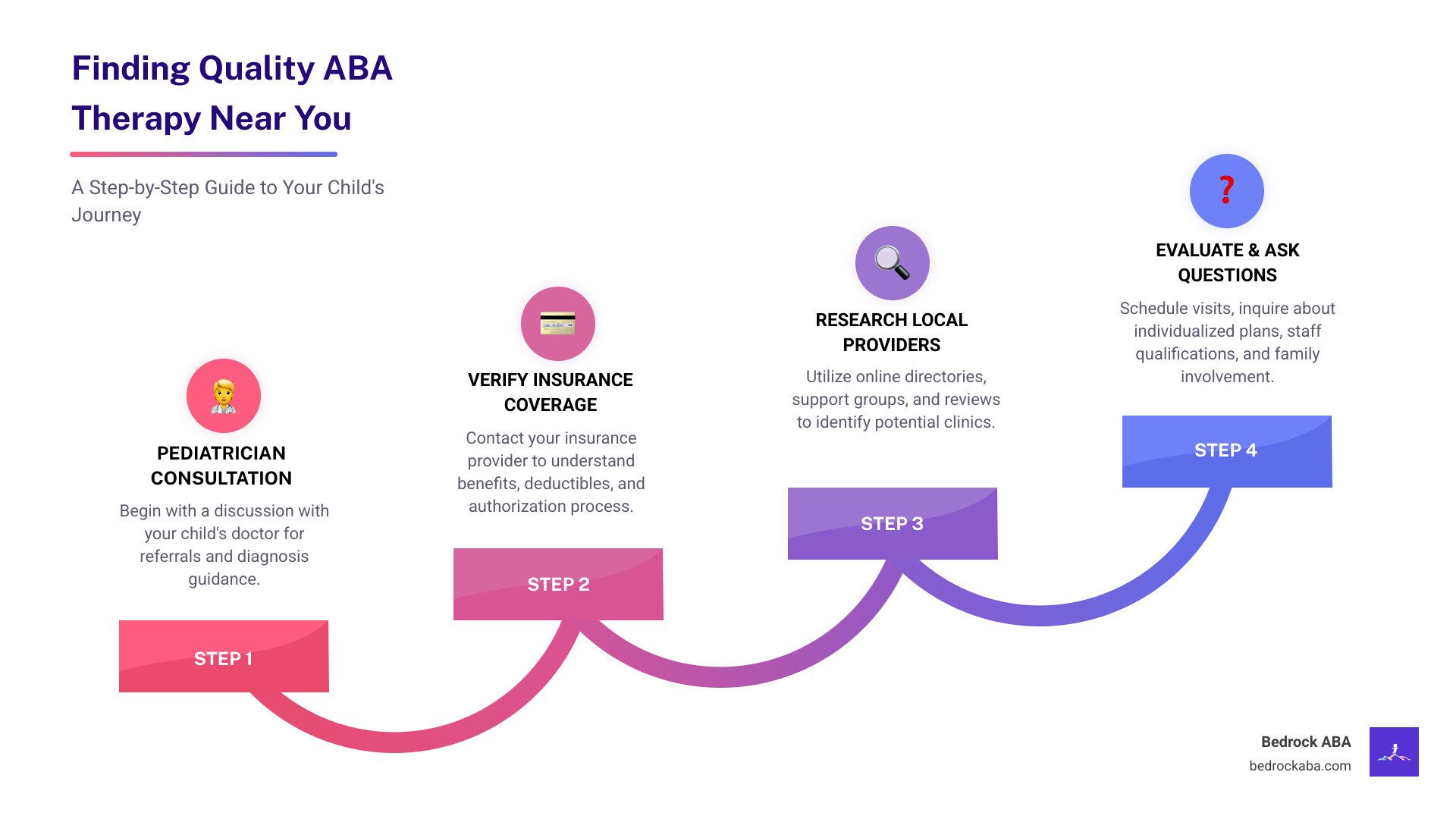
Your search for ABA therapy near me can begin with these resources:
- Your Child’s Pediatrician: They can provide trusted local referrals.
- Your Insurance Company: Check their provider directory and call to confirm your specific coverage for ABA therapy.
- Online Directories: Use resources like the Autism Speaks provider guide and the Behavior Analyst Certification Board website.
- Local Support Groups: Connect with other parents for honest recommendations and insights.
If you’re in Utah, you can learn more about our local services at ABA Therapy Salt Lake City.
What to Look for in an ABA Therapy Provider
Once you have a list of providers, interview them to find the right partner for your child’s development. Look for these key qualities:
- Personalized Treatment Plans: A quality provider will craft a program based on your child’s specific strengths, challenges, and interests.
- Family Involvement: The provider should emphasize parent training, empowering you to support progress at home.
- Welcoming Environment: If considering a center, visit in person. Check if the environment is warm, welcoming, clean, and safe.
- Open Communication: Assess their communication style. Open, transparent communication is key.
- Ask Key Questions: Inquire about staff credentials (BCBAs, RBTs), the training and supervision process, how goals are set and reassessed, and what a typical session looks like.
Essential Qualifications for ABA Therapists
Understanding therapist qualifications is crucial. The program should be led by a Board Certified Behavior Analyst (BCBA), who holds an advanced degree and has completed extensive supervised fieldwork and a national exam. Registered Behavior Technicians (RBTs) typically work directly with your child, implementing the plan under the BCBA’s close supervision.
Quality providers prioritize ongoing training and supervision to stay current with the latest research and best practices. Also, ask about state-specific licensure requirements, as some states have rules beyond the national certifications. You can verify credentials at the Behavior Analyst Certification Board website.
Navigating Your Child’s ABA Therapy Journey

Starting your ABA therapy near me journey is a big step. This part of the process involves understanding treatment plans, tracking progress, and navigating insurance. Your child’s therapy journey will be unique, shaped by their needs, your family’s goals, and the chosen therapy setting. For families in our area, we’ve created resources to help you understand ABA Therapy Utah and what to expect.
The Different Therapy Settings: In-Home, Center, and School
Choosing where your child receives ABA therapy near me depends on your child’s needs and your family’s lifestyle.
- In-Home Therapy: This allows your child to learn skills in their natural environment. It’s convenient and helps with generalizing skills to daily routines, like mealtimes and playing with siblings. We’re proud to offer personalized In-Home ABA Therapy in Utah.
- Center-Based Therapy: This provides a structured, distraction-free environment designed for learning. It offers more opportunities for peer interaction and immediate access to supervising BCBAs.
- School-Based Support: This involves therapists working with your child and their teachers in the classroom, helping to generalize skills to the academic environment.
A combination approach, using multiple settings, is often effective and can be custom to your child’s changing needs.
The Parent’s Role in Successful Therapy
As a parent, you are the most important member of your child’s therapy team. Your involvement is key to success. Here’s how you can make a difference:
- Collaborate: Share your unique insights about your child with the therapy team.
- Be Consistent: Practice the skills learned in therapy at home to reinforce learning.
- Attend Parent Training: Participate in sessions to learn strategies and feel more confident.
- Communicate Openly: Maintain open communication with your provider, sharing both successes and challenges.
- Set Goals Together: Work with the team to set meaningful goals that matter to your family.
Is ABA Therapy Covered by Insurance?
Yes, ABA therapy near me is often covered by insurance as a medically necessary treatment for autism.
- Private Insurance: Many states mandate coverage for ABA, but plans vary. It’s important to check your specific benefits.
- Medicaid: Often provides robust coverage for medically necessary ABA for children under 21.
The verification and authorization process can be complex. Our team at Bedrock ABA can help you steer your benefits, handle prior authorizations, and understand costs like deductibles and co-pays. We always recommend you also contact your insurance provider directly to confirm your coverage details. For specific information, check our guide on ABA Therapy Utah Insurance Coverage.
Frequently Asked Questions about Local ABA Therapy
When you’re searching for ABA therapy near me, it’s natural to have questions. Here are answers to some common concerns.
How does ABA therapy address specific behaviors or skill deficits?
We start with a Functional Behavior Assessment (FBA) to understand the “why” behind a behavior. We then teach appropriate replacement behaviors to help a child get their needs met in a better way. To build new skills, we use task analysis to break them into small, manageable steps, teaching one at a time. All goals are individualized to your child and family’s priorities, such as teaching coping strategies for anxiety. For more details, explore ABA Therapy for Anxiety.
What is the best age to start ABA therapy?
Research shows that the sooner, the better. Early intervention, starting as young as 18-24 months, takes advantage of the brain’s high plasticity. Children who receive intensive early ABA often show significant gains and may need less support later in life.
However, it’s never too late to start. ABA is beneficial for older children and teens as well, with therapy adapted to address age-appropriate skills like navigating complex social relationships or job preparation. Learn more about how we adapt therapy for older children through starting therapy later.
How many hours of therapy are typically recommended?
The recommended hours of therapy depend entirely on your child’s individual needs. While research often points to intensive programs of 25 to 40 hours per week for significant outcomes, this is not a one-size-fits-all recommendation.
A BCBA will make the recommendation based on a comprehensive assessment of your child’s needs, the severity of challenging behaviors, and your family’s goals. The key is consistent, high-quality therapy custom to your child. The intensity can be adjusted over time as your child makes progress.
Conclusion: Taking the Next Step for Your Child
This guide has shown how ABA therapy can change your child’s world. By improving communication and daily living skills, searching for ABA therapy near me can open doors to independence, connection, and joy. ABA is about empowerment—giving your child the tools to express themselves, connect with others, and steer their world with confidence.
Finding the right provider is key. It’s about finding a team that understands your child’s unique spark and partners with your family to create meaningful change. At Bedrock ABA, we help families find hope for progress and celebrate every victory, big or small.
Our flexible, family-centered care is custom to your child’s needs and your family’s lifestyle. We are committed to meeting you where you are. Your child’s potential is limitless. With proven, research-backed ABA support, they can thrive.
If you’re ready to take that next step and explore how ABA therapy near me can benefit your family, we’re here to walk alongside you. Let’s work together to build a foundation for your child’s brightest future. View our ABA therapy services in Utah and find how we can support your family’s unique journey toward growth and independence.