


Why Social Skills Matter for Autistic Children
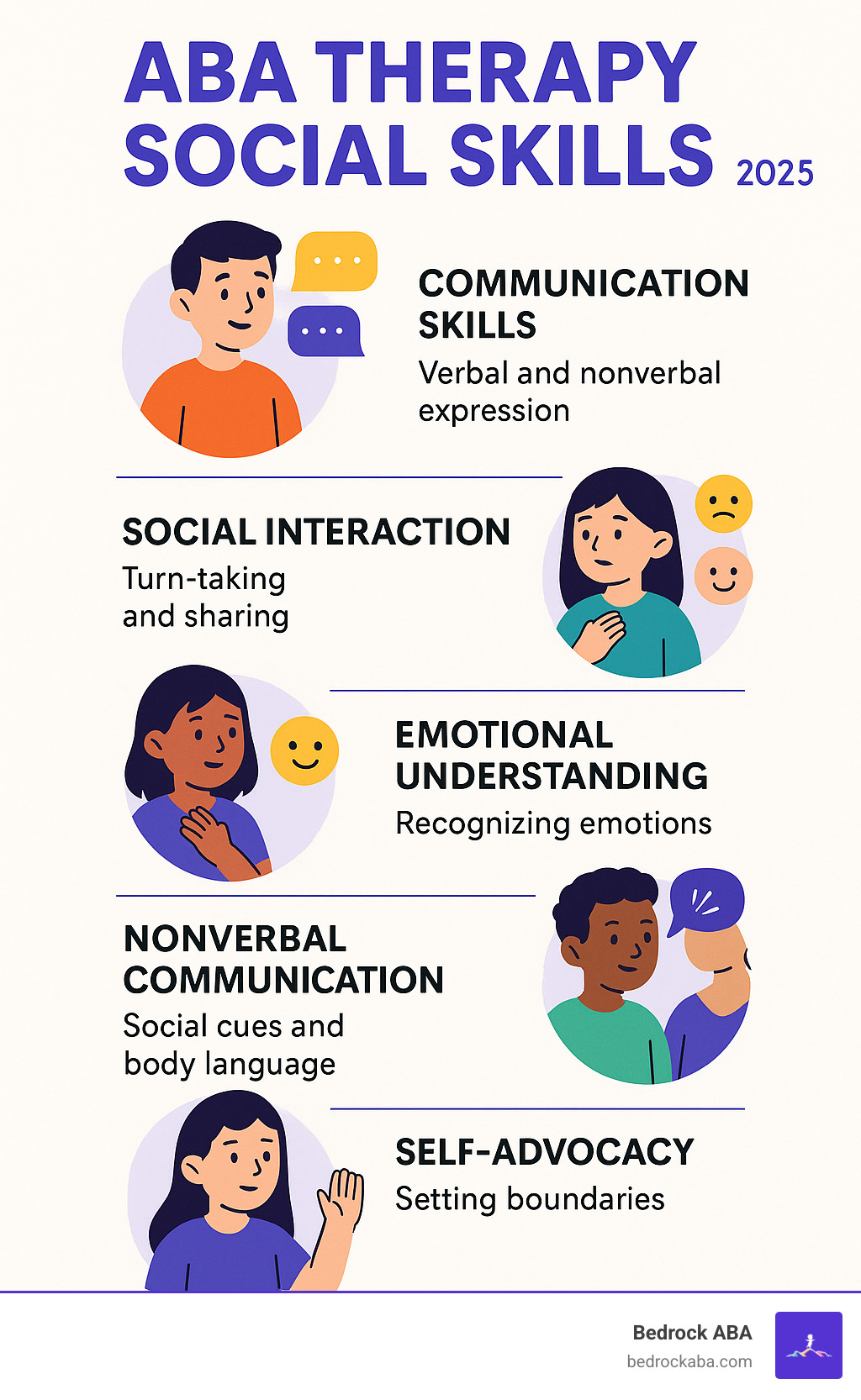
ABA therapy social skills training helps children with autism develop essential abilities to connect with others and steer social situations confidently. ABA therapy can teach your child:
- Communication skills: Starting conversations and expressing needs.
- Social interaction: Taking turns, sharing, and cooperative play.
- Emotional understanding: Recognizing feelings in themselves and others.
- Nonverbal communication: Understanding body language and social cues.
- Self-advocacy: Setting appropriate boundaries.
These skills are the foundation for meaningful relationships, school success, and future independence. For children on the autism spectrum, these skills often require targeted teaching as they may not develop naturally. Many autistic children struggle with social cues, like knowing when a conversation should end or how to join a group, which can lead to isolation.
Research confirms that structured interventions make a significant difference. Studies show that Applied Behavioral Analysis programs significantly improve social and communicative skills in children, leading to meaningful changes in their daily lives.
As Mayer Kulefsky, director of operations at Bedrock ABA, I’ve seen how ABA therapy social skills training transforms a child’s ability to connect with others. Our individualized, evidence-based approaches create lasting positive changes for families.
Handy aba therapy social skills terms:
Understanding Applied Behavior Analysis (ABA) and Its Role in Social Development
Applied Behavior Analysis (ABA) is a scientific approach to understanding and changing behavior, rooted in the work of B.F. Skinner. It provides a framework for helping children learn effective ways to connect with the world.
At its core, ABA uses the Antecedent-Behavior-Consequence (ABC) model to understand behavior patterns. A key tool is positive reinforcement, which makes social interactions rewarding and fun by celebrating successes like sharing a toy or asking a friend to play. This encourages children to repeat positive social behaviors.
ABA is a recognized evidence-based practice, endorsed by the US Surgeon General and backed by decades of research. Its effectiveness in ABA therapy social skills training comes from an individualized, data-driven approach. We assess each child’s unique needs to create a personalized plan, constantly adjusting it based on progress to ensure the best outcomes. You can learn more in our guides on Key Principles Behind ABA Therapy: Reinforcement, Behavior, and Learning and what ABA therapy is.
How ABA is Applied to Teach Social Skills
Teaching social skills through ABA involves a systematic teaching approach. We break down complex skills, like having a conversation, into smaller, manageable steps. This allows children to master each part gradually, building confidence along the way.
Learning extends beyond the therapy room. We create learning opportunities in real-world situations to promote the generalization of skills, ensuring what’s learned in therapy is useful in daily life. Our services are flexible, offering one-on-one therapy for intensive focus and group settings for peer practice, often using a combination of both.
As an evidence-based best practice treatment, ABA is adaptable to each child’s needs. Explore how we tailor our approach in our guide on ABA for autistic kids.
What an ABA Program Involves
A successful ABA therapy social skills program involves a dedicated team and a personalized plan.

Our programs are led by a Board Certified Behavior Analyst (BCBA), who designs and oversees the treatment plan, and implemented by Registered Behavior Technicians (RBTs), who work directly with your child.
Everything begins with an initial assessment to understand your child’s social strengths and support needs. From this, we develop specific, individualized goals custom to your child’s age and interests.
Parent training and collaboration are essential. We teach you the strategies we use so you can reinforce learning at home, making you a key part of the therapy team. Ongoing assessment allows us to track progress with data, ensuring the program remains effective and responsive.
Research shows that intensive and long-term therapy improves outcomes, and we are committed to this comprehensive level of support. Our family-centered approach offers flexible in-person and remote options to fit your life. Learn more about family integration.
Core Strategies and Skills Targeted in ABA Therapy for Social Skills
At Bedrock ABA, we create custom ABA therapy social skills interventions custom to each child’s needs, learning style, and personality. Our approach uses positive behavior support to make learning enjoyable and motivating.
Research confirms our methods are effective. Studies show that ABA programs significantly improve children’s social and communicative skills, leading to meaningful, real-world connections. A study found significant improvements in social skills, demonstrating the genuine impact of these interventions.

We use a variety of evidence-based techniques, adapting our approach based on what works for each child. You can explore different ABA techniques we use to achieve these results.
Key Techniques Used in ABA Therapy for Social Skills
We use several proven techniques to teach social skills:
- Discrete Trial Training (DTT): This breaks complex social skills into small, manageable steps that children can master one at a time.
- Natural Environment Training (NET): We take learning into everyday moments, encouraging children to use skills naturally during play or daily routines.
- Modeling and role-playing: Therapists demonstrate social interactions, and children practice in a safe, low-pressure environment.
- Video modeling: Children watch videos of successful social interactions, which can be highly motivating and build confidence.
- Social Stories: These personalized narratives explain social situations and expectations, helping to reduce anxiety.
- Positive reinforcement: At the heart of our approach, we celebrate every successful use of a social skill, motivating children to keep practicing.
Specific Social Skills Addressed
Our ABA therapy social skills programs address essential abilities for building relationships:
- Reciprocal conversation: Teaching the back-and-forth flow of talking with others.
- Turn-taking and sharing: Crucial skills for cooperative play and friendship.
- Identifying and expressing emotions: Recognizing feelings in oneself and others and expressing them in healthy ways.
- Nonverbal communication: Understanding body language, facial expressions, and personal space.
- Active listening: Engaging with what others are saying to make them feel valued.
- Joint attention: Sharing focus on an object or event with another person, a key building block for social skills.
- Initiating and maintaining play: Learning to approach peers, suggest activities, and play cooperatively.
- Conflict resolution: Handling disagreements respectfully and finding solutions.
- Self-advocacy: Speaking up for their needs, expressing preferences, and setting healthy boundaries.
A Balanced View: The Neurodiversity Perspective on Social Skills Training
At Bedrock ABA, we take a balanced approach to ABA therapy social skills development, respecting the neurodiversity movement. This perspective views autism as a natural variation of the human brain, not something to be “cured.” It shapes our training to empower children to connect authentically.
The Double Empathy Problem highlights that communication breakdowns are often a mutual failure in understanding between autistic and non-autistic people due to different communication styles. Research shows autistic people share information effectively with other autistic people. This shifts our focus from forcing children to “fit in” to fostering authentic connection and mutual understanding.
Concerns About Autistic Masking
We are mindful of Autistic Masking, where individuals hide their natural traits to fit in. This can involve suppressing stimming or forcing eye contact. While it may look like social success, masking leads to exhaustion, anxiety, depression, and a loss of identity. Therapy focused on passing for non-autistic can be harmful. We measure success by a child’s comfort, self-expression, and ability to form genuine relationships, not by their ability to mimic neurotypical behaviors.
Evolving ABA: A Neuro-Affirming Approach
Modern ABA is evolving, and we are proud to use a neuro-affirming approach. We combine proven ABA principles with insights from the neurodiversity movement, helping children develop skills that improve their quality of life while honoring who they are.
Our child-led therapy follows the child’s interests and comfort levels. We use assent-based learning, respecting a child’s agreement to participate in activities. A cornerstone of our approach is teaching self-advocacy and respecting boundaries, empowering children to communicate their needs and say “no” when uncomfortable.
Our goal is to provide tools for authentic self-expression and meaningful connection, not to change who a child is. We focus on fostering a sense of belonging, where children feel accepted and valued. This commitment to advocating for acceptance while providing structured support creates the best outcomes for the families we serve. Learn more about our ASD treatment approaches.
Creating a Supportive Environment for Lasting Social Growth
ABA therapy social skills development extends beyond therapy sessions. Lasting growth requires a supportive environment where families, schools, and communities work together.
Consistency across environments—at home, school, and in the community—is key to making learned skills a natural part of a child’s life. This journey is about progress over perfection. We encourage families to celebrate small victories and maintain patience and encouragement through challenges. At its heart, our goal is fostering a sense of belonging and advocating for acceptance, which helps children feel valued and motivated to connect with others.

Practical Tips for Parents and Caregivers
As a parent or caregiver, you are your child’s most important teacher. Here are some practical ways to support the ABA therapy social skills your child is learning:
- Create social opportunities: Arrange structured playdates or enroll your child in group activities based on their interests, like an art class or sports team.
- Model appropriate behaviors: Your child learns by watching you demonstrate active listening, empathy, and calm conflict resolution in daily life.
- Use visual supports: Social stories, emotion cards, and visual schedules can make social situations more predictable and less overwhelming.
- Reinforce effort and progress: Celebrate the attempt, not just the perfect outcome. Positive reinforcement motivates your child to keep trying.
- Encourage empathy: Discuss feelings related to characters in books or real-life situations to build emotional intelligence.
- Collaborate with the team: Work closely with therapists and teachers to ensure a consistent approach. Learn more about our work with schools in our guide to school-based ABA.
- Be patient and consistent: Social skill development takes time. Your steady support makes all the difference.
The Role of Schools and Community
Schools and communities are crucial partners in a child’s social development. Key elements include:
- Inclusive classrooms: These provide natural opportunities for children to learn from peers with diverse communication styles.
- Peer modeling programs: Children often learn social skills most effectively by watching their peers.
- Community-based instruction: Practicing skills in real-world settings like libraries or restaurants builds confidence and independence.
- Educating peers on neurodiversity: Teaching all children that brains work differently fosters an environment of acceptance and reduces stigma.
- Anti-bullying initiatives: These ensure a safe environment where children can focus on building positive relationships.
When schools and communities work together, they create spaces where autistic children can thrive socially. Learn more about how ABA behavioral programs in schools can help.
Conclusion: Building a Foundation for Meaningful Connections
We’ve explored why social skills matter so deeply for autistic children—they are the cornerstone of relationships, self-confidence, and future independence. Authentic connection opens doors to friendship, academic success, and a fulfilling life.
ABA therapy social skills training provides a structured, evidence-based path to developing these abilities. Through an individualized approach that breaks down complex interactions and celebrates each milestone, we help children build confidence.
We also accept the neurodiversity perspective, reminding us that our goal is not to change a child, but to empower them with tools for authentic self-expression. Modern, neuro-affirming ABA focuses on self-advocacy and genuine connection over conformity.
The ultimate goal is building a foundation for authentic, meaningful connections. We equip children with the skills to communicate their needs and steer social situations confidently, giving them the freedom to be themselves.
At Bedrock ABA, we are committed to this vision. Our personalized Applied Behavior Analysis therapy supports growth in social skills, academic abilities, and daily living skills. With flexible, family-centered care, we tailor our approach to each child’s needs.
Every child deserves to feel understood and empowered. If you’re ready to see how our ABA therapy social skills programs can help your child, we’re here for you. Let’s build a strong foundation for your child’s social growth and authentic self.