


Understanding ABA Therapy: A Parent’s Guide
ABA therapy for autistic children is a scientifically-proven approach that uses positive reinforcement to teach new skills and reduce challenging behaviors in children with autism spectrum disorder.
Quick ABA Therapy Overview:
| What is it? | A personalized therapy that breaks skills into small steps and rewards progress |
| When to start? | As early as possible, ideally before age 5 |
| Hours needed | Typically 10-20 hours per week (intensive programs may recommend 25-40) |
| Who provides it? | Board Certified Behavior Analysts (BCBAs) and Registered Behavior Technicians (RBTs) |
| Cost | $50-150 per hour, often covered by insurance in 45+ states |
| Key benefits | Improved communication, social skills, daily living abilities, and reduced challenging behaviors |
If you’re the parent of a child recently diagnosed with autism, you’re likely feeling overwhelmed with information, options, and emotions. You’re not alone. With autism affecting approximately 1 in 36 children in the United States, thousands of families are navigating this journey alongside you.
Applied Behavior Analysis (ABA) therapy stands out as the most extensively researched and evidence-based intervention for children with autism. But what exactly is it, and how might it help your child?
At its core, ABA therapy is about understanding behavior—what causes it, what maintains it, and how to change it through positive reinforcement rather than punishment. Modern ABA is play-based, child-centered, and focused on building skills that matter in everyday life.
What makes ABA effective?
- It’s highly individualized to your child’s unique needs
- It breaks complex skills into manageable steps
- It uses your child’s interests and motivations
- It measures progress with concrete data
- It involves parents and caregivers in the process
As Dr. Stephen Shore, autism researcher and self-advocate, said: “If you’ve met one individual with autism, you’ve met one individual with autism.” This perfectly captures why ABA therapy is designed to be flexible and personalized—because every child deserves an approach custom to their specific strengths and challenges.
Understanding Applied Behavior Analysis (ABA) Therapy
Applied Behavior Analysis (ABA) is the science of using what we know about learning to build practical skills and reduce behaviours that hold children back. It is recognised as a “best-practice” treatment by the U.S. Surgeon General and the American Psychological Association because decades of research show it works.
How does it work? Therapists look at the simple ABCs of every behaviour:
• Antecedent – what comes just before a behaviour
• Behavior – the action itself
• Consequence – what happens right after
By adjusting antecedents and consequences and reinforcing desired actions, children learn faster and with less frustration. Data are collected during every session so that strategies can be tweaked quickly when something isn’t effective.
A landmark study by Dr. O. Ivar Lovaas found that nearly half of the children who received intensive ABA (about 30–40 hours per week) before age four reached typical intellectual and educational functioning, compared with only 2 % in the control group. Modern ABA keeps the proven structure of that work while adding more play, choice and child-led activities.
Early Intensive Behavioral Intervention (EIBI) taps into early brain plasticity. Beginning therapy before age five often leads to larger gains in communication, social engagement and daily living skills, and can reduce the need for special-education services later on.
At Bedrock ABA we deliver these principles through fun, personalised sessions—whether in-home, in-clinic or through secure telehealth—so children in Salt Lake City and throughout Utah can learn in the environments where they live and play.
Core Principles and Popular Techniques in ABA
Think of ABA as a toolbox: we pick the tool that fits your child’s goal, motivation and learning style. These are the ones you’ll hear about most:
• Positive reinforcement – celebrating every success so your child wants to repeat it.
• Prompting & fading – giving just enough help (like training wheels) and slowly removing it.
• Shaping – rewarding small steps toward a bigger skill.
• Chaining – teaching a complex routine one link at a time.
• Generalization – practising skills in different places and with different people so they stick.
Popular teaching formats:
• Discrete Trial Training (DTT) – short, clear learning trials with immediate feedback. A 2020 review found DTT highly effective for language, imitation and academic skills (https://www.appliedbehavioranalysisprograms.com/faq/what-is-discrete-trial-teaching/).
• Natural Environment Teaching (NET) – turning everyday moments into learning opportunities so children practise skills where they really need them.
• Pivotal Response Treatment (PRT) – following the child’s lead to build motivation, self-management and communication.
• Functional Communication Training (FCT) – teaching a more appropriate way to get the same need met, which naturally reduces challenging behaviour.
• Technology-assisted ABA – secure telehealth visits, tablet-based activities and digital data tracking make high-quality therapy available anywhere in Utah.
We mix and match these strategies so sessions feel like play while still being thoroughly planned and measured.
Skills and Behaviors Targeted in ABA Therapy
At Bedrock ABA, we design therapy programs that address the whole child, focusing on skills that make the biggest difference in daily life. Every child’s program is unique, just like they are.
Communication & Language
For many children with autism, finding their voice—whether through words or alternative means—is transformative.
Verbal communication skills we help develop include asking for favorite toys, describing what they see, following step-by-step instructions, and eventually, having back-and-forth conversations. For children who aren’t speaking yet, we don’t wait to start building communication.
“When Ellie started using picture cards to tell us what she wanted instead of crying, it was like someone turned on the lights,” shares one Bedrock ABA parent. “Now she’s speaking in short sentences!”
We often incorporate specialized approaches like the Picture Exchange Communication System (PECS) for children who communicate better visually. Some children benefit from learning sign language or using speech-generating devices while their verbal skills develop.
What matters most isn’t how children communicate—it’s that they can effectively express their needs, share their thoughts, and connect with others.
Social & Play Development
Social interactions that come naturally to most children often need to be explicitly taught to children with autism. Through playful, structured activities, we help children master fundamental social skills.
Learning to play is serious business! We work on skills like:
- Sharing attention with another person (watching the same bird in the sky)
- Taking turns with favorite toys
- Understanding others’ perspectives (“Oh, Sarah is crying because she fell down”)
- Reading facial expressions and body language
- Building friendships and joining group activities
At Bedrock ABA, we often use the evidence-based LEAP model which incorporates peer interactions to develop social skills in natural settings. This might look like guided playdates where therapists can prompt and reinforce positive social behaviors in the moment.
“My son never played with other kids at the park before,” explains another parent. “His therapist helped him learn how to ask to join games. Last week, he played tag with neighborhood kids for an hour!”
Reducing Challenging Behaviors
Many children with autism express their frustration, anxiety, or sensory overload through behaviors that can be difficult for families and interfere with learning. Rather than simply trying to eliminate these behaviors, we work to understand them.
When a child has meltdowns in the grocery store, hits when frustrated, or engages in repetitive movements, we start with a Functional Behavior Assessment (FBA) to find the “why” behind the behavior. Is it communication? Sensory seeking? Escape from something uncomfortable?
Once we understand the function, we develop a Behavior Intervention Plan that focuses on teaching replacement skills. If a child throws items when overwhelmed, we might teach them to request a break using words or a break card instead.
Modern ABA therapy recognizes that some behaviors (like stimming) may be self-regulating and not harmful. We focus on helping children learn when and where certain behaviors are appropriate, rather than eliminating behaviors that are part of who they are.
“We were at our wit’s end with the tantrums,” one father told us. “Our therapist helped us see they happened when our daughter couldn’t express what she wanted. Now that she can communicate better, the meltdowns have decreased by about 80%.”
Individualized Treatment Planning and What a Typical Session Looks Like

Every child with autism has their own unique constellation of strengths, challenges, and personality traits. That’s why at Bedrock ABA, we’re passionate about creating truly personalized treatment plans rather than using a one-size-fits-all approach. Your child deserves care as unique as they are.
Building the Plan
Creating an effective aba therapy for autistic kid plan starts with getting to know your child inside and out. Our BCBAs spend time not just assessing skills, but understanding what makes your child light up with excitement.
“The assessment phase is like putting together pieces of a puzzle,” explains one of our senior BCBAs. “We’re looking at the whole picture of who this child is, not just what they can and can’t do.”
We typically use tools like the VB-MAPP or ABLLS-R to create a developmental snapshot of your child’s current abilities. These aren’t just tests—they’re roadmaps that help us see where your child is thriving and where they might need extra support.
Before setting goals, we establish a baseline—essentially taking a “before” picture so we can clearly see progress. Then we craft SMART goals (Specific, Measurable, Achievable, Relevant, and Time-bound) that give everyone clarity on what we’re working toward.
When prioritizing which skills to tackle first, we consider several factors. Safety concerns always come first—like teaching a child who tends to wander how to respond to their name. We also focus on prerequisite skills that open up other learning opportunities, while honoring family priorities and emphasizing skills with functional importance in everyday life.
For each goal, we define what mastery looks like—usually performing a skill independently across different settings and with different people at 80% accuracy or higher. This clarity helps everyone recognize when it’s time to celebrate a victory and move forward.
Inside an ABA Session for an Autistic Kid
Walking into an aba therapy for autistic kid session might look like walking into a playdate at first glance. That’s by design! Effective therapy feels engaging and fun, even while it’s carefully structured to promote learning.
A typical two-hour session at Bedrock ABA flows something like this:
The first 10-15 minutes focus on building rapport through child-led play. This “pairing” time is crucial—it helps your child associate the therapist with fun and positive experiences. The therapist might simply follow your child’s lead with toys or activities they enjoy, looking for natural opportunities to connect.
“My son used to hide when his therapist arrived,” shares one Bedrock ABA parent. “Now he runs to the door shouting her name! Those first few minutes of just playing together made all the difference.”
The next 30-45 minutes typically involve more structured learning, often using discrete trial training to work on specific skills. If your child is learning colors, for example, the therapist might present different colored blocks, asking your child to hand them the red one, then immediately reinforcing correct responses with praise and perhaps a turn with a favorite toy.
This structured time transitions into about 30-45 minutes of natural environment teaching, where skills are practiced in everyday contexts. Rather than sitting at a table identifying pictures of emotions, your child might practice recognizing feelings while playing with dolls or reading a story.
A 15-minute snack or break time isn’t just downtime—it’s a natural opportunity to practice requesting, waiting, and social skills. The session typically wraps up with 15-20 minutes of parent training, where you’ll learn about your child’s progress and get practical tips for reinforcing skills at home.
Throughout the session, therapists maintain a delicate balance between structured learning and following your child’s interests and energy levels. The best sessions feel like guided play with purpose.
Measuring Progress & Adjusting
One of the hallmarks of aba therapy for autistic kid is its data-driven approach. While your child is having fun, their therapist is carefully tracking progress on each goal.
“Data tells us the truth about what’s working and what isn’t,” explains our clinical director. “It takes the guesswork out of treatment and lets us make decisions based on facts rather than impressions.”
During each session, therapists document everything from correct responses to the level of prompting needed. This detailed record-keeping helps us spot patterns—maybe your child performs better in the morning, or perhaps they learn faster with visual rather than verbal cues.
Your child’s supervising BCBA reviews this data weekly, making small adjustments to teaching strategies as needed. More comprehensive reviews happen monthly or quarterly, with team meetings to discuss overall progress and refine the treatment plan.
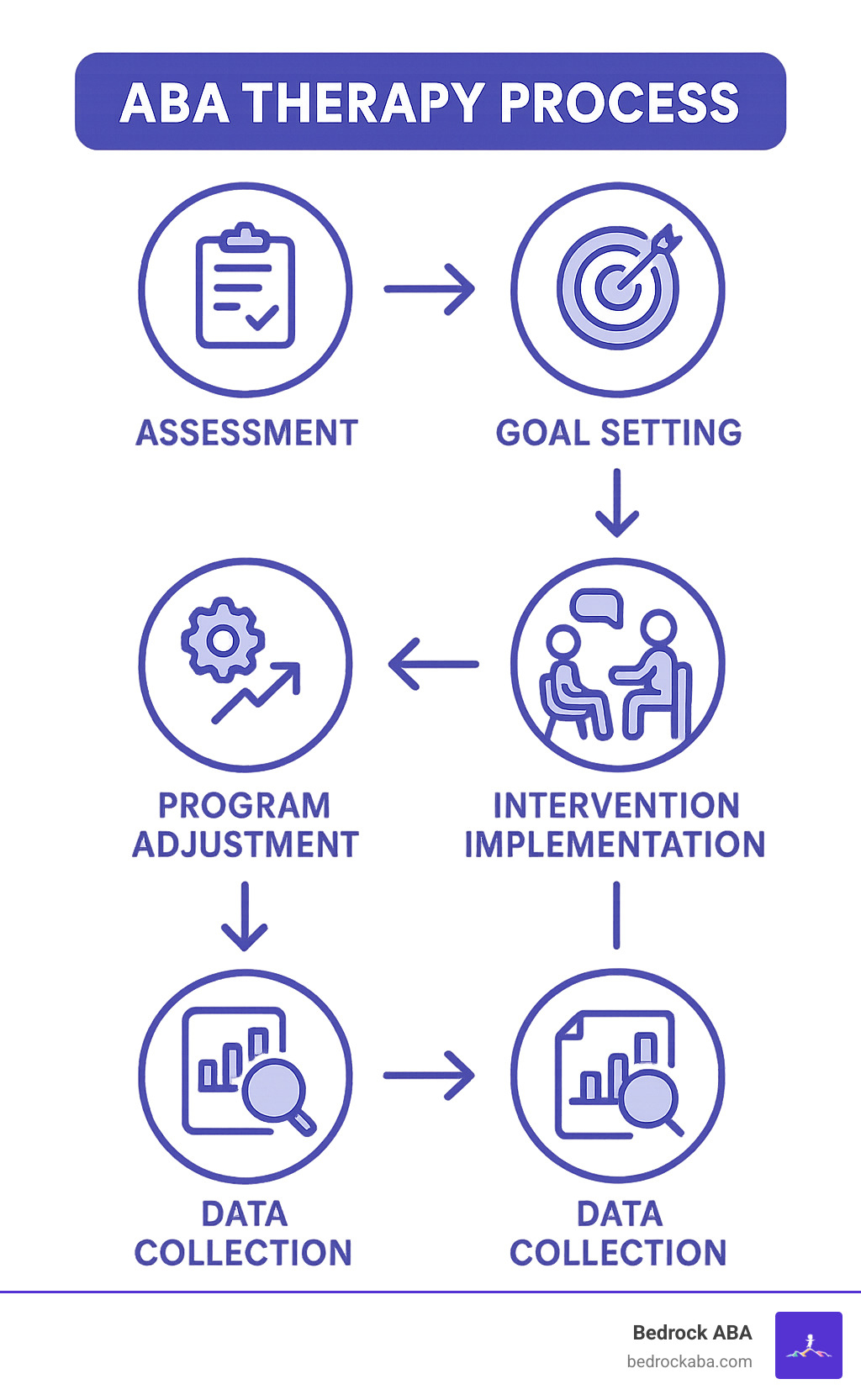
This constant cycle of assessment, intervention, data collection, and adjustment ensures that your child’s therapy evolves as they do. When a skill is mastered, we celebrate and move on to the next challenge. If progress stalls, we don’t just try harder—we try differently, adjusting our approach until we find what works for your unique child.
At Bedrock ABA, we view treatment planning as a partnership with families. Your insights about your child’s interests, challenges, and progress at home are invaluable pieces of the puzzle. Together, we create not just a treatment plan, but a roadmap to help your child thrive.
Evidence, Benefits, Criticisms and How ABA Has Grown
Large meta-analyses show that quality ABA programs lead to medium-to-large improvements in language (effect size ≈ 1.48), IQ (≈ 1.19), daily living skills (≈ 0.62) and social functioning (≈ 0.95) compared with other educational approaches. Behind every statistic is a child who can now ask for help, join a game or dress themselves.
Families report ripple effects:
• Better communication means fewer meltdowns and less stress at home.
• Increased independence frees up time for genuine family activities.
• School readiness opens doors to typical classrooms and community life.
Criticisms & what’s changed
Some autistic self-advocates felt that early ABA tried to make children appear “less autistic” rather than helping them thrive as themselves. Those voices prompted major changes:
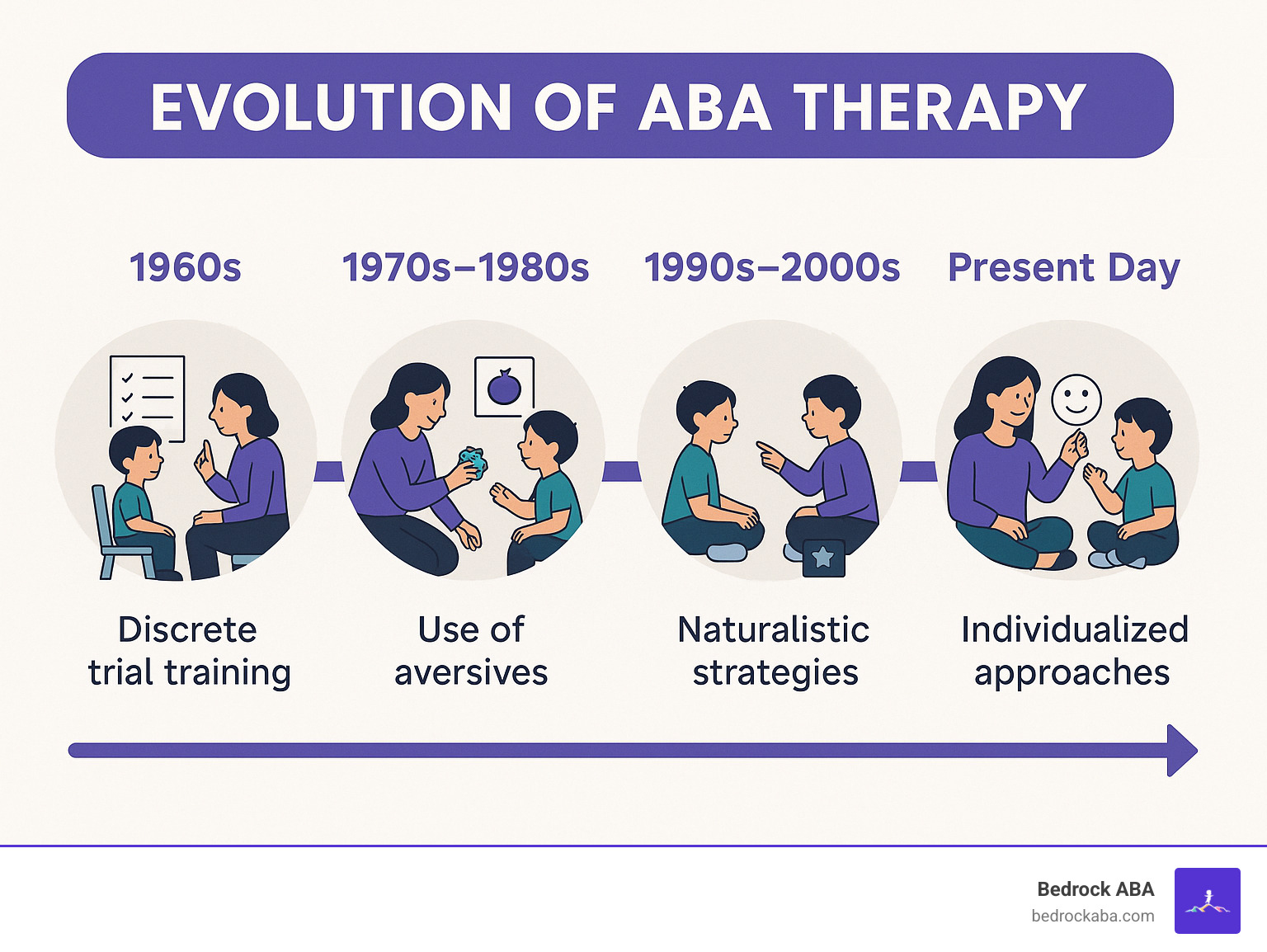
• Aversive techniques have been replaced with positive reinforcement.
• Therapy now follows the child’s interests and provides choices.
• The focus is on meaningful goals—communication, safety, self-advocacy—not suppressing harmless stims.
• Providers accept trauma-informed, assent-based care and collaborate closely with families.
In short, ABA has evolved from compliance-driven drills to respectful, child-centred teaching—exactly the model used at Bedrock ABA.
Practical Guide for Parents: Hours, Credentials, Costs and Your Role

How many hours?
• Comprehensive programs – 25-40 hrs/week for toddlers and preschoolers.
• Focused programs – 10-20 hrs/week for specific goals.
• Maintenance – 5-10 hrs/week once core skills are solid.
Credentials decoded
• BCBA – Master’s-level clinician who designs and oversees the program.
• BCaBA – Bachelor’s-level assistant under BCBA supervision.
• RBT – Therapist who works directly with your child; should receive BCBA supervision for 5–10 % of their hours.
Paying for therapy
Most private insurers in Utah, as well as Medicaid, cover ABA. Hourly rates range from $50–$150, but co-pays are usually far lower after insurance. Ask providers:
- Are you in-network with my plan?
- What will my out-of-pocket costs be after deductibles?
- Do you obtain pre-authorisations?
Your involvement is crucial
Children progress faster when parents practise skills during daily routines. Even 15 minutes of focused practice at breakfast or bath time can double the opportunities your child has to learn. Bedrock ABA provides easy-to-follow parent coaching so you feel confident carrying therapy into real life.
How ABA Fits with Other Therapies & Where the Field Is Headed
ABA rarely stands alone. Many children benefit from a team approach:
| Service | Main Focus | Typical Hours |
|---|---|---|
| ABA | Behaviour, communication, social skills | 10–40/wk |
| Speech Therapy | Pronunciation, vocabulary | 1–3/wk |
| Occupational Therapy | Sensory processing, fine-motor | 1–3/wk |
| Physical Therapy | Gross-motor, balance | 1–2/wk |
Co-ordination is key; therapists should share goals and strategies so your child hears the same cues everywhere.
Future directions
• Telehealth is expanding access for rural families.
• Wearables and apps may flag rising anxiety so children can learn self-regulation skills sooner.
• Virtual-reality practice arenas let children rehearse challenging situations in a safe, graduated way.
• Artificial-intelligence tools are beginning to suggest the most effective teaching prompts in real time.
Bedrock ABA is already integrating these innovations while keeping human connection at the heart of every session.
Frequently Asked Questions about ABA Therapy
What age should my child start ABA?
The window of early childhood offers incredible learning potential. Research consistently shows that starting ABA therapy before age 5, when brain plasticity is at its peak, provides the strongest foundation for development. That said, it’s never too late to begin—we’ve witnessed remarkable progress in teenagers just beginning their ABA journey, though their goals naturally differ from those of younger children.
The American Academy of Pediatrics takes a proactive stance, recommending intervention at the first sign of developmental concerns, even before receiving a formal autism diagnosis. If you notice your child struggling with communication, social interaction, or showing unusual behavioral patterns, don’t wait for a diagnostic label to seek help. Early action creates more opportunities for positive outcomes.
How long before we see results?
Parents often notice small but meaningful changes within the first 1-3 months of consistent therapy. Your child might begin making more eye contact, using a new word, or having fewer meltdowns in specific situations. These early wins are worth celebrating!
However, the most significant and lasting changes typically unfold over 6-12 months of dedicated intervention. Think of it like learning a musical instrument—small improvements come quickly, but mastery takes time and practice.
Several factors influence how quickly you’ll see progress:
- Program intensity (more hours generally means faster progress)
- Consistency across therapy sessions and home environment
- Your child’s unique learning style and motivation
- The complexity of the skills being taught
- Family involvement and implementation of strategies at home
At Bedrock ABA, we set realistic expectations by establishing clear baseline measures and tracking incremental improvements. We celebrate small victories along the way rather than waiting for dramatic overnight changes.
Is ABA harmful or disrespectful of neurodiversity?
This important question reflects genuine concerns within the autism community. Modern, quality ABA therapy has evolved significantly to accept neurodiversity while helping children develop skills that improve their independence and quality of life.
At Bedrock ABA, our approach centers on respect and empowerment. We:
- Focus on meaningful skills that help children express themselves and steer their world on their terms
- Honor individual preferences and sensory needs rather than forcing compliance
- Build therapy around each child’s interests and incorporate plenty of choices
- Avoid practices that cause distress or try to eliminate harmless stimming behaviors
- Listen to autistic voices when shaping our therapeutic approaches
Much of the controversy surrounding ABA stems from outdated practices from decades ago that ethical providers no longer use. Today’s ABA therapy is about building bridges to greater independence and self-expression, not changing who a person fundamentally is.
Parents often tell us they were initially hesitant about ABA based on things they’d read online, but their experience with compassionate, child-centered therapy proved to be nothing like what they feared. The best way to evaluate if ABA is right for your family is to observe a session and see modern approaches in action.
Conclusion
ABA therapy, when delivered with compassion and individuality, can open doors that once felt closed. At Bedrock ABA we combine science with heart, offering flexible in-person and telehealth options for families across Utah.
The journey can feel overwhelming, but you do not have to walk it alone. From the first unprompted “hello” to the first stress-free grocery trip, we’ll celebrate every win together.
Ready to learn more? Visit our ABA services page and schedule a free consultation. Together, we can build a foundation that lets your child’s personality and potential shine.