


Why ABA Therapy for Toddlers Opens Doors to Lifelong Success
ABA therapy for toddlers is a play-based approach that helps children with autism develop essential communication, social, and daily living skills during their most critical learning years. Starting between 18 months to 3 years, this evidence-based therapy uses positive reinforcement and child-led activities to build foundational skills that last a lifetime.
Quick Overview: What You Need to Know About ABA Therapy for Toddlers
- Best Age to Start: 18 months to 3 years old (autism can be reliably diagnosed at 18 months)
- Session Format: Play-based, one-on-one therapy lasting 2-5 hours per day
- Weekly Hours: Typically 10-25 hours per week for toddlers
- Key Skills Targeted: Communication, social interaction, daily living, reducing challenging behaviors
- Modern Approach: Child-led, naturalistic learning through play; no punishment or aversive techniques
- Team: A Board-Certified Behavior Analyst (BCBA) designs the plan, and Registered Behavior Technicians (RBTs) provide direct therapy
- Parent Role: Active participation and training to reinforce skills at home
If you’ve recently received an autism diagnosis for your toddler, you might feel overwhelmed. The good news is that research consistently shows that early intervention before age 3 has a huge positive impact. Medical research shows that starting specialized ABA intervention between ages 2-3 can significantly improve a toddler’s trajectory by taking advantage of rapid brain development.
Modern ABA therapy looks like play because that’s how toddlers learn best. Today’s ABA for toddlers focuses on building rapport, following your child’s interests, and making learning fun and engaging. As director of operations at Bedrock ABA, I’ve seen how transformative early intervention can be when families in Utah, North Carolina, and beyond receive the right support during these crucial years.
Key aba therapy for toddlers vocabulary:
Understanding ABA Therapy and the Power of Early Intervention
Applied Behavior Analysis (ABA) is the science of learning and behavior. It uses the principles of how we all learn to intentionally help children develop communication, social, and daily living skills. At its heart is positive reinforcement: when a toddler claps after stacking blocks, they’re more likely to try again. We use this natural process to build skills and confidence.

ABA has evolved significantly since the 1960s. Modern ABA therapy for toddlers is play-based and personalized. If your child loves bubbles, we use bubbles to teach requesting and turn-taking. The goal is to make therapy feel so natural that your child looks forward to their sessions. You can explore more in What is ABA Therapy and How Does It Work?.
The magic of starting early lies in brain plasticity. During a toddler’s first few years, their brain forms millions of neural connections daily. This adaptability means skills learned now become deeply embedded, creating a strong foundation for the future. Medical research on early intervention shows that children receiving ABA between ages 2-3 make more significant gains than those who start later. We’re not just teaching skills; we’re shaping how your child learns to learn.
Why is Age 2 an Ideal Time to Start?
Autism can be reliably diagnosed as early as 18 months. This early diagnosis is a gift, opening the door to intervention when it can make the biggest difference. At age 2, a child is naturally exploring their world and developing social connections, making it the perfect time for ABA therapy for toddlers to support their natural development.
Starting early also allows us to address challenging behaviors before they become ingrained. A 2-year-old learning to communicate their needs is more receptive to new ways of expression. This critical learning window lets us build foundational skills in communication, social interaction, and daily living that will serve your child for life, an approach supported by reliable diagnosis information from medical experts.
How Modern ABA Has Evolved for Toddlers
Modern ABA therapy for toddlers has moved far beyond the rigid, table-based drills of the past. Today’s approach is about child-led learning, following your toddler’s interests and natural curiosity. If they want to play with toy animals, we use that play to work on naming, requesting, and pretend play skills.
Building rapport is our first priority. We want your child to genuinely enjoy their time with their therapist, which means lots of smiles, laughter, and celebration of every small victory. We’re not just teaching skills; we’re focusing on joy and creating positive associations with learning.
Most importantly, modern ABA uses no aversive techniques. We never use punishment or any approach that might cause distress. Our entire focus is on positive reinforcement and creating a safe environment to try new things. This naturalistic approach is supported by numerous studies on modern ABA that show how effective compassionate, play-based methods can be.
What an ABA Therapy Program for Toddlers Looks Like
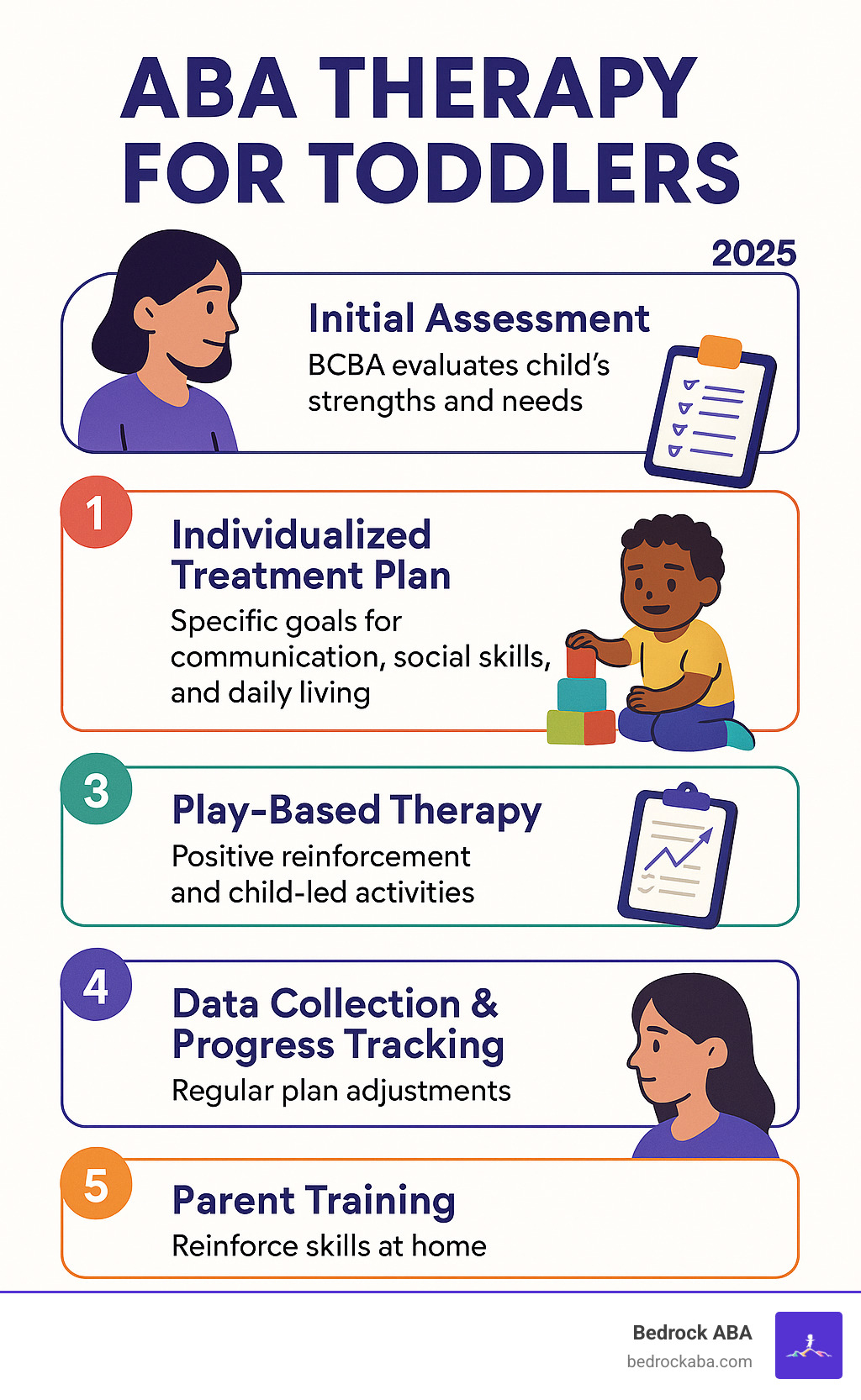
Starting ABA therapy for toddlers begins with a comprehensive initial assessment. Our Board-Certified Behavior Analyst (BCBA) observes your child, talks with your family, and learns about their favorite activities, communication style, and challenges.

This assessment forms the basis of your child’s Individualized Treatment Plan (ITP), a personalized roadmap for your toddler’s unique needs and your family’s goals. The plan might focus on communication if your child is learning to express their needs, or social skills if they’re ready to engage with peers.
ABA therapy for toddlers looks remarkably like high-quality playtime. Our play-based sessions are one-on-one with trained Registered Behavior Technicians (RBTs) who turn everyday activities into learning opportunities. Stacking blocks can become a lesson in turn-taking or color recognition, while playing with cars can teach requesting or sharing.
Behind the scenes, we use a data-driven approach to track progress. Therapists collect information naturally during activities, noting when a skill is mastered or needs more support. Session duration is typically 2-5 hours per day, with a weekly recommendation of 10-25 hours for toddlers. We keep sessions short and frequent to maintain engagement and ensure therapy feels enjoyable, not overwhelming. Learn more in ABA Services for Children.
Key Skills Targeted in ABA Therapy for Toddlers
The skills we target in ABA therapy for toddlers are the building blocks for independence and joy. We focus on fundamental abilities needed to communicate, connect, and care for themselves.
- Communication skills are central. We help toddlers find their voice, whether through words, gestures, or pictures. Functional communication, like asking for a drink, reduces frustration and makes daily life easier.
- Social skills development focuses on early connection abilities. We practice eye contact during games, turn-taking with toys, and parallel play to build comfort playing alongside others. These are huge steps toward future friendships.
- Daily living skills cover practical abilities like toilet training, feeding skills, and self-care routines. We break these complex skills into manageable steps, celebrating each victory.
- Reducing challenging behaviors involves understanding the “why” behind the behavior. We teach children better ways to express their needs and build coping strategies to handle frustration.
How Progress is Measured and Tracked
Quality ABA therapy for toddlers is defined by its commitment to measuring real progress. During every session, therapists collect data on specific, measurable goals, such as “requests preferred items using gestures in 8 out of 10 opportunities.” This precision allows you to see exactly how your child is progressing.
Your BCBA conducts regular reviews, analyzing the data to see what’s working and what needs adjustment. If a strategy isn’t yielding results, we pivot to a different approach. This individualized treatment ensures the plan remains effective.
Collaboration with parents is essential. You’ll receive regular updates, often with easy-to-understand graphs showing development over time. This partnership ensures you’re always informed, involved, and equipped to support your child’s development at home, where new skills generalize to everyday life.
Common Techniques and Methodologies in ABA Therapy for Toddlers
ABA therapy for toddlers uses a toolkit of proven techniques grounded in the idea that learning should feel good. The foundation is positive reinforcement—celebrating your child’s successes to encourage them to keep trying. We also use other supportive strategies like prompting (giving helpful hints), modeling (showing them what to do), and generalization (ensuring skills transfer to real-life settings).

Our goal is to make learning stick in real life, not just in therapy. Every technique is chosen to respect how young children naturally learn and grow. For a deeper dive, explore The Different Types of ABA Therapy Techniques.
Play-Based and Naturalistic Approaches
We meet your child where they are, using their favorite activities as springboards for learning. These naturalistic approaches feel so much like play that your toddler may not realize they’re in therapy.
- Natural Environment Teaching (NET) turns everyday moments into learning opportunities. If your child loves bubbles, we use that to work on requesting or turn-taking. The reward is built-in—they get the bubbles they asked for!
- Pivotal Response Treatment (PRT) focuses on key developmental areas like motivation and initiating interactions. By focusing on these pivotal skills, we can open up broader learning and development.
These approaches work because they tap into a toddler’s natural curiosity. When learning feels like play, children stay engaged and remember skills better.
Structured Learning and Core Strategies
While play is central, we also use structured techniques when they fit a child’s goals. Even these methods are designed to be positive and engaging.
- Discrete Trial Training (DTT) breaks skills into small, manageable pieces. For example, when teaching block stacking, we break it down: hold one block, place it on another, and build a tower. Each step is celebrated, and we provide gentle guidance to ensure success.
- The Early Start Denver Model (ESDM) is designed for very young children (12-48 months) and blends structured DTT with play-based learning. A single game of peek-a-boo can target eye contact, social smiles, and turn-taking all at once.
- Task analysis helps teach complex daily living skills, like getting dressed, by breaking them into bite-sized steps. We use errorless learning to provide just enough help for the child to succeed, gradually fading support as they gain confidence.
- The Antecedent-Behavior-Consequence (ABC) framework helps us understand why behaviors happen so we can adjust the environment and teach better coping strategies.
Every technique is chosen thoughtfully, keeping your toddler’s developmental stage and personality in mind. The goal is to help your child develop skills that will serve them throughout their life.
The Therapy Team and Your Crucial Role as a Parent
In ABA therapy for toddlers, success is a team effort. The partnership between your child, the therapy team, and your family is essential for the best results. The magic happens when skills learned in therapy carry over into everyday life.

Your insights are invaluable. You know your child better than anyone, and that knowledge helps us create a treatment plan that fits their unique personality. We believe in a true partnership, which means we work with your entire family. Learn more about our Family Integration ABA philosophy.
The Professionals Guiding Your Child
Your child’s team includes highly trained professionals. The Board-Certified Behavior Analyst (BCBA) is the architect of your child’s program. With a master’s or doctoral degree and rigorous certification, the BCBA conducts the initial assessment, designs the treatment plan, and supervises the entire process.
The Registered Behavior Technicians (RBTs) are the dedicated individuals who work directly with your toddler each day. After specialized training and under the BCBA’s ongoing supervision, RBTs get down on the floor to play, sing, and turn every moment into a learning opportunity. Their ability to connect with your child makes therapy feel like the best part of the day.
You can verify any provider’s qualifications on the Behavior Analyst Certification Board website. We believe in transparency and your confidence in our team.
Why Family Involvement is Key for Success
Research shows that parental involvement is the single most important factor in the success of early intervention for children with autism. It’s you, the parent, who makes the biggest difference.
We don’t just provide ABA therapy for toddlers; we teach you the strategies we’re using. You’ll learn how to celebrate small wins, handle challenging moments, and weave learning into your daily routines.
Your child spends more time with you than with us. When you reinforce positive behaviors during meals, bathtime, and playtime, you extend the benefits of therapy throughout the day. This consistency helps skills stick and grow.
Our parent training is essential. We’ll show you our techniques, help you practice them, and support you in becoming your child’s most powerful co-therapist. When families feel equipped, they create homes where children can thrive. Learn more in our guide on ABA Therapy for Parents.
Navigating the Logistics: Costs, Insurance, and Choosing a Provider
Starting ABA therapy for toddlers involves navigating costs, insurance, and finding the right provider. While this can feel daunting, having the right information will help you make confident decisions for your child’s care.
Understanding Costs and Insurance Coverage
The cost of ABA therapy for toddlers can range from $120 to $150 per hour. With programs typically involving 10-25 hours per week, understanding your insurance coverage is critical.
Fortunately, ABA therapy is widely recognized as medically necessary for children with autism, and insurance coverage has expanded dramatically.
- Medicaid coverage is often a comprehensive option for qualifying families, as all plans must cover medically necessary treatments for children under 21.
- Private insurance plans have also improved due to state mandates. However, coverage varies. For example, Florida provides up to $36,000 per year in state-mandated coverage, while North Carolina caps coverage at $40,000 annually.
Securing coverage depends on establishing medical necessity, which is documented by a qualified professional like a BCBA. At Bedrock ABA, our team helps you verify benefits and understand any out-of-pocket costs, so you don’t have to steer insurance complexities alone.
How to Find and Choose the Right Provider for Your Toddler
Choosing an ABA provider is a crucial decision. You need a team that understands your family’s values, creates a joyful learning environment, and partners with you.
When evaluating providers, consider these key areas:
- Qualifications: Ensure BCBAs are properly certified. You can verify their credentials on the BACB website.
- Staff Training: Ask how RBTs are trained and how often they are supervised by a BCBA.
- Safety Protocols: Confirm they use only positive, evidence-based strategies and never use punishment.
- Family Involvement: Look for teams that emphasize parent training and involve you in goal-setting.
- Goal-Setting & Progress: The process should be collaborative. Ask to see how they measure and report progress.
- Session Structure: Ensure their approach is play-based and developmentally appropriate for toddlers.
- Logistics: Ask about waitlist times and confirm they accept your insurance.
Trust your instincts. The right provider will make you feel heard, supported, and confident. They should explain their approach clearly and show genuine enthusiasm for working with your family. You can always make a change if a provider isn’t the right fit. What matters most is finding a team that helps your child reach their full potential through compassionate, evidence-based care.
Conclusion
Starting ABA therapy for toddlers is a hopeful and empowering decision for your child’s future. Early intervention during these formative years can create lasting positive change, helping your child develop essential communication, social, and daily living skills.
Today’s ABA therapy for toddlers is centered on joy and natural, play-based learning. Therapy sessions are built around positive reinforcement, celebrating your child’s unique personality while guiding them toward new skills. The team includes qualified BCBAs and RBTs, but you, the parent, are the most important member. Your involvement accelerates your child’s progress by creating a consistent, loving environment for growth at home.
Navigating the logistics of insurance and choosing a provider is manageable. With expanded coverage and by asking the right questions, you can find a team that understands your child’s needs.
At Bedrock ABA, we believe that small, consistent steps lead to life-changing results. We offer flexible in-person and remote options, creating individualized programs that honor your child’s strengths. Every milestone your toddler reaches—from their first request to mastering a new skill—builds a foundation for lifelong success and independence.
Taking this next step might feel big, but you don’t have to do it alone. We are here to support your family every step of the way.
Ready to learn more? Visit Learn more about our ABA therapy services in Utah to find how Bedrock ABA can help your toddler build the skills for a bright future.