


Empowering Your Family Through ABA
ABA therapy for parents involves learning evidence-based techniques to help your child with autism develop communication, social, and daily living skills through positive reinforcement. Here’s what you need to know:
- What it is: Parent training in Applied Behavior Analysis techniques
- Why it matters: Research shows parental involvement significantly improves outcomes
- Core benefits: Helps skills generalize across settings, improves family dynamics
- Key techniques: Positive reinforcement, visual supports, structured routines
- Getting started: No psychology degree required—just consistent application
Parenting a child with autism comes with unique challenges, but you don’t need to steer this journey alone. ABA therapy for parents equips you with practical strategies that can be seamlessly integrated into your daily routines. Unlike clinical sessions alone, parent-implemented ABA ensures skills learned in therapy transfer to home, school, and community settings.
When parents actively participate in their child’s ABA program, research shows a 47.7% reduction in challenging behaviors compared to just 31.8% with parent education alone. This remarkable difference highlights why learning these techniques is so valuable for your family.
The beauty of ABA therapy for parents is its flexibility. You can implement these strategies during everyday activities—mealtimes, bath time, play dates—without disrupting your family’s schedule.
I’m Mayer Kulefsky, director of operations at Bedrock ABA, where I’ve helped countless families implement ABA therapy for parents to create meaningful behavior change at home. My experience has shown that parents who master even basic ABA techniques can dramatically improve their child’s independence and communication skills.
ABA Therapy for Parents 101
When you’re raising a child with autism, having effective tools can make all the difference in your family’s daily life. ABA therapy for parents provides exactly that – practical, proven strategies that can transform challenges into opportunities for growth and connection.
Applied Behavior Analysis (ABA) isn’t just another therapy approach – it’s the gold standard for autism intervention, endorsed by the U.S. Surgeon General and the American Psychological Association. Why? Because it works. More than 20 independent studies have confirmed that consistent ABA therapy significantly improves cognitive abilities, language development, social skills, and everyday functioning for children across the autism spectrum.
What makes ABA special is its personalized approach. At Bedrock ABA, we don’t believe in cookie-cutter solutions. Every child’s therapy plan is as unique as they are, built around their specific strengths, challenges, and your family’s goals.
We’ve seen how children make faster progress when parents are actively involved in their therapy journey. The research backs this up too – parent participation is one of the strongest predictors of positive outcomes, especially when supported by scientific evidence.
What Is ABA & Why It Works
At its heart, ABA is simply the science of how we learn. It gives us a framework to understand behavior – why it happens, what influences it, and how to help positive changes stick.
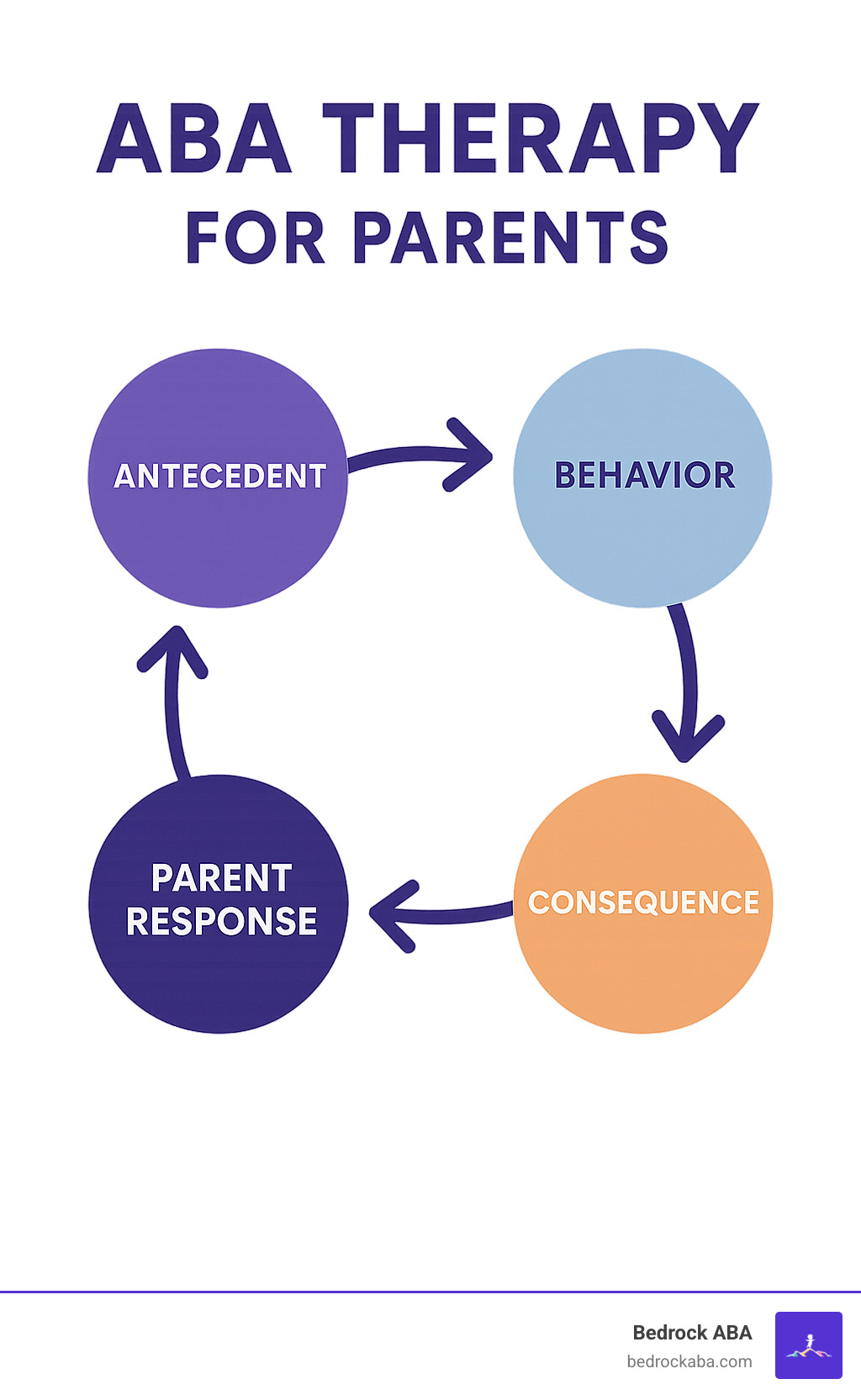
The magic of ABA happens through what we call the ABC model:
- Antecedent: What happens right before a behavior
- Behavior: What your child does
- Consequence: What happens immediately after
Let’s bring this to life: Your child wants juice (antecedent), they say “juice please” (behavior), and you give them juice with praise (consequence). That positive outcome makes them more likely to use words next time they’re thirsty, rather than crying or grabbing.
This is positive reinforcement – the cornerstone of effective ABA. When we reward behaviors we want to see more of, those behaviors naturally increase. The beauty of ABA therapy for parents is learning to spot these teaching moments that already exist in your everyday routines.
ABA isn’t just about reducing challenging behaviors like tantrums or repetitive actions. It’s equally focused on building new skills – from communication and social interaction to independence in daily living tasks. For a deeper dive into how these principles work, check out more information about ABA basics.
When Should My Child Start?
The research on this question is crystal clear: earlier is better. The younger brain has remarkable plasticity – the ability to form new connections and learning pathways. This makes early childhood an ideal time to begin ABA therapy, with many experts recommending a start before age 5 whenever possible.
That said, I want to reassure you that it’s never too late to begin. Children, teens, and even adults with autism can benefit from ABA techniques. The most important step is simply getting started.
Comprehensive ABA programs typically recommend between 25-40 hours weekly for younger children, though this varies based on individual needs. Don’t let these numbers overwhelm you – many of these hours can be naturally woven into everyday activities once you learn the techniques.
Good news for families concerned about costs: many states now mandate insurance coverage for ABA therapy for children with autism. Here in Utah, our team at Bedrock ABA can help you steer insurance requirements to access the services your child deserves.
Early intervention creates ripple effects that benefit your child throughout their lifetime. The skills they develop now – from communication to self-regulation – build a foundation for future independence and success. By starting ABA therapy early and being actively involved as a parent, you’re giving your child their best chance to reach their full potential.
Core Principles & Techniques Made Simple
Let’s explore some ABA techniques you can start using at home today—and I promise, you won’t need a psychology degree to understand them!
Think of prompting as offering just enough help for your child to succeed. You might gently guide your child’s hand to show them how to brush their teeth (physical prompt), give a hint like “What do we say when we want something?” (verbal prompt), point to a picture (visual prompt), or simply nod in the right direction (gestural prompt). The real magic happens when you gradually fade these prompts as your child gains confidence, helping them become more independent.
Shaping is about celebrating small steps toward a bigger goal. If you’re teaching your child to say “water” when thirsty, you might first get excited when they make any sound at all, then specifically when they make a “w” sound, then “wa,” until eventually they can say the full word. It’s like teaching someone to swim—you don’t start in the deep end!
When teaching complex skills, chaining becomes your best friend. This means breaking down activities into bite-sized steps. Take hand-washing: instead of the overwhelming “go wash your hands,” you might work on turning on the water, then getting soap, then rubbing hands together, and so on. Each small victory builds toward independence.
One of the most powerful concepts in ABA therapy for parents is generalization—making sure skills work everywhere, not just at the therapy table. If your child learns to say “hello” to their therapist, we want them saying it to grandma, neighbors, and classmates too. This might mean practicing the same skills in different rooms, with different people, or with different materials.

Reinforcement vs. Punishment
| Approach | What It Is | When To Use | Examples | Effect |
|---|---|---|---|---|
| Positive Reinforcement | Adding something desirable after a behavior | To increase desired behaviors | Praise, tokens, preferred activities | Increases behavior |
| Negative Reinforcement | Removing something unpleasant after a behavior | To increase desired behaviors | Removing a difficult task after compliance | Increases behavior |
| Positive Punishment | Adding something unpleasant after a behavior | Rarely recommended in modern ABA | Time-out, reprimand | Decreases behavior |
| Negative Punishment | Removing something desirable after a behavior | For serious behaviors, with caution | Brief removal of a toy | Decreases behavior |
At Bedrock ABA, we’re big believers in the power of positive reinforcement. Why? Because focusing on what your child is doing right—rather than what they’re doing wrong—not only works better but also builds a stronger relationship between you and your child.
The secret to effective reinforcement is making it immediate (right after the good behavior), consistent (especially when first teaching a skill), and meaningful (using rewards your child actually cares about). What motivates one child might bore another, so becoming a detective of your child’s interests is part of ABA therapy for parents.
Discrete Trial vs. Naturalistic Teaching
Think of Discrete Trial Training (DTT) as learning in clear, predictable chunks. It’s like flash cards on steroids: you present a clear instruction (“Touch the blue card”), your child responds, and you provide immediate feedback and reinforcement. This structured approach is fantastic for teaching specific skills that need practice—like identifying colors, matching objects, or learning letters.
Naturalistic Environment Teaching (NET), on the other hand, is more like catching teachable moments as they happen naturally. When your child reaches for a toy car, that’s your cue to practice words like “car” or “drive,” or concepts like sharing and turn-taking. It’s learning disguised as everyday fun.
Most families find that a blend of both approaches works best. At Bedrock ABA, we’ll help you learn when a structured teaching moment makes sense and when to embed learning into playtime and daily routines. The beauty of ABA therapy for parents is that you can learn to apply these principles in ways that fit your family’s unique style.
Data Collection Without the Jargon
Don’t let the words “data collection” scare you off! It’s simply keeping track of progress so you can celebrate wins and adjust when needed. Here are some parent-friendly ways to do this:
When trying to understand challenging behaviors, ABC data is your friend. Just jot down what happened right before the behavior (Antecedent), the behavior itself, and what happened afterward (Consequence). This detective work often reveals patterns you might otherwise miss.
For behaviors you can count—like words spoken or tantrums—frequency counts help you see if things are improving over time. A simple tally mark in a notebook or counter app on your phone works perfectly.
To track how long behaviors last, duration recording is your go-to. This works well for measuring things like how long your child can play independently or how long tantrums typically last.
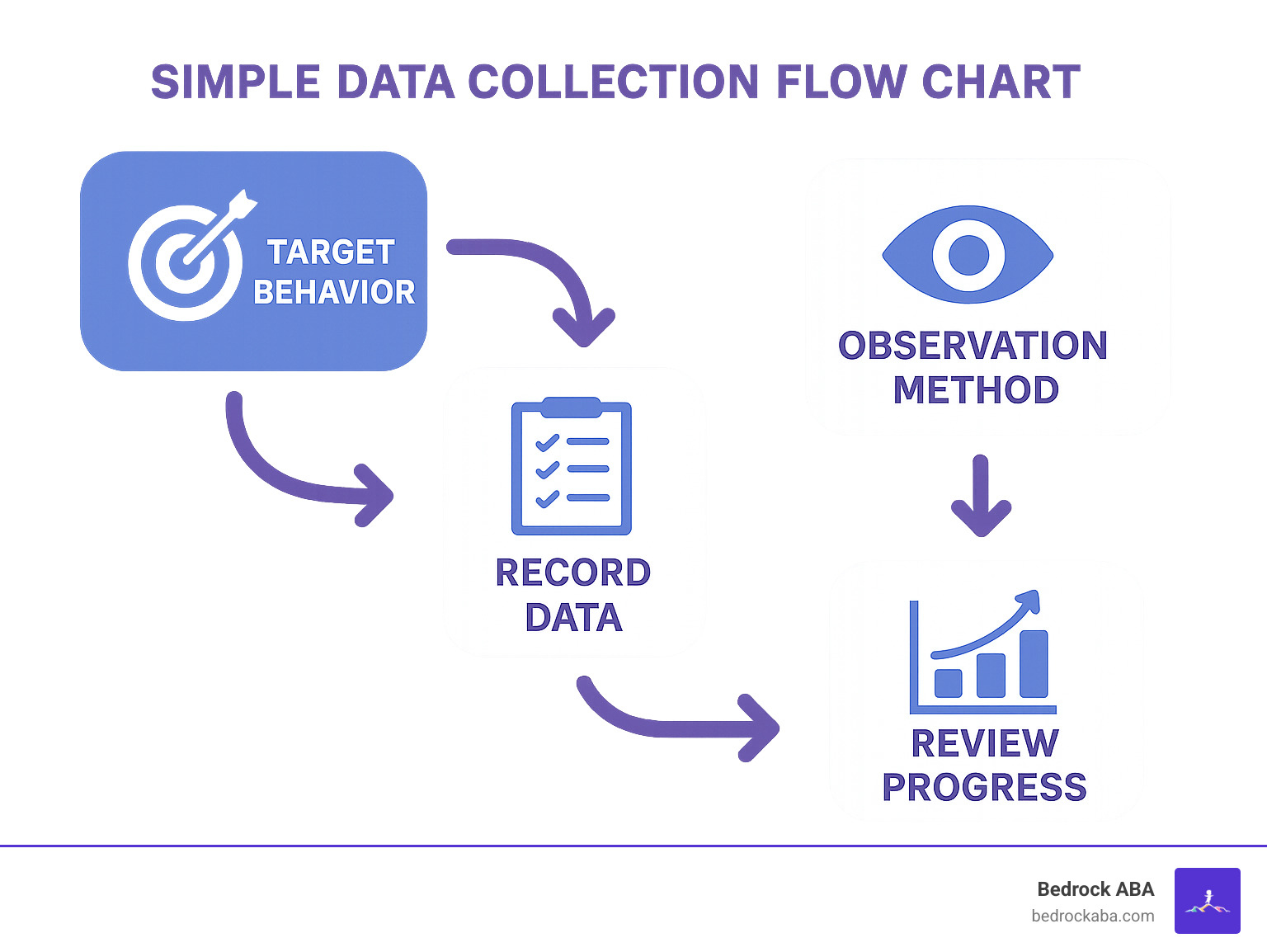
The most valuable thing isn’t fancy charts or complex systems—it’s consistency. Even simple notes can reveal important patterns and help you see progress that might otherwise get lost in the daily hustle. Many parents tell us that data becomes their evidence of hope, showing small improvements that build into significant changes over time.
At Bedrock ABA, we’ll help you find a data collection method that fits into your life rather than taking it over. After all, ABA therapy for parents should make family life better, not more complicated! Our team can show you how parent training in these research-backed methods leads to lasting improvements for children with autism.
Your Role: Parent Participation & Home Strategies
You’re the constant in your child’s life—the one who’s there morning, noon, and night. That’s why your involvement in your child’s therapy journey isn’t just helpful—it’s essential. Research consistently shows that when parents actively participate in their child’s early intervention program, outcomes improve dramatically.
ABA therapy for parents doesn’t mean you need to become a full-time therapist on top of being a parent. Instead, think of it as adding some powerful tools to your parenting toolbox—strategies that help you reinforce skills and steer behaviors during everyday moments with your child.
At Bedrock ABA, we believe parents are the true experts on their children. Our parent training programs are designed to build on your existing strengths by:
- Giving you opportunities to observe therapy sessions and see techniques in action
- Providing hands-on practice with gentle, constructive feedback
- Scheduling regular check-ins to celebrate progress and troubleshoot challenges
- Supplying practical resources you can use at home
- Offering continuous support as your child grows and their needs change
You don’t need to master everything overnight. Start small with one strategy that addresses your most pressing concern. As your confidence grows, you can gradually add more techniques to your repertoire.
ABA Therapy for Parents in Daily Routines
The magic of ABA therapy for parents happens in those everyday moments that might seem mundane but are actually perfect learning opportunities.
Morning routines become chances to build independence. A colorful visual schedule showing the steps of getting ready (wake up → bathroom → teeth → clothes → breakfast) can transform a hectic morning into a structured learning experience. Breaking down complex tasks like buttoning a shirt into smaller steps makes them less overwhelming. When your child successfully puts on their socks independently, specific praise like “Wow, you pulled those socks up all by yourself!” reinforces that accomplishment.
Mealtimes offer natural opportunities to practice communication. Your child reaching for apple slices becomes a moment to prompt “I want apple, please” before serving. The family dinner table is the perfect place to work on waiting skills (“First sit, then eat”) and trying new foods using the Premack principle—”First try one bite of broccoli, then you can have your favorite yogurt.”
Community outings may seem challenging, but with preparation, they become valuable learning experiences. Before heading to the grocery store, reading a simple social story about what to expect can ease anxiety. Practicing specific skills like waiting in line or greeting the cashier helps your child steer social situations with confidence. A small portable token board can reinforce positive behaviors while you’re out and about.
Bedtime routines that incorporate sensory activities help your child wind down naturally. A consistent, predictable sequence signals to your child that sleep time is approaching. Visual timers can make transitions easier by showing exactly how much time remains before the next step.
The beauty of integrating ABA therapy for parents into these everyday routines is that you’re not setting aside special “therapy time”—you’re simply enhancing the interactions you’re already having with your child.
Home Activities: ABA Therapy for Parents in Action
Let’s look at some specific activities you can implement at home using ABA principles:
The Look-at-Me Game builds eye contact in a playful way. Simply hold a favorite toy near your eyes and wait. The moment your child makes eye contact, immediately hand over the toy with enthusiastic praise. Over time, you can gradually increase how long they need to maintain eye contact before receiving the reward.
Color matching turns learning into a treasure hunt. Gather items from around your house—red socks, blue blocks, yellow bananas—and turn sorting them into a game. Each correct match earns praise or a small reward, reinforcing the skill while having fun together.
A First/Then Board uses visual supports to help your child understand the sequence of activities. A simple board with two pictures—one showing homework (first) and one showing tablet time (then)—helps your child understand that completing less-preferred tasks leads to preferred activities.
Token economies work wonders for many families. Your child earns tokens (stickers, poker chips, or checkmarks) for targeted behaviors like using words to request or completing chores. Once they collect a predetermined number, they can trade them in for a larger reward—creating a powerful motivation system.
Social stories prepare your child for new or challenging situations. These simple illustrated stories describe what might happen in specific social settings, what behaviors are expected, and how to respond appropriately. Reading these regularly before relevant situations helps your child know what to expect.
At Bedrock ABA, we work closely with each family to develop personalized home activities that target specific goals while fitting naturally into your unique family dynamics and routines. Learn more about our family integration approach.
Overcoming Common Challenges
Even with the best strategies, challenges will arise—and that’s completely normal. Here’s how to steer some common problems:
Tantrums can be overwhelming, but they’re often your child’s way of communicating when they lack better tools. Start by identifying triggers through ABC data collection—what happens just before the tantrum starts? Then teach alternative ways to communicate those same needs. When a tantrum occurs, remain calm (easier said than done, we know!) and avoid accidentally reinforcing the behavior with attention. When calm behavior returns, that’s your moment to reinforce positively.
Aggression requires addressing safety first. Once everyone is safe, determine what function the behavior serves—is your child trying to get attention, escape a demand, or obtain something? Teaching appropriate alternative behaviors that serve the same function is key. Consistently reinforce using appropriate communication instead of aggression.
Sensory overload can trigger meltdowns that look like behavioral issues but actually stem from overwhelming sensory input. Creating a designated “calm down” space at home with sensory tools like weighted blankets, noise-canceling headphones, or fidget toys gives your child a safe place to regulate. Prepare for potentially overwhelming environments by bringing sensory tools and having an exit strategy if needed.
Anxiety often manifests differently in children with autism than in neurotypical children. Visual supports increase predictability, which can significantly reduce anxiety. Breaking down anxiety-provoking tasks into smaller, manageable steps makes them less overwhelming. Gradually exposing your child to anxiety-triggering situations in a controlled, supportive way helps build confidence over time.
Sibling dynamics require thoughtful navigation. Teaching siblings basic ABA strategies empowers them to be part of the solution. Creating opportunities for positive interactions through structured activities builds relationships. Most importantly, making sure each child gets balanced attention and special one-on-one time helps prevent resentment.
The key to addressing all these challenges is consistency. When all caregivers use the same approach, your child receives clear, predictable messages about expectations and consequences. At Bedrock ABA, we work with your entire family to create a consistent, supportive environment where everyone can thrive together.
Tracking Progress & Troubleshooting
Watching your child grow and develop is one of parenting’s greatest joys—and ABA therapy for parents gives you tools to track this progress meaningfully. One thing I love about ABA is how it focuses on clear, measurable goals that let you actually see your child’s development rather than just hoping things are improving.
The secret to setting effective goals is following the SMART framework:
- Specific: Instead of “better communication,” aim for “using words to request snacks”
- Measurable: You should be able to count or observe it happening
- Achievable: Set your child up for success with realistic next steps
- Relevant: Focus on skills that will truly improve your child’s daily life
- Time-bound: Include a timeframe to create gentle accountability
For example, rather than “Johnny will communicate better,” a SMART goal might be: “Johnny will point to pictures on his communication board to request preferred items in 4 out of 5 opportunities for three consecutive days.”
At Bedrock ABA, we help you create these clear targets and establish simple tracking systems that won’t overwhelm your already busy life. Regular check-ins with your BCBA provide chances to review progress, celebrate wins (even small ones!), and troubleshoot any roadblocks you’re encountering.
Measuring Success & Tweaking Plans
Children grow and change quickly, and your approach should evolve right along with them. Once your child masters a skill, you’ll want to maintain it while pushing forward to new challenges.
Maintenance is like watering a plant—you can’t just stop once it grows! Schedule occasional practice of mastered skills to ensure they stick around. You might practice less frequently, but don’t abandon skills entirely.
I’ve seen many parents get discouraged when their child performs perfectly at home but struggles elsewhere. This is where generalization probes come in—regularly checking if skills transfer to different settings, people, or materials. If your child can request “more” with you but not grandma, you’ll need targeted practice with other people.
The art of fading prompts is another key parent skill. Think of it as gradually removing the training wheels. If you’ve been physically guiding your child’s hand to brush teeth, you might switch to just pointing, then verbal reminders, and eventually just a toothbrush left by the sink.
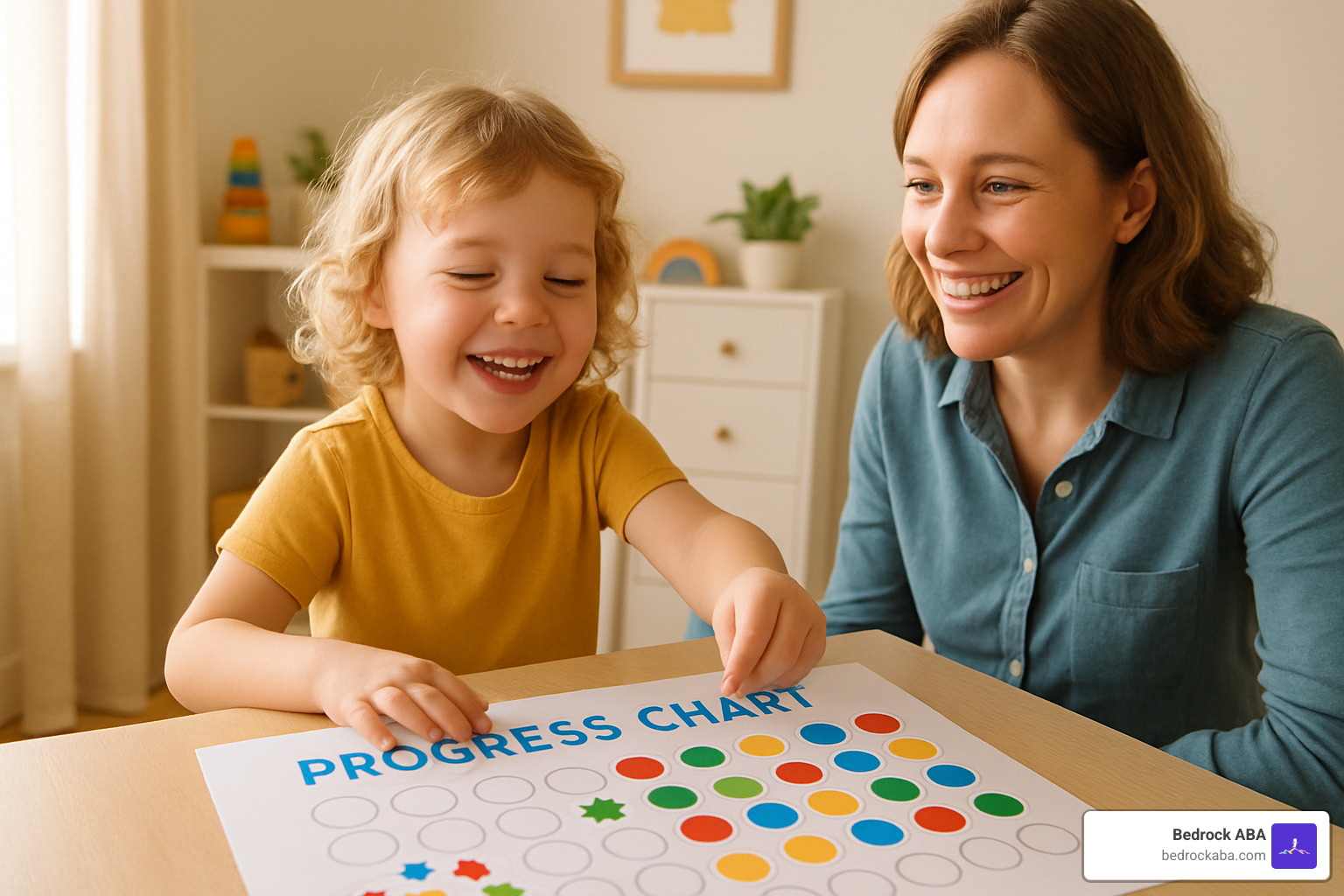
Don’t wait for perfection before celebrating! One mom I worked with kept a special “wins jar” where she dropped in notes about small victories. On tough days, reading these reminders of progress provided much-needed perspective and motivation.
Funding & Access Essentials
Let’s face it—therapy can be expensive, but understanding your options helps make quality ABA services more accessible.
Insurance coverage for ABA has improved dramatically in recent years. Many private insurance plans now cover ABA therapy for autism thanks to state mandates. The coverage varies widely though, so it’s worth calling your insurance company to understand your specific benefits. Ask about session limits, copays, and whether parent training is included.
If you’re on Medicaid, you should know that all Medicaid plans must cover medically necessary ABA services for children under 21 through the Early and Periodic Screening, Diagnostic and Treatment (EPSDT) benefit. This is a powerful right that many families aren’t aware of!
Some families choose private pay options, which while more expensive, can offer more flexibility in choosing providers and service models. Many providers offer sliding scale fees or payment plans to make this more manageable.
For families in rural areas or with busy schedules, telehealth options like those offered by Bedrock ABA can be game-changers. Virtual services often emphasize parent training, empowering you to implement strategies consistently throughout your child’s day. Learn more about ABA telehealth and how it might work for your family.
If you find yourself on a waitlist for services (unfortunately common in many areas), don’t just wait passively. Ask about parent workshops or resources to get started. At Bedrock ABA, we believe that equipping parents with basic ABA strategies can make a significant difference while waiting for more intensive services.
We’re committed to helping Utah families steer these options to find the best fit for their unique needs. No family should have to figure this out alone—that’s why our team at Bedrock ABA is always ready to answer your questions about accessing quality ABA therapy.
Frequently Asked Questions about ABA Therapy for Parents
How many hours of ABA does my child really need?
This might be the question I hear most often from parents. The truth is, there’s no one-size-fits-all answer. Research on intensive ABA therapy for parents shows the best outcomes typically occur with 25-40 hours weekly for young children with significant needs.
But here’s the reassuring part – not all those hours need to be with a professional therapist sitting in your living room. Once you’ve learned the techniques, many of these hours can happen during breakfast, bath time, or a trip to the grocery store.
At Bedrock ABA, we work closely with each family to find that sweet spot – the right balance between professional sessions and parent-implemented strategies that fits your child’s needs and your family’s life. Some children thrive with more intensive professional support, while others make wonderful progress with fewer professional hours and more parent involvement.
Can I do ABA at home without a BCBA on site?
Absolutely! Many parents become incredibly skilled at implementing ABA therapy for parents techniques at home. That said, having a Board Certified Behavior Analyst (BCBA) develop and periodically supervise the program is important – think of them as your coach and guide on this journey.
Your BCBA brings specialized training to:
* Assess your child’s unique behavior patterns
* Develop effective, personalized intervention plans
* Help troubleshoot when strategies hit a roadblock
* Keep your program evidence-based and current
* Adjust goals as your child grows and develops
At Bedrock ABA, we understand that flexibility matters to families. That’s why we offer both in-person and telehealth supervision options. This approach lets you implement strategies in your everyday life while still having professional guidance when you need it. Many parents tell us they love the confidence that comes from knowing they’re on the right track while still maintaining their primary role as mom or dad, not therapist.
What if my child isn’t making progress?
First, take a deep breath. Plateaus happen for nearly every child, and they don’t mean ABA therapy for parents isn’t working. If your child seems stuck, several factors might be at play.
Sometimes goals need adjustment – they might be too challenging or not broken down into small enough steps. What works as a reinforcer can also change over time (the stickers that were exciting last month might be boring now). Consistency across caregivers matters too – if grandma, dad, and the babysitter are all using different approaches, it can be confusing for your child.
Other factors like sleep problems, medical issues, or changes in routine can also impact learning. And occasionally, the teaching approach simply needs modification – some children respond better to different teaching styles or environments.
If you’re concerned about progress, talk openly with your BCBA. At Bedrock ABA, we regularly review progress data and make adjustments to ensure each child continues moving forward. Sometimes a small tweak – like changing when you practice skills or finding a more motivating reward – can make a world of difference. This is a marathon, not a sprint, and we’re here to support you through every step of the journey.
Conclusion & Next Steps
Taking the first steps with ABA therapy for parents isn’t about becoming an overnight expert—it’s about embracing a journey of learning alongside your child. The beauty of this approach is that you don’t need specialized credentials, just a willing heart and consistent practice.
Your involvement as a parent creates a powerful bridge between formal therapy sessions and everyday life. When you implement ABA strategies during bedtime routines, grocery trips, or playground visits, you’re helping your child generalize skills across all environments—something that can’t happen with clinical sessions alone.
As you move forward, keep these essential principles in mind:
Start early whenever possible. Research consistently shows that beginning ABA interventions soon after diagnosis leads to the most significant gains. The developing brain is remarkably receptive during those early years, making it the ideal time to introduce new skills and routines.
Consistency creates confidence. When all caregivers—parents, grandparents, babysitters—use the same approaches and language, your child will learn faster and with less confusion. This shared framework provides the predictability that many children with autism crave.
Small victories deserve big celebrations. The path isn’t always linear, and progress might come in unexpected ways. That first unprompted “hello” or independently completed morning routine deserves recognition—these moments fuel motivation for both you and your child.
Build your support network. Implementing ABA therapy for parents doesn’t mean doing it all alone. At Bedrock ABA, our family-centered approach means we’re partners in this journey, offering guidance when challenges arise and celebrating alongside you when breakthroughs happen.
Your well-being matters too. Supporting a child with autism requires emotional and physical energy. Schedule respite time, connect with other parents who understand, and remember that taking care of yourself isn’t selfish—it’s essential for sustainable caregiving.
Our team at Bedrock ABA is deeply committed to empowering Utah families through personalized support that respects your unique family dynamics and values. We understand that effective therapy doesn’t just change behaviors—it improves relationships and quality of life for the entire family.
Whether you’re just beginning to explore ABA or looking to improve your current approach, mastery comes with time. Start with one technique that addresses your most pressing concern, practice until it feels natural, and then gradually add more strategies to your parenting toolkit.
The journey of raising a child with autism has its challenges, but with the right support and strategies, it also offers profound opportunities for connection, growth, and joy. We’d be honored to walk alongside you on this path toward a more empowered, connected family life.
Ready to take the next step? Learn more about our in-home services or reach out to schedule a conversation about how we can tailor our approach to your family’s specific needs and goals.