


Understanding the Power of ABA Behavior Support Plans
A behavior support plan ABA is a structured document that outlines strategies to reduce challenging behaviors and teach positive replacement skills based on applied behavior analysis principles. This plan is developed after identifying the function of problem behaviors through assessment.
What is a Behavior Support Plan in ABA?
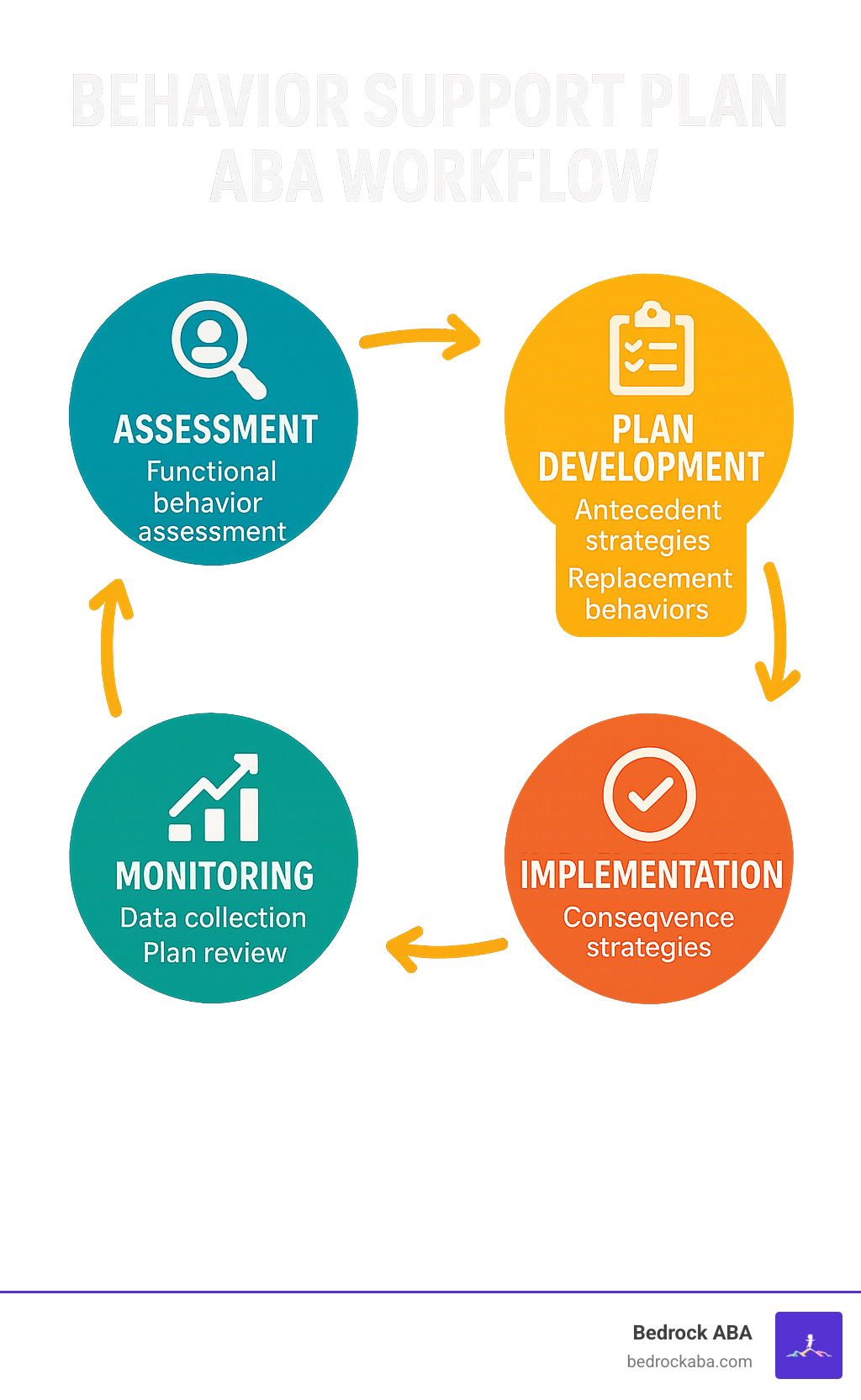
* A personalized, data-driven intervention strategy
* Based on functional behavior assessment results
* Includes antecedent strategies (preventing problems)
* Teaches replacement behaviors (new skills)
* Implements consequence strategies (reinforcement)
* Requires consistent monitoring and adjustment
Creating an effective behavior support plan doesn’t have to be overwhelming. When developed correctly, these plans can reduce challenging behaviors by up to 80% while teaching valuable new skills. The key is understanding the step-by-step process and keeping it simple enough for everyone involved to implement consistently.
Think of a behavior support plan as a roadmap – it shows where you are now, where you want to go, and the best route to get there. Without this map, you might try random strategies that lead nowhere or even make the situation worse.
I’m Mayer Kulefsky, director of operations at Bedrock ABA, where I’ve overseen the development and implementation of hundreds of successful behavior support plan ABA interventions across multiple states. My experience has shown that the most effective plans are those that are both scientifically sound and practical for families to implement in their daily lives.
Why This Guide Matters
The need for effective behavior support plans has never been greater. With approximately 1 in 36 children in the United States now diagnosed with Autism Spectrum Disorder, families and practitioners need practical, evidence-based approaches to support these children’s development and well-being.
Research consistently shows that positive behavior support plans ABA can reduce challenging behaviors by up to 80% when implemented with fidelity. What’s more, a study found that 94% of teachers reported improved classroom behavior after implementing individualized behavior support plans based on functional behavior assessments.
These aren’t just numbers—they represent real children gaining skills, families experiencing less stress, and educators creating more effective learning environments. Data-driven ABA interventions, including behavior support plans, have been shown to improve adaptive behaviors in 70% of children with autism when consistently applied over a 12-month period.
At Bedrock ABA in Salt Lake City, Utah, we’ve seen how well-designed behavior support plans transform lives. This guide will walk you through our proven process for creating plans that work—without driving you crazy in the process.
What Is a Behavior Support Plan ABA?
Think of a behavior support plan ABA as your personalized roadmap to positive change. It’s not just a document—it’s a thoughtful strategy designed specifically for individuals with developmental disabilities, behavioral challenges, or autism spectrum disorder.
Unlike those one-size-fits-all approaches that rarely fit anyone well, a proper behavior support plan puts the person at the center of everything. When I work with families at Bedrock ABA, I always emphasize that we’re building this plan around your child’s unique personality, preferences, and needs—not forcing them into a predetermined box.
What makes a behavior support plan ABA truly effective is that it’s built on understanding. Through careful assessment, we find why behaviors happen, not just what behaviors occur. As one parent told me recently, “It was like someone finally put on detective glasses and saw what my child was really trying to tell us.”
Good plans are proactive rather than reactive. Instead of simply responding to problems after they occur, we create environments and teach skills that prevent challenges in the first place. The plan addresses everything from environmental adjustments to new skill development to how adults should respond when behaviors do occur.
And perhaps most importantly, these plans are guided by data, not guesswork. We track progress objectively so we can celebrate real victories and make adjustments when needed.
The foundation of any solid behavior support plan ABA is the Functional Behavior Assessment (FBA). This crucial first step helps us identify what triggers behaviors, exactly what those behaviors look like, and what purpose they serve for the individual. Without this understanding, we’d be shooting in the dark.
I love how one of our behavior analysts at Bedrock puts it: “A truly effective behavior plan changes not just the child’s behavior, but how everyone around them responds too.” This perspective shift makes all the difference—behavior change happens within relationships and environments, not in isolation.
Benefits of a Behavior Support Plan ABA
When we implement a thoughtful behavior support plan ABA, the positive ripple effects can transform daily life for the whole family.
First and foremost is the improved quality of life. When challenging behaviors decrease, doors open. I’ve watched children who previously couldn’t participate in family outings gradually join in neighborhood walks, restaurant meals, and even crowded events. One mom told me with tears in her eyes, “We went to the movies as a family for the first time in four years.”
Safety improvements can be life-changing too. For behaviors that pose physical risks, having clear prevention protocols and response strategies dramatically reduces injuries and emergencies. This brings peace of mind that’s hard to measure but impossible to overvalue.
Beyond just reducing problems, effective plans build lasting skills. We don’t just stop unwanted behaviors—we teach valuable replacement skills that serve the same purpose but in more appropriate ways. This leads to greater independence and self-regulation that continues long after therapy ends.
The written plan creates consistency across all environments. When everyone from parents to teachers to grandparents responds in similar ways, learning accelerates and confusion decreases. As one dad put it, “Finally, we’re all on the same page!”
The most successful plans incorporate input from the individual (whenever possible) and their entire support network. This ensures the goals are meaningful and the strategies fit within the family’s cultural values and daily realities.
The numbers back this up too—up to 60% of students with disabilities who receive behavior intervention plans show significant reductions in discipline issues within just one year. That translates to more time learning and building relationships instead of managing crises.
Common Functions Tackled by a Behavior Support Plan ABA
Understanding why behaviors happen—their function—is the secret sauce of effective ABA intervention. Most challenging behaviors serve one or more of these five primary purposes:
Attention behaviors are all about human connection. When a child throws toys while adults are chatting, they might be saying, “Hey, notice me!” This function can involve positive attention (like comforting or praising) or even negative attention (like scolding or negotiating).
Escape behaviors help avoid uncomfortable situations. The student who disrupts class when faced with a challenging math worksheet might actually be communicating, “This is too hard for me right now.” These behaviors delay or avoid non-preferred activities, demands, or overwhelming sensory experiences.
Access to tangibles is straightforward—these behaviors help obtain desired items or activities. The tantrum in the toy store has a clear purpose from the child’s perspective.
Sensory/automatic behaviors provide internal feedback or regulation. Hand-flapping might give visual stimulation or help manage sensory overload in a busy environment. These behaviors often continue even when no one is watching because the reinforcement comes from within.
Pain attenuation behaviors reduce physical discomfort. A child hitting their ear might be communicating an ear infection before they have the words to explain it.
A well-crafted behavior support plan ABA identifies which function(s) drive the challenging behavior and then develops interventions specifically targeted to address that root cause. For a behavior serving an escape function, we might teach appropriate break-requesting skills rather than using attention-based strategies that miss the mark entirely.
At Bedrock ABA, we take the time to truly understand these functions because when we address the real need behind the behavior, that’s when lasting change begins.
Step 1: Run a Rock-Solid Functional Behavior Assessment
The foundation of any effective behavior support plan ABA is a thorough Functional Behavior Assessment (FBA). This critical first step determines why challenging behaviors occur and guides all subsequent intervention decisions.
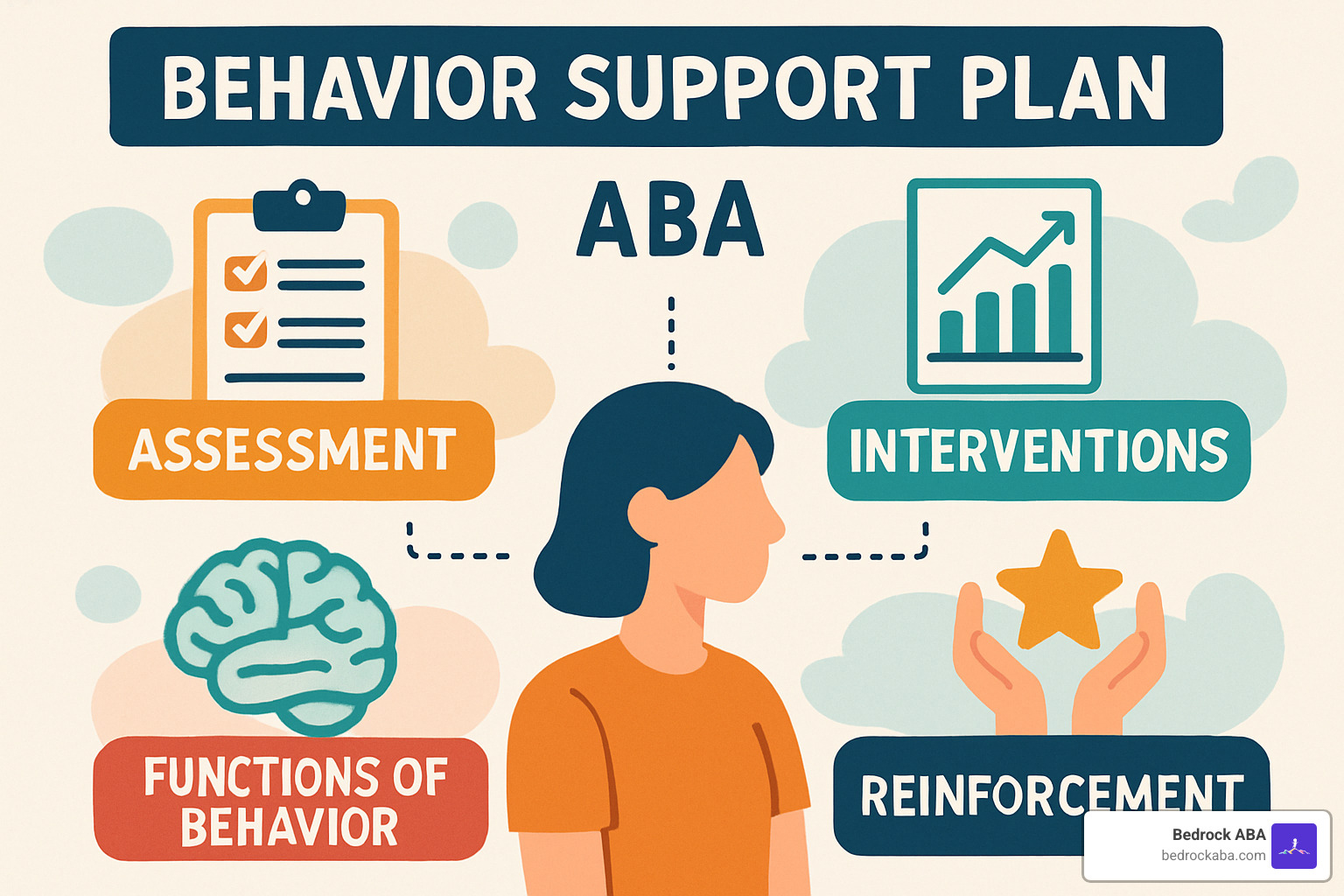
Think of an FBA as detective work – we’re gathering clues to solve the mystery of why behaviors happen. When I work with families at Bedrock ABA, I often explain that we need to look beyond what we see on the surface to understand what’s really driving behaviors.
An effective FBA helps us identify exactly what the behavior looks like (is it hitting, screaming, or withdrawing?), what happens right before it occurs (those triggers we call antecedents), what follows the behavior (consequences that might accidentally reward it), where patterns emerge, and ultimately – the “why” behind it all.
This process isn’t just clipboard-and-stopwatch work. It involves meaningful conversations with parents, teachers, and caregivers who know the child best. We observe in natural environments – during meals, transitions, playtime – to see how behaviors unfold in real life. We might use standardized tools like the FAST or QABF assessments, but the heart of our work is careful ABC data collection (tracking the Antecedent-Behavior-Consequence chain) that reveals the patterns hiding in plain sight.
“The patterns we find during a good FBA are like finding the key to a lock,” one of our behavior analysts often tells parents. “Once we have that key, we can open up strategies that actually work.”
Choosing the Right Data Tools
Not all behaviors can be measured the same way – just as you wouldn’t use a ruler to weigh yourself or a scale to measure distance. At Bedrock ABA, we carefully select the right measurement tools for each unique situation.
For behaviors that happen in distinct episodes (like hitting or verbal outbursts), we typically use frequency data to count how often they occur. When behaviors drag on (like tantrums or refusal), duration data tells us how long they last. Sometimes we need to know how quickly a child responds to instructions, so we use latency data to measure that time gap.
For behaviors that happen so often they’re hard to count, we might divide observation periods into intervals with interval recording. Our bread-and-butter approach is often ABC data, documenting exactly what happened before, during, and after the behavior. And when we suspect timing patterns (like behaviors that spike before lunch or during transitions), a scatterplot analysis helps us see those time-based trends.
The beauty of good data collection isn’t in the numbers themselves – it’s in the story they tell us. As one parent told me recently, “I never realized my son’s meltdowns almost always happened when I gave multiple instructions at once until we saw it in the data.”
Most of our behavior analysts use a combination of these methods to get a complete picture. We might track both how often a behavior happens and what triggers it, giving us both the “how much” and the “why” information we need for a solid plan. You can learn more about these critical data collection methods in this resource on ABA data collection.
Synthesizing Results Into a Clear Hypothesis
After a few weeks of thoughtful data collection, it’s time for the magic moment – turning all those observations into a clear understanding of what’s happening and why. This is where science meets storytelling.
A good hypothesis isn’t vague – it’s precise and actionable. Instead of saying “Johnny has meltdowns because he’s seeking attention,” we might say: “Johnny’s tantrums (screaming, crying, and dropping to the floor) occur 5-7 times daily, lasting around 8 minutes each. They most frequently happen when presented with writing tasks or multi-step directions. The function appears to be escape from demanding academic tasks, particularly those involving writing. This is supported by our observation that in 85% of instances, the behavior resulted in the task being delayed or removed, and the behavior stopped within 2 minutes of task removal.”
Notice the difference? One gives you a general idea; the other gives you a roadmap for intervention.
This clear hypothesis becomes the foundation for your behavior support plan ABA. If we get this wrong, even the most creative interventions won’t work. It’s like trying to solve a puzzle with the wrong picture as your guide.
In real life, behavior is messy – it often serves multiple functions or different functions in different settings. A child might tantrum to escape demands at school but to gain attention at home. A comprehensive plan addresses all these identified functions, which is why we take the time to gather data across different environments.
At Bedrock ABA, we believe this foundation-setting work is worth every minute. As one of our senior analysts puts it, “A week of careful assessment saves months of ineffective intervention.” If you’re interested in learning more about the principles behind our assessment approach, check out our article on key principles behind ABA therapy.
Step 2: Craft the Plan—Antecedent, Teaching & Consequence Strategies
With your functional behavior assessment complete, it’s time to build the heart of your behavior support plan ABA: the intervention strategies. Think of this as designing a three-part harmony where each component supports the others:
- Preventing problems before they start
- Teaching better ways to get needs met
- Responding in ways that reinforce progress
Let’s walk through how to create this balanced approach:
Antecedent Strategies That Prevent Meltdowns
The best intervention is prevention. Antecedent strategies are like setting the stage for success by removing or modifying triggers before challenging behaviors even have a chance to appear.
Visual schedules work wonders for creating predictability. I’ve seen countless families transform their mornings from chaos to calm with simple picture schedules showing the sequence of activities. One Bedrock ABA parent told me, “The visual schedule made a night-and-day difference. My son went from daily meltdowns to independently following his routine within two weeks.”
Offering choices gives children a sense of control without compromising your expectations. Instead of saying, “Do your homework now,” try “Would you like to do your math first or reading first?” The task still gets done, but with significantly less resistance.
When tasks are overwhelming, demand fading can build tolerance gradually. Start with just 30 seconds of a non-preferred activity, then slowly increase as success builds. This approach is particularly effective for children who shut down when facing challenging tasks.
Sometimes the physical environment itself is the trigger. Environmental redesign might mean creating a quiet corner, using noise-canceling headphones, or simply rearranging seating to reduce distractions. These small tweaks can make a huge difference in preventing sensory overload.
Teaching Powerful Replacement Skills
This is where lasting change happens. We’re not just stopping problematic behaviors—we’re building better alternatives that serve the same purpose.
Functional communication training is often the game-changer in a behavior support plan ABA. If tantrums currently “work” to escape difficult tasks, we need to teach a more appropriate way to request breaks. This might be a simple break card, a hand signal, or a verbal phrase like “I need help” or “Break please.”
For children who become overwhelmed by emotions, self-management strategies provide concrete tools to recognize and address their feelings before reaching the breaking point. This might include using a 5-point scale to rate their frustration, practicing deep breathing, or following a calming routine with specific steps.
Many challenging behaviors stem from social difficulties. Social skills training helps children learn appropriate ways to join activities, request attention, or steer conflicts. At Bedrock ABA, we use a lot of role-play and real-world practice rather than just talking about these skills.
Complex tasks often trigger avoidance behaviors. Using task analysis, we break intimidating activities into bite-sized steps. Instead of facing “clean your room” (overwhelming!), a child might follow a checklist: pick up clothes, put away toys, make bed. Each small success builds confidence for the next step.
The key is ensuring replacement skills are:
– At least as efficient as the problem behavior
– Achievable with the child’s current abilities (with support)
– Genuinely effective at meeting the same need
– Appropriate across different environments
Consequence Strategies & Reinforcement Systems
What happens after a behavior occurs powerfully shapes whether it will happen again. A thoughtful behavior support plan ABA carefully designs these responses.
Differential reinforcement is our most powerful tool—actively reinforcing positive behaviors while not reinforcing challenging ones. This might look like immediately praising a child for using their words instead of grabbing, while not providing attention for minor inappropriate behaviors.
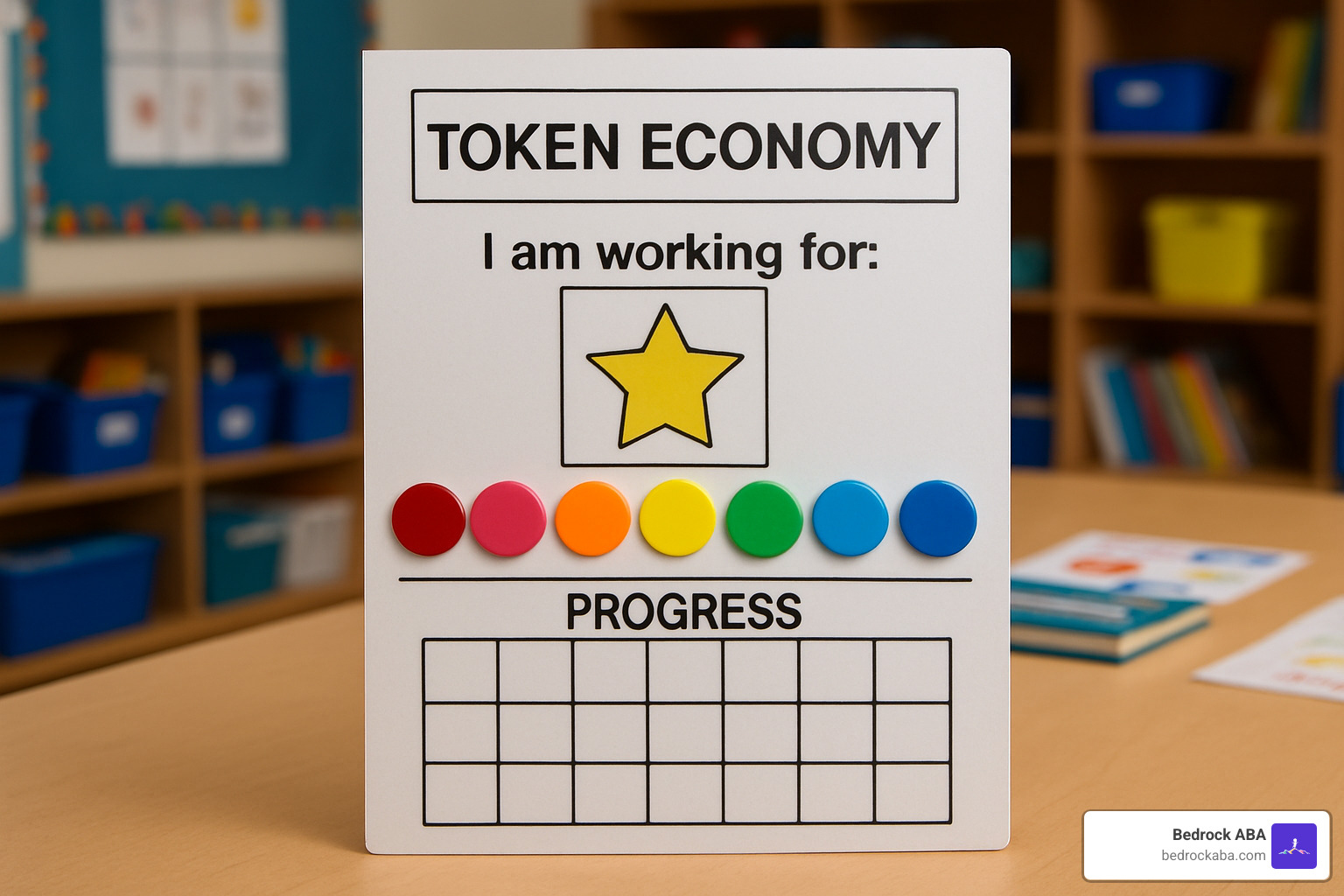
Token economies bridge the gap between immediate behavior and delayed rewards. A child might earn stickers or points throughout the day for using replacement skills, then exchange them later for preferred activities or items. This system helps build delayed gratification while still providing immediate acknowledgment of progress.
Sometimes behaviors persist because they’ve worked reliably in the past. Extinction involves carefully removing the reinforcement that maintained the problem behavior. If attention maintains a behavior, planned ignoring might be appropriate—though be prepared for the “extinction burst” where the behavior temporarily increases before improving.
The most effective reinforcement is:
– Immediate – delivered right after the positive behavior
– Consistent – applied the same way by everyone
– Meaningful – truly motivating to that specific child
– Clearly connected – the child understands exactly why they earned it
At Bedrock ABA, we help families find what truly motivates their child, which often changes over time. The best reinforcers aren’t always toys or treats—for many children, specific activities or special time with parents are far more powerful.
Writing Measurable Goals & Benchmarks
Clear goals transform vague hopes into achievable targets. They help everyone stay on the same page and provide concrete ways to measure progress.
The best goals in a behavior support plan ABA follow the SMART framework—they’re Specific, Measurable, Achievable, Relevant, and Time-bound. Compare these examples:
| Vague Goal | SMART Goal |
|---|---|
| Johnny will have fewer tantrums. | Within 3 months, Johnny will use his communication card to request a break when frustrated, reducing tantrum behavior (screaming, crying, falling to floor) from a current average of 6 times daily to fewer than 2 times daily across all settings. |
The SMART goal specifies exactly what success looks like, how we’ll measure it, and when we expect to achieve it. It focuses on both decreasing the challenging behavior and increasing the replacement skill.
For each goal, we also define:
– Mastery criteria – What level of performance indicates success (e.g., using the skill independently 80% of opportunities across 3 consecutive sessions)
– Generalization plans – How we’ll ensure the skill transfers to different settings, people, and situations
– Maintenance checks – How we’ll verify the skill continues after direct teaching ends
At Bedrock ABA, we typically focus on 3-5 priority goals at a time. This keeps things manageable for families and prevents the overwhelm that comes from trying to change everything at once. As initial goals are achieved, we can always add new targets based on current priorities.
A well-crafted behavior support plan ABA isn’t about controlling a child—it’s about teaching skills that lead to greater independence, better communication, and improved quality of life. The plan should feel supportive rather than restrictive, with strategies that everyone involved can consistently implement.
Step 3: Implementation, Progress Monitoring & Troubleshooting
Creating a behavior support plan ABA is just the first step—the real magic happens during implementation. This is where your carefully crafted plan comes to life, requiring teamwork, consistency, and a healthy dose of flexibility.

Think of implementation like launching a rocket—everything needs to be aligned for liftoff. You’ll need to train everyone involved, create necessary materials like visual supports, establish clear communication channels between team members, set up environments for success, and create a schedule for checking progress.
Don’t worry if things don’t go perfectly from day one! There’s always an adjustment period as everyone gets comfortable with new strategies. As one of our BCBAs at Bedrock ABA likes to say, “The first week is about surviving, not thriving.”
Assigning Roles and Training Your Team
A behavior support plan ABA works best when everyone knows exactly what they’re responsible for—like a well-rehearsed orchestra rather than musicians playing different songs.
Your BCBA serves as the conductor, overseeing the plan, training team members, analyzing data, and recommending adjustments. They’ll observe regularly to make sure everyone’s playing the same tune.
RBTs are your daily implementers—the ones in the trenches working directly with the individual, collecting data, and noticing what’s working (and what’s not). Their feedback is gold.
Parents and caregivers are the unsung heroes who ensure consistency at home and in the community. Their insights about behavior patterns outside of therapy sessions are invaluable.
Teachers and school staff adapt classroom strategies to align with the plan, becoming essential partners in creating consistency across environments.
And whenever appropriate, the individual themselves should be involved in understanding their own plan and learning self-monitoring skills. After all, they’re the star of the show!
At Bedrock ABA, we believe family integration isn’t just helpful—it’s absolutely essential for lasting success. One parent told us, “Once I understood why my son’s behaviors were happening and had specific tools to address them, I felt empowered rather than overwhelmed.”
We provide hands-on practice sessions, video models of strategies, clear written instructions, ongoing coaching, and troubleshooting support when things get tough. Training isn’t a one-and-done event but an ongoing conversation as needs evolve.
Monitoring Data & Making Data-Driven Revisions
Without good data, a behavior support plan ABA is like driving with your eyes closed—you have no idea if you’re headed in the right direction. Ongoing measurement keeps your plan on track and tells you when to make adjustments.
Continue using the same measurement systems you established during your FBA to track both challenging behaviors and the new replacement skills. Consistency in data collection allows you to make valid comparisons over time.
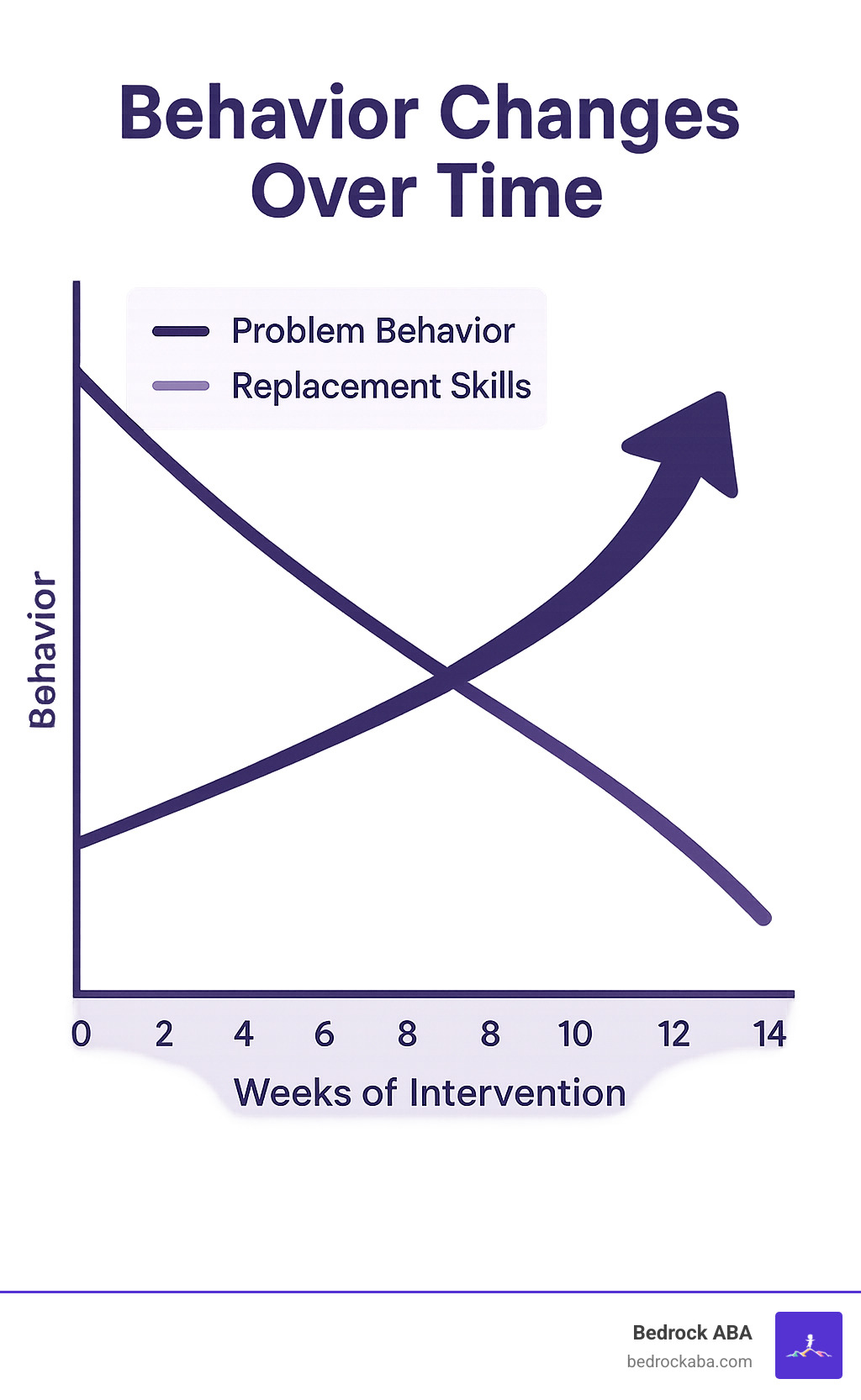
Graphs make this data come alive, turning numbers into visual stories that reveal trends at a glance. When you see that line of challenging behavior trending downward while replacement skills climb upward, it’s cause for celebration!
Look closely at your data for patterns: Is progress better on weekdays than weekends? Does behavior improve in certain settings but not others? Has progress plateaued? These insights guide your next steps.
Establish clear decision rules upfront about when to make adjustments. For instance, if there’s no improvement after two weeks of consistent implementation or if behavior suddenly worsens for three consecutive days, it’s time to revisit your strategies.
Schedule regular team meetings every 6-8 weeks to review progress together. These meetings should feel supportive and solution-focused, not like performance reviews. Include everyone who works with the individual when possible.
Here’s a reality check that might actually make you feel better: only about one-third of initial behavior plans work without any revisions. Adjustments aren’t failures—they’re an expected part of the process!
Common Pitfalls & How to Fix Them Without Losing Your Mind
Even the most thoughtfully designed behavior support plan ABA will hit some bumps in the road. Here’s how to steer the most common challenges without pulling your hair out:
Inconsistent Implementation can confuse the individual and slow progress. Create simple one-page “cheat sheets” for key strategies that anyone can follow. Video models can also help ensure everyone implements techniques the same way. Schedule regular fidelity checks to catch and correct drift before it becomes problematic.
Reinforcement Issues happen when motivators lose their magic over time. Think of reinforcers like favorite songs—even the best ones get old after too much repetition! Conduct preference assessments regularly to find new motivators, and rotate reinforcers to keep things fresh and exciting.
Extinction Bursts (temporary worsening of behavior) can catch teams off guard. It’s actually a good sign that your plan is working—the behavior is fighting to survive! Prepare your team for this common phenomenon and provide extra support during this challenging but temporary phase.
Resource Limitations are a reality for most families and schools. When time or materials are scarce, simplify procedures where possible and integrate strategies into existing routines. Focus on consistency with your highest-priority strategies rather than perfect implementation of everything at once.
Staff Turnover can disrupt progress when new team members aren’t familiar with the plan. Create detailed but accessible onboarding materials and pair new staff with experienced mentors who can model proper implementation.
Caregiver Burnout is real and needs to be addressed proactively. Build self-care into your plan from the beginning, start with fewer strategies before gradually adding more, and celebrate small victories to maintain motivation. As one Bedrock ABA parent shared, “The day I realized I needed to put on my own oxygen mask first was the day our whole family’s progress improved.”
Generalization Challenges occur when skills don’t transfer to new settings or people. Deliberately practice skills in different environments, with different people, and with varied materials to promote flexible learning.
At Bedrock ABA, we’ve found that the most successful families approach behavior change as a marathon, not a sprint. Perfect implementation isn’t the goal—consistent effort and data-based decision-making are what truly matter. When you hit obstacles (and you will!), adaptability is just as important as adherence to the plan.
The journey of implementing a behavior support plan ABA might have its challenges, but the destination—seeing a child gain new skills and independence—makes every effort worthwhile.
Frequently Asked Questions About Behavior Support Plan ABA
How often should a BSP be reviewed?
Think of your behavior support plan ABA as a living document that grows and changes alongside your child. At Bedrock ABA, we’ve found that regular check-ins keep plans effective and responsive to your child’s developing needs.
During the first month, weekly reviews help us catch any early implementation challenges. We look at the data together, talk about what’s working, and make quick adjustments before small issues become big ones. Parents often tell us this frequent early support helps them feel confident in implementing new strategies.
Once we see stable positive results, we typically shift to bi-weekly reviews. This gives enough time to spot trends while still keeping the momentum going. For plans that have been successful over time, monthly maintenance reviews usually suffice.
Of course, life doesn’t always follow our schedule. If you notice a sudden change in behaviors or if there’s a significant shift in your child’s environment (like starting a new school or welcoming a sibling), we’ll conduct an immediate review rather than waiting for the next scheduled check-in.
The most comprehensive reviews happen every 6-8 weeks with your entire support team. These meetings are valuable opportunities to celebrate progress, problem-solve challenges, and ensure everyone remains on the same page.
What’s the difference between a BSP and a BIP?
“Is it a Behavior Support Plan or a Behavior Intervention Plan? Does it really matter what we call it?” Parents ask us this question frequently, and the answer is both yes and no.
While these terms are often used interchangeably (even by professionals), there are subtle differences worth understanding:
A behavior support plan ABA tends to be more comprehensive, addressing multiple behaviors and emphasizing positive, proactive approaches. These plans often include broader quality-of-life goals and are commonly used in home and community settings. When we develop BSPs at Bedrock ABA, we’re looking at the whole child and their complete environment.
In contrast, a Behavior Intervention Plan (BIP) might focus more narrowly on specific target behaviors. BIPs are frequently required in educational settings as part of an Individualized Education Program (IEP) and may have specific legal requirements that schools must follow. Some people perceive BIPs as being more focused on reducing problem behaviors rather than building skills.
At Bedrock ABA, we prefer the term “Behavior Support Plan” because it better reflects our positive, supportive approach to behavior change. We believe in building skills, not just eliminating problems. However, what truly matters isn’t the name but the quality of the assessment, the function-based interventions, and how consistently the plan is implemented.
How do I ensure generalization across settings?
“My child can use their communication card perfectly at therapy, but at grandma’s house, it’s like they’ve never seen it before!” This common frustration highlights the importance of generalization—the ability to use skills across different settings, with different people, and in various situations.
Generalization doesn’t happen automatically. It requires thoughtful planning from the very beginning of your behavior support plan ABA. Here’s how we approach this at Bedrock ABA:
We start programming for generalization immediately rather than waiting until a skill is mastered in one setting. This might mean practicing communication skills both at our center and during family dinner, or working on waiting skills both during therapy and at the grocery store checkout.
Using varied materials and settings is crucial. If your child is learning to request items, we’ll practice with different toys, foods, and activities across multiple environments. This prevents the skill from becoming too rigidly connected to specific circumstances.
We’re also big believers in gradually reducing prompts and assistance across different settings. The goal is for your child to respond to natural cues in the environment rather than depending on a therapist’s specific instructions.
Natural reinforcers play a key role too. We identify rewards that naturally occur in the environments where your child needs to use their skills. Getting the requested item is much more meaningful than receiving a token for making the request.
Perhaps most importantly, we work closely with everyone in your child’s life—family members, teachers, babysitters—to ensure consistent implementation across settings. When everyone responds the same way to behaviors, generalization happens much more quickly.
At Bedrock ABA in Salt Lake City, we’ve found that starting with more structured practice and gradually introducing natural variations leads to the most successful skill transfer between home, school, and community settings. The pride we see in parents’ faces when their child spontaneously uses a new skill in an unexpected setting makes all the careful planning worthwhile.
Conclusion & Next Steps
Creating and implementing an effective behavior support plan ABA isn’t just about following a checklist—it’s about changing lives through thoughtful, consistent support. When done right, these plans open doors to new skills, stronger relationships, and genuine independence for individuals with behavioral challenges.
Throughout this guide, we’ve walked through the essential steps that make behavior support plans work in real life:
First, we dive deep with a functional behavior assessment to truly understand the “why” behind challenging behaviors. Then, we craft personalized strategies that prevent problems before they start, teach meaningful replacement skills, and respond effectively when behaviors occur. The magic happens when we implement these strategies consistently across environments, continuously track progress, and make adjustments based on what the data tells us.
Behavior change is a journey, not a destination. Some families see quick wins within the first few weeks, but the most meaningful changes unfold over months of consistent practice. Be patient with the process—and equally important, be gentle with yourself along the way.
At Bedrock ABA, we’ve seen how well-designed behavior support plans empower families throughout Utah. Our approach is always collaborative—we believe parents are the true experts on their children, and we’re simply guides who bring evidence-based strategies to the table.
We know that implementing a behavior support plan ABA can sometimes feel overwhelming. That’s why we focus on making plans that are not just effective but sustainable for real families living real lives. Our team works alongside parents, teachers, and other caregivers to ensure everyone feels confident implementing strategies that make sense in their unique environments.
Whether your child struggles with meltdowns during homework time, has difficulty transitioning between activities, or needs support developing friendship skills, a thoughtfully designed behavior plan can be transformative. The key is breaking complex challenges into manageable steps that build toward meaningful goals.
You don’t have to steer this journey alone. With the right support system and strategies custom to your family’s needs, positive behavior change is absolutely possible—without sacrificing your sanity in the process.
If you’re ready to start developing a behavior support plan ABA for your child, or if you simply have questions about what this process might look like for your family, our team at Bedrock ABA in Salt Lake City is here to help. Together, we can create a roadmap for growth that honors your child’s unique strengths while addressing the challenges that matter most to your family.
The path to positive behavior change may not always be straightforward, but with consistent support and evidence-based strategies, it’s one that leads to genuine, lasting change.