


Why Finding the Right ABA Provider Changes Everything
ABA services for children are a proven, evidence-based treatment that helps kids with autism develop essential skills while reducing challenging behaviors. Applied Behavior Analysis uses positive reinforcement and data-driven techniques to teach communication, social skills, and daily living abilities.
Quick Provider Checklist:
– ✅ Board Certified Behavior Analyst (BCBA) supervision
– ✅ Flexible delivery options (home, clinic, school, telehealth)
– ✅ Parent training and family involvement
– ✅ Insurance/Medicaid acceptance
– ✅ Individualized treatment plans
– ✅ Regular progress monitoring and data collection
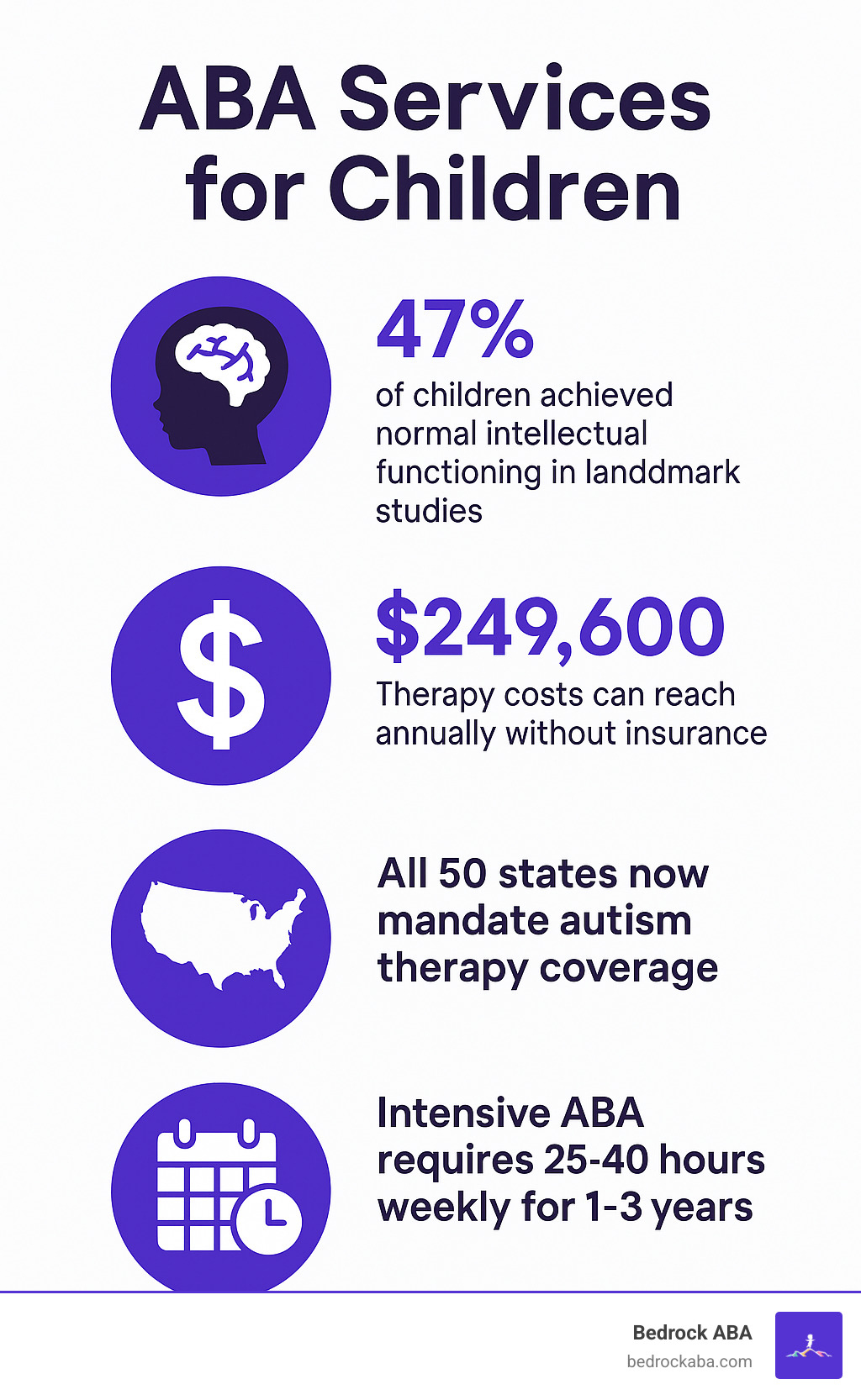
More than 20 studies show that intensive ABA therapy (25-40 hours per week for 1-3 years) improves outcomes in intellectual functioning, language development, and social skills. The US Surgeon General and American Psychological Association recognize ABA as an evidence-based best practice for autism treatment.
As one parent shared: “We were so overwhelmed at the beginning, but your staff helped us get the help we needed so efficiently.”
The challenge? Not all ABA providers are created equal. Some focus only on reducing behaviors without building meaningful skills. Others lack proper family training or use outdated techniques.
Early intervention matters most. ABA therapy shows particularly strong results for children under four years old. But finding the right provider can feel overwhelming when you’re already managing appointments, evaluations, and insurance paperwork.
This guide cuts through the confusion. We’ll show you exactly what to look for, compare different service models, and help you ask the right questions during consultations.
Why This Guide Matters
When you’re searching for ABA services for children, you’re not just choosing a therapy provider—you’re selecting a partner in your child’s development journey. The provider you choose will shape how your child learns to communicate, interact socially, and steer daily routines.
Early intervention creates the foundation for lifelong success. Research shows that children who receive ABA therapy before age four demonstrate significantly better outcomes in language development, social skills, and academic readiness. Every month matters when building these critical neural pathways.
The decision criteria we’ll explore—from BCBA qualifications to family training approaches—directly impact your child’s progress. A provider with strong parent coaching helps you reinforce skills at home, while one with flexible delivery options adapts to your family’s changing needs.
What Makes Great ABA Services for Children
When you’re looking for ABA services for children, you want to find a provider who sees your child as more than just behaviors to modify. The best providers understand that every child is unique, with their own personality, interests, and family dynamics that shape their learning journey.
Quality starts with individualized treatment plans. Exceptional providers never use cookie-cutter approaches. Instead, they spend time getting to know your child through comprehensive assessments, observing how they communicate, play, and interact with the world around them. This deep understanding becomes the foundation for a treatment plan that actually fits your child’s specific needs and your family’s goals.
BCBA supervision makes all the difference. Board Certified Behavior Analysts bring serious expertise to your child’s care. These professionals hold master’s degrees, completed extensive supervised fieldwork, and passed rigorous certification exams. When a BCBA designs your child’s treatment plan, trains the therapy team, and analyzes progress data, you know your child is getting evidence-based care from someone who truly understands ABA principles.
Here’s what really sets great providers apart: they make you part of the team. As one parent beautifully put it, “Parents are a child’s number one teacher.” The most effective programs don’t just work with your child during therapy hours—they teach you how to use ABA strategies during everyday moments. Bath time, meals, and bedtime all become opportunities for your child to practice new skills.
Insurance shouldn’t be a headache. Quality providers understand that navigating Medicaid and private insurance can feel overwhelming when you’re already managing so much. All Medicaid plans must cover medically necessary ABA services for children under 21, and private insurance coverage continues to expand. The best providers handle verification and prior authorization processes, so you can focus on what matters most—your child’s progress.
The Scientific research on ABA effectiveness consistently shows positive outcomes across multiple areas of development. Children make meaningful gains in communication, social relationships, academic skills, and daily living abilities while challenging behaviors decrease. But remember, research outcomes only happen when you find a provider who implements ABA with skill and compassion.
7 Must-Have Features in Any Program
Comprehensive assessment tools should be your first green flag. Look for providers using standardized assessments like ABLLS-R or VB-MAPP. These tools help identify exactly where your child is now and create clear baseline measurements for tracking progress over time.
Positive reinforcement focus means your child should actually enjoy therapy sessions. Modern ABA emphasizes building skills through encouragement and motivation rather than punishment-based approaches. If your child looks forward to therapy and feels proud of their accomplishments, that’s a sign you’ve found the right fit.
Real-time data tracking might sound technical, but it’s incredibly important. Every session should include careful data collection on target behaviors and skills. This information drives treatment decisions and shows you concrete evidence of your child’s progress—something both you and insurance companies will appreciate.
Skill generalization ensures your child can use what they’ve learned everywhere, not just in therapy. Quality programs make sure skills transfer to home, school, and community settings. Your child should be able to use their communication skills at the grocery store, not just in the therapy room.
Meaningful parent collaboration goes beyond occasional check-ins. You should participate in goal setting, receive regular training, and feel confident implementing strategies at home. Your insights about your child’s preferences, challenges, and family routines should directly shape the treatment plan.
Cultural responsiveness means the provider adapts interventions to fit your family’s background, language preferences, and values. Therapy should feel authentic to your child’s identity and respectful of your family’s culture and beliefs.
Ethical practice standards protect your child’s dignity and well-being. All staff should follow the BACB Professional and Ethical Compliance Code, always prioritizing your child’s autonomy and treating them with respect throughout every interaction.
Comparing ABA Delivery Models
| Setting | Best For | Advantages | Considerations |
|---|---|---|---|
| In-Home | Natural environment learning, family involvement | Familiar setting, sibling inclusion, real-world practice | Limited peer interaction, space requirements |
| Center-Based | Structured learning, social skills | Specialized equipment, peer models, controlled environment | Transportation needs, less family involvement |
| School-Based | Academic integration, IEP goals | Classroom application, teacher collaboration | Limited intensity, scheduling constraints |
| Telehealth | Rural access, supplemental support | Flexibility, cost-effective, family coaching | Technology requirements, limited hands-on support |
In-Home ABA Services for Children
In-home therapy leverages your child’s natural environment for skill building. Daily routines become teaching opportunities—practicing communication during snack time, working on independence during morning routines, and building social skills during play.
Caregiver coaching happens in real-time as therapists demonstrate techniques during actual family situations. You learn to implement strategies immediately rather than trying to remember instructions from clinic visits.
Research shows that skills learned in familiar environments generalize more readily to other settings. When your child masters requesting help in their own bedroom, they’re more likely to use that skill at school or grandma’s house.
More info about In-Home ABA Therapy provides detailed guidance on preparing your home environment and maximizing therapy benefits.
Center-Based Programs
Center-based programs offer structured learning environments designed specifically for ABA therapy. Specialized equipment, visual supports, and sensory tools create optimal conditions for skill acquisition.
Peer interaction becomes a natural part of therapy as children practice social skills with age-matched partners. Group activities teach turn-taking, sharing, and cooperative play in ways that individual therapy cannot replicate.
The controlled environment minimizes distractions while maximizing learning opportunities. Therapists can focus entirely on teaching without managing household interruptions or environmental variables.
School-Based ABA Services for Children
School-based ABA services integrate therapeutic goals with educational objectives. BCBAs collaborate with teachers to align intervention strategies with IEP goals, creating seamless support across academic and behavioral domains.
Teacher training ensures consistency between therapy sessions and classroom instruction. When teachers understand ABA principles, they can reinforce skills throughout the school day rather than just during designated therapy times.
Academic readiness skills—sitting appropriately, following directions, participating in group activities—receive targeted attention in the actual classroom environment where they’ll be used.
More info about School-Based ABA Therapy explains how to coordinate services with your child’s educational team.
Telehealth & Hybrid Options
Telehealth expands access to quality ABA services, particularly for families in rural areas or those with transportation challenges. Video modeling allows children to watch themselves practicing skills, enhancing learning through visual feedback.
Parent coaching via telehealth empowers caregivers to implement interventions throughout the week, not just during scheduled visits. Real-time guidance during challenging moments provides immediate support when you need it most.
Hybrid models combine in-person and remote services, offering flexibility as your child’s needs change. Initial assessments might occur in person, followed by regular telehealth check-ins and periodic in-home visits.
More info about ABA Telehealth Therapy details how technology improves traditional therapy approaches.

Professionals, Techniques & Progress Tracking
Understanding professional roles helps you evaluate provider qualifications. BCBAs design treatment plans, supervise implementation, and analyze data to guide clinical decisions. They must maintain continuing education and adhere to strict ethical standards through the Scientific research on certification standards.
Registered Behavior Technicians (RBTs) implement therapy programs under BCBA supervision. They collect data, deliver interventions, and provide direct support to children and families. Quality providers ensure RBTs receive ongoing training and supervision.
The seven dimensions of ABA define quality practice: Applied (socially significant), Behavioral (measurable), Analytic (data-driven), Technological (clearly described), Conceptually Systematic (research-based), Effective (produces meaningful change), and Generality (maintains over time and settings).
Discrete Trial Training (DTT) breaks complex skills into small, teachable steps. Each trial includes a clear instruction, child response, and immediate feedback. This structured approach works particularly well for academic skills and following directions.
Natural Environment Training (NET) embeds learning opportunities within play and daily routines. Children practice skills during preferred activities, making therapy feel less like work and more like fun.
Functional Communication Training teaches children to express needs appropriately rather than through challenging behaviors. A child who previously screamed for attention learns to say “play with me” or use picture cards to communicate.
Behavior data graphs track progress across multiple measures—frequency of target behaviors, percentage of correct responses, and duration of skill practice. Visual representations help families understand their child’s development trajectory.
Measuring Success
Progress measurement begins with baseline data collection before therapy starts. BCBAs document current skill levels and behavioral patterns to establish starting points for intervention.
Weekly data reviews allow for rapid program adjustments. If a child isn’t making expected progress, strategies can be modified immediately rather than waiting for formal reassessments.
Six-month comprehensive evaluations examine progress across all domains—communication, social skills, daily living, and behavioral goals. These formal reviews guide treatment plan updates and goal revisions.
Caregiver feedback provides crucial insights into skill generalization and family satisfaction. Your observations about your child’s behavior at home, school, and in the community inform clinical decision-making.
Addressing Challenging Behaviors
Functional Behavior Assessments (FBAs) identify why challenging behaviors occur before developing intervention plans. Understanding whether a child hits to escape demands, gain attention, or express frustration determines the most effective response strategy.
Replacement skills teaching gives children appropriate ways to meet their needs. Instead of just stopping problem behaviors, quality programs teach functionally equivalent skills that serve the same purpose.
Safety plans protect children, families, and staff during behavioral crises. Clear protocols outline when to implement specific strategies, when to seek additional support, and how to prevent escalation.
Crisis prevention focuses on environmental modifications and early intervention strategies that reduce the likelihood of challenging behaviors occurring in the first place.
Costs, Insurance & Getting Started
State insurance mandates have transformed ABA accessibility. All 50 states now require some level of autism therapy coverage, though specific benefits vary. Private insurance plans must cover medically necessary ABA services when prescribed by qualified physicians.
Medicaid EPSDT (Early and Periodic Screening, Diagnostic and Treatment) provides comprehensive coverage for children under 21. All Medicaid plans must cover medically necessary treatments, including ABA therapy, when prescribed by healthcare providers.
Prior authorization requirements vary by insurance plan but typically require autism diagnosis documentation, physician prescription, and BCBA assessment results. Quality providers handle these administrative processes, reducing family burden.
Without insurance, ABA therapy costs can reach $249,600 annually for intensive programs. This staggering figure underscores the importance of understanding your coverage options and working with in-network providers.
Diagnosis requirements typically include formal autism spectrum disorder evaluation by qualified professionals—psychologists, psychiatrists, or developmental pediatricians. Some providers offer diagnostic services, while others require existing diagnoses before beginning therapy.
Wait-list navigation strategies include contacting multiple providers, expressing interest in cancellation openings, and considering different service delivery models. Telehealth options often have shorter wait times than in-person services.
More info about ABA Therapy Services in Utah provides specific guidance for families in our service area, including local resources and insurance considerations.
Step-by-Step Intake Checklist
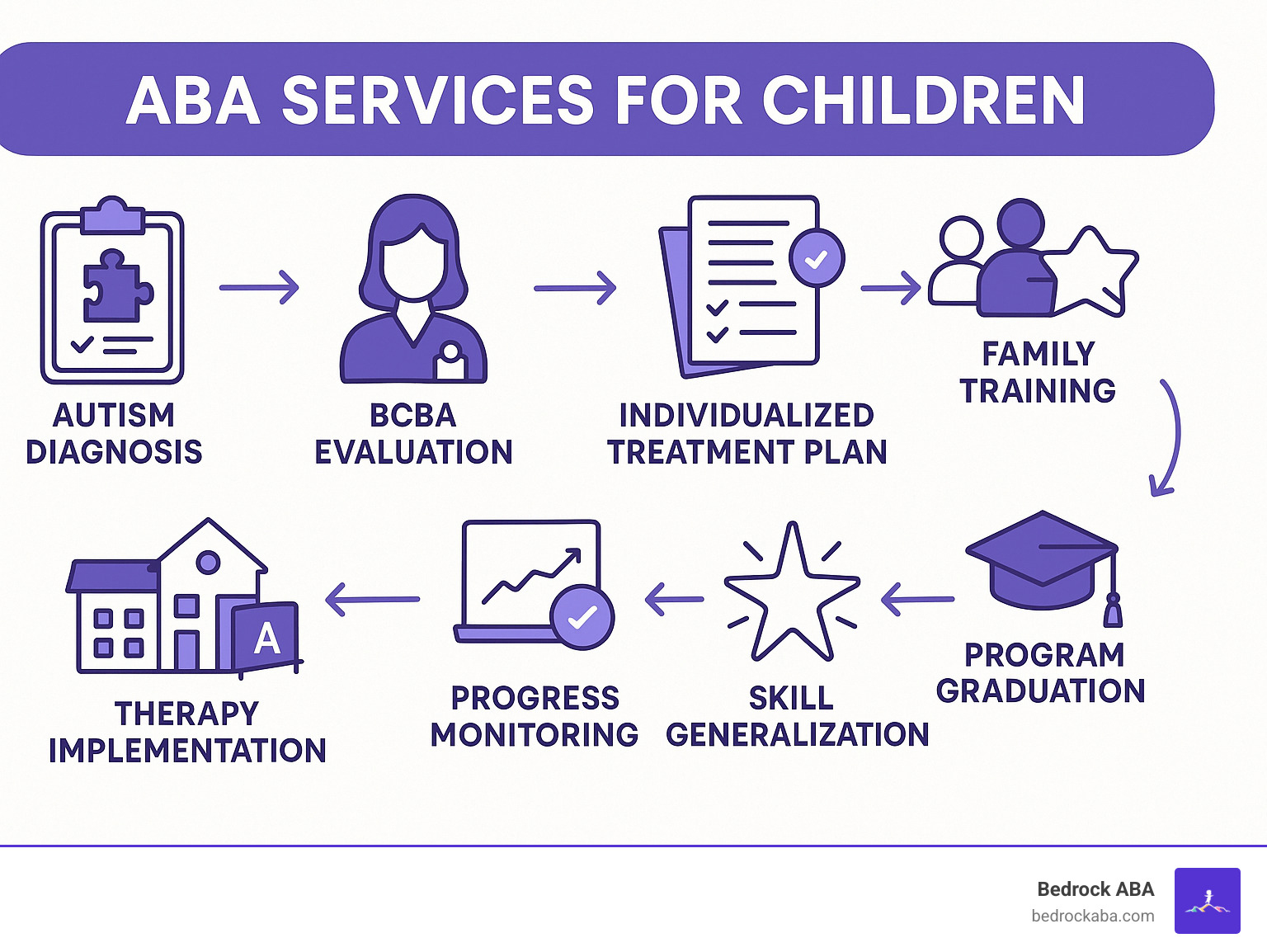
1. Obtain Formal Diagnosis
Secure autism spectrum disorder diagnosis from qualified professional. Gather all evaluation reports and medical documentation for insurance submission.
2. Complete Insurance Benefit Check
Contact your insurance company or ask providers to verify ABA coverage, copayments, deductibles, and prior authorization requirements.
3. Schedule Comprehensive Assessment
BCBA conducts detailed evaluation using standardized tools, direct observation, and family interviews to identify treatment goals.
4. Launch Therapy Services
Begin with reduced hours to allow your child to adjust, gradually increasing intensity based on tolerance and progress.
5. Establish Ongoing Supervision
Regular BCBA oversight ensures program effectiveness, staff competency, and family satisfaction throughout treatment.
Frequently Asked Questions about ABA Services for Children
How many hours of therapy does my child really need?
This question keeps many parents awake at night, and honestly, there’s no one-size-fits-all answer. Research shows that intensive intervention of 25 to 40 hours weekly for 1-3 years produces the strongest outcomes, but your child’s individual needs matter more than any study.
Think about it this way: a three-year-old just diagnosed might thrive with 15-20 hours weekly to start. You don’t want to overwhelm them right out of the gate. As they get comfortable with therapy and show they’re ready for more, you can gradually increase hours.
School-age children often need a different approach entirely. They might benefit from 10-25 hours of focused ABA services for children** targeting specific challenges like communication or behavioral goals. After all, they’re already spending 30+ hours weekly in school.
Your BCBA becomes your guide here. They’ll look at your child’s assessment results, your family’s realistic capacity, and what you’re hoping to achieve. A well-designed 20-hour program with strong family involvement often beats a poorly planned 40-hour program where everyone feels burned out.
Quality trumps quantity every time. It’s better to have fewer hours of excellent, targeted therapy than more hours of generic programming.
Is ABA only for autism, or can other conditions benefit?
While ABA services for children are most famous for autism treatment, the techniques help kids with many different challenges. The core principles—positive reinforcement, breaking skills into manageable steps, and using data to track progress—work beautifully for various conditions.
Children with ADHD often benefit from ABA strategies for improving focus and following directions. Kids with anxiety disorders can learn coping skills and gradually face their fears through systematic approaches. Even children recovering from traumatic brain injuries use ABA techniques to relearn daily living skills.
We’ve seen success with children who have sensory processing disorders, intellectual disabilities, and communication delays. The beauty of ABA lies in its flexibility—the same principles adapt to whatever challenges your child faces.
Here’s the catch though: insurance coverage varies significantly. An autism spectrum disorder diagnosis typically guarantees coverage under state mandates, while other conditions might require more documentation or advocacy. Some families find themselves fighting harder for approval when autism isn’t the primary diagnosis.
The good news? Many providers are expanding their expertise beyond autism, recognizing that effective behavioral strategies benefit all children who need extra support.
What questions should I ask a potential provider before enrolling?
Walking into that first consultation can feel overwhelming, especially when you’re already managing so much. But asking the right questions upfront saves heartache later and helps you find the perfect fit for your family.
Start with the basics about BCBA qualifications and supervision. How many board-certified behavior analysts work on staff? What’s their experience level? Most importantly, what’s the BCBA-to-client ratio? You want to ensure your child gets adequate oversight, not just occasional check-ins.
Dig into their assessment and treatment approach. Which standardized tools do they use for initial evaluations? How do they involve families in setting goals? What’s their philosophy on challenging behaviors—do they focus on punishment or building replacement skills?
Family involvement separates great providers from mediocre ones. Ask how often they provide parent training and whether it’s included in your coverage. Find out if they adapt their approach to your family’s cultural background and values.
Don’t forget the practical stuff: insurance acceptance, wait list length, and staff turnover rates. High staff turnover disrupts your child’s progress and creates unnecessary stress for everyone.
Finally, ask for references from current families. Any provider worth considering will happily connect you with parents who can share their real experiences. Trust your gut—if something feels off during the consultation, keep looking. The right provider will welcome your questions and make you feel confident about moving forward.
Conclusion
Finding the right ABA services for children isn’t just about choosing a therapy provider—it’s about finding a partner who truly understands your family’s unique journey. Every child deserves care that celebrates their individual strengths while gently guiding them toward new possibilities.
At Bedrock ABA, we’ve learned that the most meaningful progress happens when therapy feels natural and joyful. That’s why our flexible, family-centered approach adapts to what works best for your child, whether that’s learning new skills during playtime at home, practicing social interactions in our welcoming center, or combining different settings as your child grows.
We know that you understand your child better than anyone else. Our comprehensive parent training ensures you never feel alone in this journey. When you feel confident using ABA strategies during everyday moments—from breakfast conversations to bedtime routines—your child’s learning accelerates in ways that surprise and delight families.
Our team brings both clinical expertise and genuine heart to every session. We’re the people who cheer when your child says their first word, who brainstorm creative solutions when challenges arise, and who remind you to celebrate progress that might seem small but represents huge victories for your family.
Right here in Salt Lake City, Utah, we’re honored to serve families throughout our community with personalized therapy that evolves alongside your child’s changing needs. More info about ABA Therapy Services in Utah shares more about how we support local families and connect you with additional resources.
Your child’s potential stretches far beyond what anyone can predict today. The right ABA provider doesn’t just teach skills—they help open up the confident, capable person your child is becoming through skilled intervention, genuine partnership, and unwavering belief in what’s possible.

Ready to take the next step? Contact us today to schedule a consultation and find how Bedrock ABA can support your family’s journey toward meaningful progress and lasting success.