


Why Understanding ABA Therapy’s Benefits and Drawbacks Matters
ABA therapy pros and cons spark heated debates among parents, professionals, and autism advocates. With roughly 1 in 44 children diagnosed with autism spectrum disorder in the U.S., understanding this widely-used treatment is crucial for making informed decisions.
Quick Answer: ABA Therapy Pros and Cons
| Pros | Cons |
|---|---|
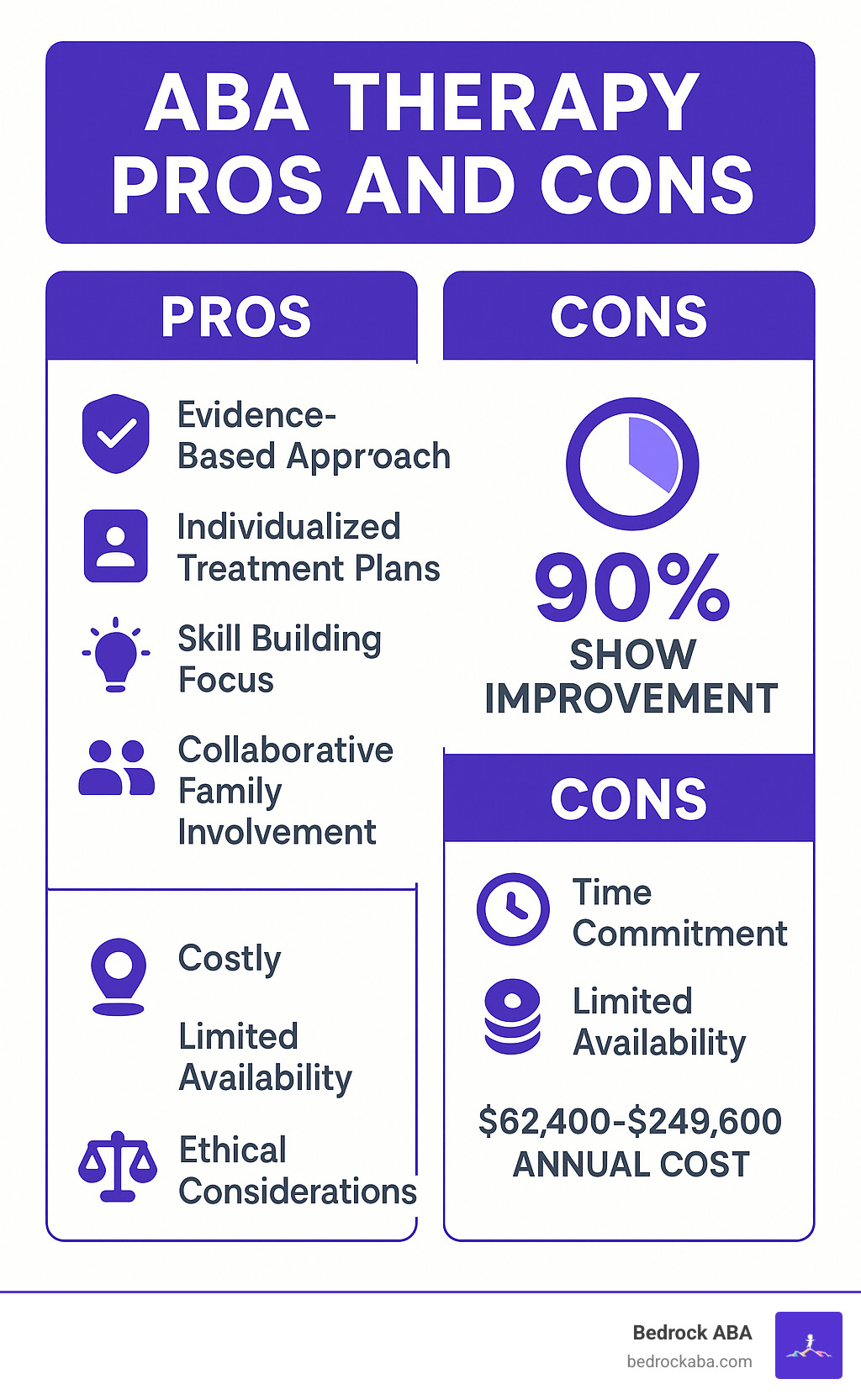
| • Evidence-based with decades of research | • High cost ($62,400-$249,600 annually) |
| • Individualized to each child’s needs | • Time-intensive (10-40 hours weekly) |
| • Improves communication and daily skills | • Limited therapist availability in some areas |
| • Teaches parents techniques to use at home | • Ethical concerns about compliance focus |
| • Covered by most insurance plans | • Results vary significantly between children |
Applied Behavior Analysis uses positive reinforcement and data-driven methods to help children with autism develop new skills and reduce challenging behaviors. The therapy has evolved significantly from its early days – modern ABA focuses on play-based learning rather than rigid table work.
Yet controversy remains. Some autism self-advocates argue that ABA tries to make autistic children “indistinguishable from peers” rather than celebrating neurodiversity. Others credit ABA with giving their children communication tools and independence they never thought possible.
The reality? ABA isn’t simply a hero or villain – it’s a complex intervention with real benefits and legitimate concerns.
As one parent shared: “ABA helped my son learn to express his needs instead of having meltdowns. But we had to find the right therapist who respected his personality.”
ABA Therapy 101: Foundations & Program Structure
Understanding ABA therapy pros and cons starts with grasping how this treatment actually works. At its heart, ABA therapy uses a simple but powerful principle called operant conditioning – when good things happen after a behavior, that behavior is more likely to happen again.
Think of it like this: when your child says “please” and gets what they want, they learn that polite words work better than whining. ABA takes this natural learning process and applies it systematically to help children develop new skills.
Discrete Trial Training (DTT) breaks down complex skills into bite-sized pieces. Instead of overwhelming a child by teaching all colors at once, a therapist might start with just red versus blue blocks. Once the child masters that, they gradually add more colors. It’s like learning to walk before you run.
Natural Environment Teaching (NET) brings learning into everyday moments. Rather than sitting at a table with flashcards, children might practice counting while putting away toys or learn social skills during snack time. This approach feels more like play than work – which is exactly the point.
Early intervention makes a huge difference in outcomes. Children who start ABA before age 4 often show the most dramatic improvements because their young brains are incredibly adaptable. Every month matters when it comes to building those crucial early skills.
Modern ABA programs require oversight from Board Certified Behavior Analysts (BCBAs) – professionals with master’s degrees who’ve passed rigorous national exams. These experts design individualized treatment plans and train the Registered Behavior Technicians (RBTs) who work directly with your child.
Therapy settings each offer unique advantages. In-home therapy lets children practice skills in their natural environment with family nearby, though it can sometimes have distractions. Center-based programs provide structured environments and opportunities for peer interaction, but require travel time. Telehealth options increase access for families in remote areas and offer flexible scheduling, though they may have technology limitations.
Most programs recommend between 10-40 hours of therapy weekly, though the right “dosage” depends entirely on your child’s individual needs. While early research suggested 40 hours was necessary, newer studies show that even 20 hours or less can produce meaningful results for many children.
More info about ABA services for children
Scientific research on ABA basics
Assessments & Individualized Plans
Every successful ABA program begins with a thorough Functional Behavior Assessment (FBA). This isn’t a quick checklist – BCBAs spend time observing your child across different environments, identifying what triggers challenging behaviors, and finding their unique strengths and interests.
The beauty of this assessment lies in its individualized approach. No two children are exactly alike, so no two ABA programs should be identical either. Your child’s plan reflects their specific needs, your family’s priorities, and their natural learning style.
From this assessment comes measurable, specific goals. Instead of vague objectives like “improve communication,” ABA targets concrete behaviors: “Child will request preferred items using two-word phrases in 8 out of 10 opportunities.” This precision allows everyone to track progress clearly and celebrate real achievements.
BCBA oversight ensures your child receives quality, ethical treatment. These professionals review data weekly, adjust strategies based on what’s working, and train families to support learning at home. They also serve as advocates, helping families steer insurance coverage and school systems.
More info about key principles
Parent & Caregiver Training
One of ABA’s greatest strengths is how it empowers families. Parent training isn’t just a nice add-on – it’s essential for helping skills transfer from therapy sessions into real life.
Consider a child learning to ask for help during therapy. They might master saying “help please” when working on puzzles with their therapist. But without parent training, they might still have meltdowns at home when they get frustrated with toys. ABA teaches families to recognize these teachable moments and respond consistently.
Home reinforcement extends learning far beyond therapy hours. Parents find how to turn daily routines – getting dressed, eating meals, bath time – into natural teaching opportunities. This approach makes progress feel organic rather than forced or clinical.
Data tracking might sound intimidating at first, but modern tools make it surprisingly manageable. Simple smartphone apps allow parents to record behaviors and celebrate small victories. This information helps BCBAs fine-tune programs and gives families concrete proof of their child’s growth over time.
The generalization of skills across different people and environments is what makes ABA truly effective. When parents use the same positive reinforcement strategies as therapists, children learn that good behaviors work everywhere – not just during therapy sessions.
More info about the role of a certified ABA therapist
ABA Therapy Pros and Cons

When families first hear about ABA therapy, they often want a simple answer: Does it work or doesn’t it? The truth about ABA therapy pros and cons is more nuanced than a yes-or-no response. Like most meaningful interventions, ABA comes with significant benefits alongside real challenges that families need to understand.
The research tells a compelling story. A comprehensive 2012 review examining 14 randomized controlled trials found meaningful improvements across autism symptoms for many children. The landmark 1987 Lovaas study remains influential, showing that 90% of participants made significant progress, with nearly half reaching skill levels similar to their peers.
But here’s what the statistics don’t capture: the individual experiences vary dramatically. One family might see their non-speaking child develop functional communication within months. Another might invest years of intensive therapy with minimal visible progress. This isn’t a reflection of ABA’s quality – it’s the reality of autism’s complexity.
Modern ABA emphasizes positive reinforcement over the harsh methods sometimes used decades ago. Today’s sessions often look like structured play, with children earning access to preferred activities through learning new skills. Many kids actually look forward to their therapy time, especially when therapists tap into their special interests.
The time commitment and financial burden represent perhaps the biggest problems families face. Recommended therapy intensities can feel overwhelming when you’re already juggling medical appointments, school meetings, and the daily demands of raising a child with autism. Annual costs potentially reaching $249,600 can strain even well-insured families, despite insurance coverage mandates in all 50 states.
Service availability creates another real barrier. Rural families often face impossible choices between long commutes and inadequate local services. Even in cities, waiting lists for quality providers can delay critical early intervention when it matters most.
The client voice and neurodiversity perspectives add crucial depth to these discussions. Some autistic adults credit ABA with teaching them essential life skills and communication tools. Others describe feeling pressured to suppress natural behaviors that help them self-regulate. These diverse experiences remind us that respectful, individualized approaches matter enormously.
Top Pros within aba therapy pros and cons
Evidence-based research foundation gives ABA a solid scientific backing that few other autism interventions can match. Since the 1970s, hundreds of studies have documented its effectiveness. This research base not only helps families make informed decisions but also supports insurance coverage battles.
Individualized treatment plans mean no cookie-cutter approaches. A child obsessed with dinosaurs might learn math through counting prehistoric creatures, while another practices social skills through their favorite video games. BCBAs design programs around each child’s unique interests, challenges, and family culture.
Parent empowerment through training transforms entire families, not just the child receiving therapy. Parents learn to recognize what triggers challenging behaviors and respond with effective strategies. This knowledge extends far beyond therapy sessions, improving daily life and reducing family stress.
Long-term skill maintenance shows impressive staying power in follow-up studies. Over 90% of children maintained significant gains five years after completing intensive programs. These aren’t temporary improvements that fade – they represent lasting changes that support independence throughout life.
Improved peer integration often improves school performance and friendships. Children learn classroom routines, appropriate social interactions, and academic foundations that support success in mainstream education. Many families report fewer behavioral incidents and more positive school experiences.
More info about advantages of ABA
Notable Cons within aba therapy pros and cons
High financial costs can overwhelm families even with insurance coverage. Hourly rates of $120-$150 multiply quickly when you need 20-40 hours weekly. Copays, deductibles, and services that fall outside coverage create additional financial pressure. Some families exhaust savings or take on debt to continue treatment.
Intensive scheduling demands can consume family life entirely. When therapy requires 30+ hours weekly, families describe feeling like their entire schedule revolves around ABA appointments. This leaves little time for other activities, family relationships, or simply letting kids be kids.
Potential emphasis on compliance concerns some autism advocates who worry about suppressing natural autistic behaviors. Some programs inadvertently discourage helpful self-regulation strategies like stimming, focusing more on appearing “normal” than supporting authentic self-expression.
Limited availability in many areas particularly affects rural families who may drive hours for quality services or settle for inadequate local options. Even urban areas often have long waiting lists for experienced providers, delaying critical early intervention.
Variable and unpredictable results mean some children show minimal progress despite intensive, well-implemented programs. Predicting which children will benefit most remains challenging, leaving some families disappointed and financially drained after months or years of treatment.
Scientific research on concerns
Ethical Debates, Evolution & Alternative Treatments
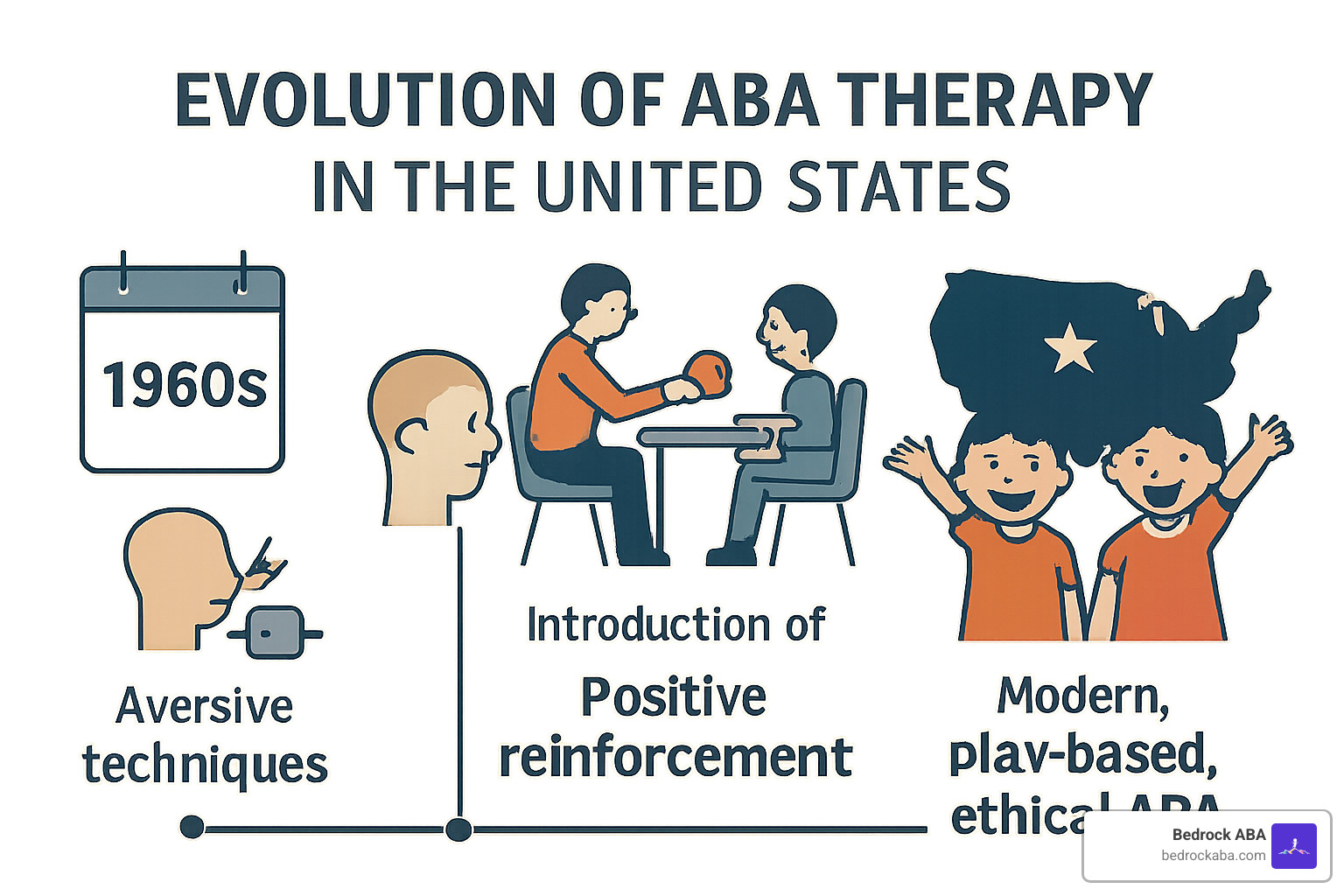
The story of ABA therapy includes some dark chapters that still shape today’s heated debates about ABA therapy pros and cons. Back in the 1960s, early programs used shocking methods – literally. Electric shocks, physical punishment, and other harsh techniques were mixed with positive reinforcement in misguided attempts to change behavior.
These harmful practices, now completely banned, left deep scars on some participants and their families. They also created lasting distrust that influences autism advocacy today. It’s no wonder some people view ABA with suspicion when they hear these historical accounts.
Modern ABA looks nothing like those early programs. Today’s therapy centers on positive reinforcement, child-led play, and genuine respect for each person’s unique qualities. Professional ethics codes strictly forbid any aversive techniques, and behavior analysts receive extensive training in respectful, effective methods.
Yet ethical concerns haven’t disappeared entirely. Some autistic adults describe feeling like their true selves were discouraged in favor of appearing “normal.” Ido Kedar, an autistic author, powerfully described traditional ABA drills as feeling trapped while others ignored his inner thoughts and intelligence.
This raises profound questions: Should therapy help autistic children blend into typical society, or should it celebrate their differences while teaching useful skills? The compliance versus authenticity debate reflects this core tension. Most modern programs lean heavily toward honoring authenticity, though quality varies between providers.
The field continues evolving as professionals listen to these important voices. Rigid table work gives way to natural play-based learning. Therapists now incorporate children’s special interests and respect their unique communication styles. The old goal of making children “indistinguishable from peers” has shifted toward helping each child reach their fullest potential.
Alternative treatments offer different philosophical approaches that some families prefer or combine with ABA. DIR/Floortime follows each child’s natural interests during play, emphasizing emotional connections over behavior change. TEACCH creates visual supports and structured environments that work with autistic learning styles rather than against them.
Cognitive Behavioral Therapy helps older children and teens understand their emotions and thoughts – particularly valuable for managing anxiety and social challenges. Occupational therapy addresses sensory differences and daily skills through a developmental approach that feels more natural to many families.
Many families find success mixing approaches – perhaps using ABA for specific communication goals while incorporating occupational therapy for sensory needs. There’s no rule saying you must choose just one path.
More info about different ABA techniques
Scientific research on ethical guidelines
Frequently Asked Questions about ABA Therapy Pros and Cons
What is the average success rate of ABA therapy?
When families ask about ABA therapy pros and cons, success rates often top their list of concerns. The answer isn’t as straightforward as we’d all like it to be.
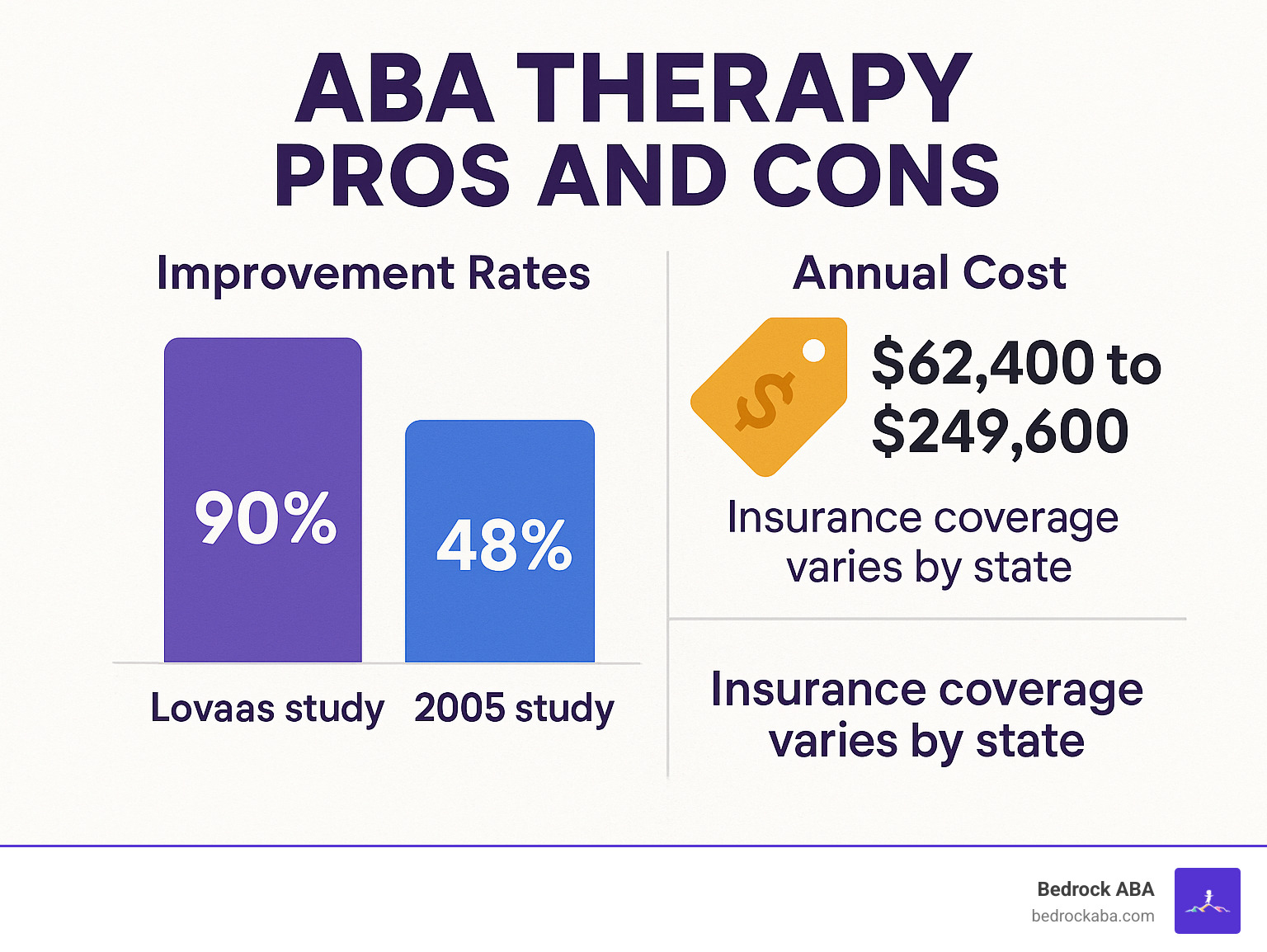
The famous 1987 Lovaas study set high expectations – reporting that 90% of children showed significant improvement after intensive ABA, with nearly half achieving what researchers called “normal functioning.” These numbers sound incredible, and they sparked decades of hope for families.
But here’s the reality: more recent research tells a more nuanced story. A comprehensive 2012 review looking at 555 children found small to medium improvements across different skill areas. Another study from 2005 showed that 48% of children had remarkable progress after four years of therapy.
The encouraging news? Long-term follow-up studies reveal that over 90% of children maintain their gains five years after completing therapy. That’s pretty remarkable – it means the skills they learn tend to stick around.
What these statistics don’t capture is how differently each child responds. Some families watch their previously non-speaking child develop rich communication skills. Others see gradual improvements in daily routines and social interactions. And yes, some families experience minimal progress despite months of dedicated effort.
Success depends on several key factors:
Age matters tremendously – children who start ABA before age 4 typically see more dramatic improvements. The quality and intensity of therapy also play crucial roles, along with family involvement and how consistently strategies are used at home.
Your child’s unique characteristics, motivation level, and any additional medical conditions all influence outcomes too. There’s no crystal ball to predict exactly how your child will respond, which can feel frustrating when you’re making such a significant decision.
How much does ABA therapy cost and who pays for it?
Let’s talk money – because the financial reality of ABA therapy is something every family needs to understand upfront.
The numbers can feel overwhelming. ABA therapy typically costs between $120-$150 per hour. With recommended therapy ranging from 10-40 hours weekly, you’re looking at $1,200 to $4,800 per week. That translates to annual costs between $62,400 and $249,600.
Before you panic, here’s the good news: all 50 states now mandate insurance coverage for autism treatments, including ABA therapy. This represents a huge victory for families who previously faced these costs entirely out-of-pocket.
Insurance coverage varies significantly though. Some plans cover unlimited hours when therapy is deemed medically necessary. Others cap coverage at 20 hours weekly. Most require prior authorization, which means your BCBA will need to submit detailed treatment plans and progress reports.
You’ll still likely face copays, deductibles, and some uncovered expenses. Many families report spending several thousand dollars annually even with good insurance coverage.
Additional funding sources can help fill gaps. Medicaid often provides comprehensive coverage for eligible families. Some states offer supplemental autism funding programs. Private foundations and organizations provide limited grant assistance, though competition is intense.
Flexible Spending Accounts can help with uncovered expenses by using pre-tax dollars for qualified medical costs.
Here’s something many families don’t expect: you’ll become an insurance expert. Learning to steer appeals processes, prior authorization requirements, and provider networks becomes part of the journey. The silver lining? Most quality ABA providers offer administrative support to help with insurance approvals.
Are there effective alternatives if ABA is not a good fit?
Absolutely – and this is where understanding ABA therapy pros and cons becomes really important. ABA isn’t the only path forward for children with autism.
DIR/Floortime takes a completely different approach. Instead of structured behavior modification, it follows your child’s lead in natural play interactions. The focus shifts to emotional connection and developmental stages. Research shows real improvements in social engagement and communication, especially for children who thrive in relationship-based learning.
Speech-Language Therapy directly tackles communication challenges through various methods. Some children flourish with Picture Exchange Communication Systems (PECS), while others benefit from sign language instruction or assistive technology training. The beauty lies in finding what clicks for your specific child.
Social Skills Groups offer something ABA sometimes misses – natural peer interaction. These structured programs teach friendship skills and conversation techniques through games and activities. Many children who struggle in one-on-one therapy settings come alive in group environments.
Occupational Therapy addresses the sensory processing differences that often accompany autism. OTs help children develop fine motor skills, sensory regulation strategies, and independence in daily tasks like getting dressed or eating meals.
TEACCH uses visual supports and structured environments to accommodate autistic learning styles rather than trying to change core behaviors. This approach celebrates neurodiversity while building practical skills.
Many families find that combining multiple approaches works best. Your child might receive speech therapy for communication needs, occupational therapy for sensory challenges, and social skills groups for peer interaction – creating a comprehensive support system without traditional ABA.
The key is finding approaches that respect your child’s unique neurodiversity while building practical skills for independence and happiness. What matters most isn’t following a specific therapy model, but finding what helps your child thrive.
Conclusion
Making decisions about ABA therapy pros and cons feels overwhelming – and that’s completely normal. You’re weighing research studies against real family experiences, balancing hope with practical concerns, and trying to predict what might work for your unique child.
The evidence shows ABA can create meaningful change for many children. Decades of research demonstrate improvements in communication, social skills, and independence. Yet every family’s story unfolds differently. Some parents describe ABA as life-changing, helping their children express needs and connect with others. Others find the approach doesn’t match their child’s learning style or family values.
Modern ABA looks nothing like the rigid programs of the past. Today’s therapy emphasizes play, follows children’s interests, and respects their natural ways of being. But quality still varies between providers. The therapist who celebrates your child’s stimming while teaching new skills creates a vastly different experience than one focused solely on compliance.
Your family’s values matter most in this decision. Some parents prioritize intensive skill-building to maximize independence. Others prefer gentler approaches that honor neurodiversity while addressing specific challenges. Neither choice is right or wrong – they simply reflect different priorities and circumstances.
Consider what feels authentic for your family. Does your child thrive with structure and clear expectations? Can you realistically manage 20+ hours of weekly therapy alongside work, school, and family time? Do local providers demonstrate genuine respect for autistic children? These practical questions matter as much as research statistics.
Professional guidance helps steer these complex choices. Developmental pediatricians, BCBAs, and experienced families can share insights about local providers and alternative approaches. Don’t hesitate to interview potential therapists or observe sessions before committing.
No intervention works for every child. Some families find tremendous success with ABA. Others find their child flourishes with speech therapy, occupational therapy, or different educational approaches. The goal isn’t finding the “perfect” solution – it’s finding what helps your child grow while staying true to themselves.
At Bedrock ABA, we understand these aren’t easy decisions. Our approach centers on your family’s needs and your child’s unique personality. Whether you choose traditional sessions, telehealth options, or a combination approach, we’re here to support your journey with flexibility and genuine care.
Trust your instincts. You know your child better than any research study or expert opinion. Gather information, ask questions, and make choices that feel right for your family. The autism support landscape offers more options than ever before, and the best therapy is simply the one that helps your child thrive.