


Why ABA Therapy at Home Is Changing Family Life
ABA therapy at home is changing how families support children with autism by bringing evidence-based strategies directly into daily routines. Instead of waiting for center appointments, parents can now integrate proven behavioral techniques into mealtimes, bedtime, and play sessions.
Key Benefits of Home-Based ABA:
- Natural Learning Environment – Skills practiced where they’re actually used
- Family Involvement – Parents and siblings become part of the therapy team
- Flexible Scheduling – Sessions fit around your family’s routine
- Daily Living Focus – Target real-world skills like dressing, eating, and communication
- Reduced Transitions – No travel stress or unfamiliar settings
Research shows that up to 71% of children in play therapy experience positive change, and home-based programs can provide the natural environment needed for skills to stick. As one parent shared: “Andrew had zero words at Halloween 2000; after one year of home ABA he spoke over 200 words.”
I’m Mayer Kulefsky, Director of Operations at Bedrock ABA, and I’ve seen how ABA therapy at home empowers families to become active partners in their child’s growth. Through our work expanding services across multiple states, I’ve witnessed the profound impact that family-centered approaches can have on both children and their caregivers.
Aba therapy at home glossary:
Understanding ABA Therapy Fundamentals
ABA therapy at home is a science-backed approach that transforms how families support their children with autism. Applied Behavior Analysis works because it’s built on how we all naturally learn through positive reinforcement.
Picture this: Your child says “please” when asking for their favorite snack. You smile, praise them, and hand over the treat. That positive response makes it more likely they’ll use polite language next time.
The ABC model helps us understand behavior patterns. Every behavior has three parts: what happens before (antecedent), the actual behavior, and what follows (consequence). Understanding this pattern helps families make small changes that lead to big improvements.
Discrete trial training breaks complex skills into bite-sized pieces, while naturalistic teaching weaves learning into everyday moments. Your child might practice counting while setting the table or work on communication during playtime.
Evidence-based research consistently shows that intensive ABA therapy improves outcomes for many children with autism. The US Surgeon General and American Psychological Association recognize ABA as a best practice treatment. Scientific research on ABA effectiveness demonstrates meaningful gains in communication, daily living skills, and social functioning.
How ABA Works Step-by-Step
Assessment begins with getting to know your child and family. Your BCBA will observe your child during typical routines and identify strengths to build from.
Goal setting transforms observations into specific targets like “requests favorite activities using two-word phrases during 8 out of 10 opportunities.”
Data collection tracks progress through systematic recording, while skill generalization ensures abilities transfer across different people and situations.
Who Delivers Quality ABA Care
Board Certified Behavior Analysts (BCBAs) lead your child’s program with master’s-level education and extensive training. Registered Behavior Technicians (RBTs) provide direct therapy under BCBA supervision.
Ongoing supervision ensures therapy quality through regular observation and feedback. At Bedrock ABA, our team members meet the highest professional standards. More info about services
Why Choose ABA Therapy at Home
When families first consider ABA therapy at home, they often wonder if it’s really as effective as center-based programs. The answer is yes – and in many ways, home-based therapy can be even more powerful.
Family involvement becomes natural when therapy happens in your living room. Your child’s siblings can join in games that teach turn-taking. Grandparents can practice new communication strategies during visits. Research consistently shows that parental involvement is the single most important factor in successful early intervention programs.
The natural environment of your home provides learning opportunities that can’t be replicated elsewhere. When your child practices asking for help during actual homework time, these skills stick because they’re already happening in real life.
Daily living skills take center stage in home programs. Your child learns to brush teeth at their own bathroom sink and gets dressed in their familiar bedroom. These aren’t simulated activities – they’re the actual skills your child needs every day.
The convenience factor eliminates rushing to appointments during traffic and disrupted schedules. Flexible scheduling means therapy adapts to your family’s rhythm, not the other way around.
Reduced transitions benefit children who find changes stressful, while sibling participation creates authentic opportunities for social skill development.
| Home-Based ABA | Center-Based ABA |
|---|---|
| Natural environment for skill practice | Structured clinical setting |
| Family involvement throughout the day | Limited family participation |
| Flexible scheduling around family needs | Fixed appointment times |
| Sibling interaction opportunities | Primarily peer interactions |
| Daily living skills in real context | Simulated daily living activities |
| Reduced travel and transition stress | Regular transitions to/from center |
Benefits Over Center-Based Services
Generalization happens automatically because there’s no gap between learning and application. Parent coaching becomes incredibly effective when it happens in real-time during actual family situations.
Motivation boosters are everywhere in your home environment. Your child’s favorite stuffed animal or access to the backyard swing can serve as powerful reinforcers.
Potential Challenges & Solutions
Space limitations don’t require a dedicated therapy room – a corner of the living room works beautifully. Caregiver burnout requires establishing clear boundaries and remembering that taking breaks is necessary.
Privacy concerns and scheduling conflicts can be addressed by discussing expectations upfront and working closely with your BCBA to develop a supportive schedule.
Setting Up for Successful ABA Therapy at Home

Creating an effective home therapy environment doesn’t require major renovations. The beauty of ABA therapy at home lies in changing ordinary spaces into powerful learning environments with thoughtful adjustments.
More info about In-Home ABA Therapy
Preparing Your Environment
Choose a consistent room or area where therapy activities will happen. Many families successfully use a corner of the living room or dining room section.
Organizing materials in clear storage boxes or labeled bins keeps therapy supplies separate from everyday toys. Storing reinforcers strategically in a locked cabinet or high shelf maintains their motivational power.
Many children benefit from sensory supports like noise-canceling headphones or fidget tools kept in a small basket.
Creating the Daily Session Flow
Establish an arrival routine like putting on a special therapy shirt or reviewing the visual schedule. Start with a warm-up activity your child enjoys to build positive momentum.
Break sessions into skill blocks with built-in breaks between activities. End with a clean-up routine that teaches responsibility and provides closure.
Proven Techniques & Daily Routine Integration
The magic of ABA therapy at home happens when proven strategies become a natural part of your family’s day. These techniques transform ordinary moments into powerful learning opportunities.
Positive reinforcement forms the foundation – that enthusiastic “Great job!” needs to happen the instant your child attempts something new. Modeling works because children are natural mimics. Task analysis breaks big skills into bite-sized pieces.
Visual supports make expectations clear, while Natural Environment Teaching embeds learning everywhere. Pivotal Response Training focuses on skills that open up other skills.
Morning & Self-Care Routines
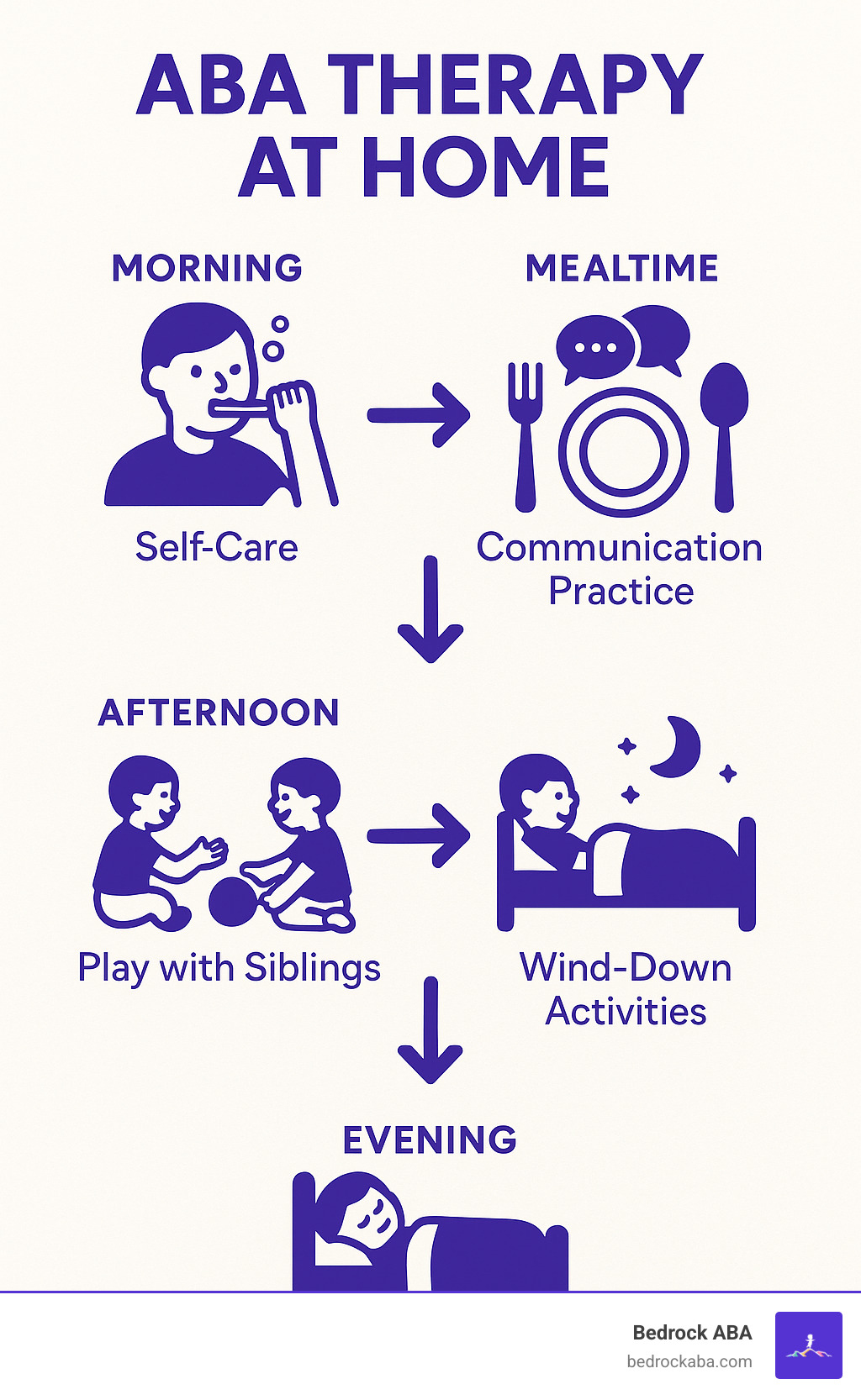
Tooth-brushing becomes manageable with visual schedules showing each step. Dressing skills develop through systematic practice using backward chaining – help with most of the task but let your child complete the final step independently.
Prompting hierarchy guides your approach from physical prompts to independence, while fading involves gradually reducing support as skills develop.
Play & Communication
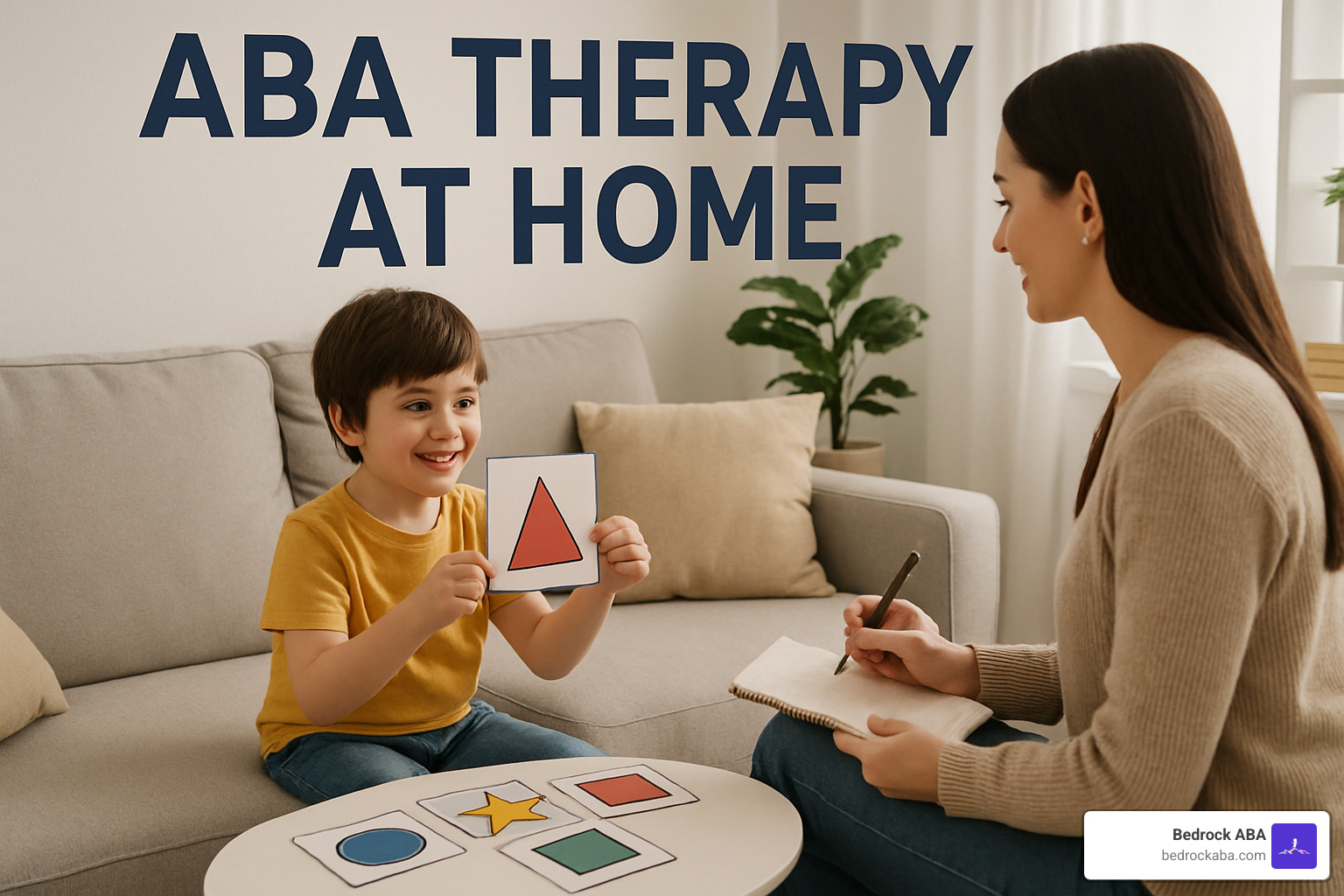
Mand training teaches your child to request what they want. Social turn-taking develops through board games and building blocks. Sibling play scripts help children engage meaningfully with brothers and sisters.
Token boards make abstract concepts concrete and visual.
Evening Wind-Down Strategies
Dinner requests transform mealtime into communication practice. Chore completion teaches responsibility while building task completion skills. Bedtime visuals help children understand evening sequences.
More info about ABA Therapy for Parents
Tracking Progress, Collaboration & Funding
Success with ABA therapy at home depends on knowing what’s working and staying connected with your professional team. Simple tracking methods provide powerful insights into your child’s progress.
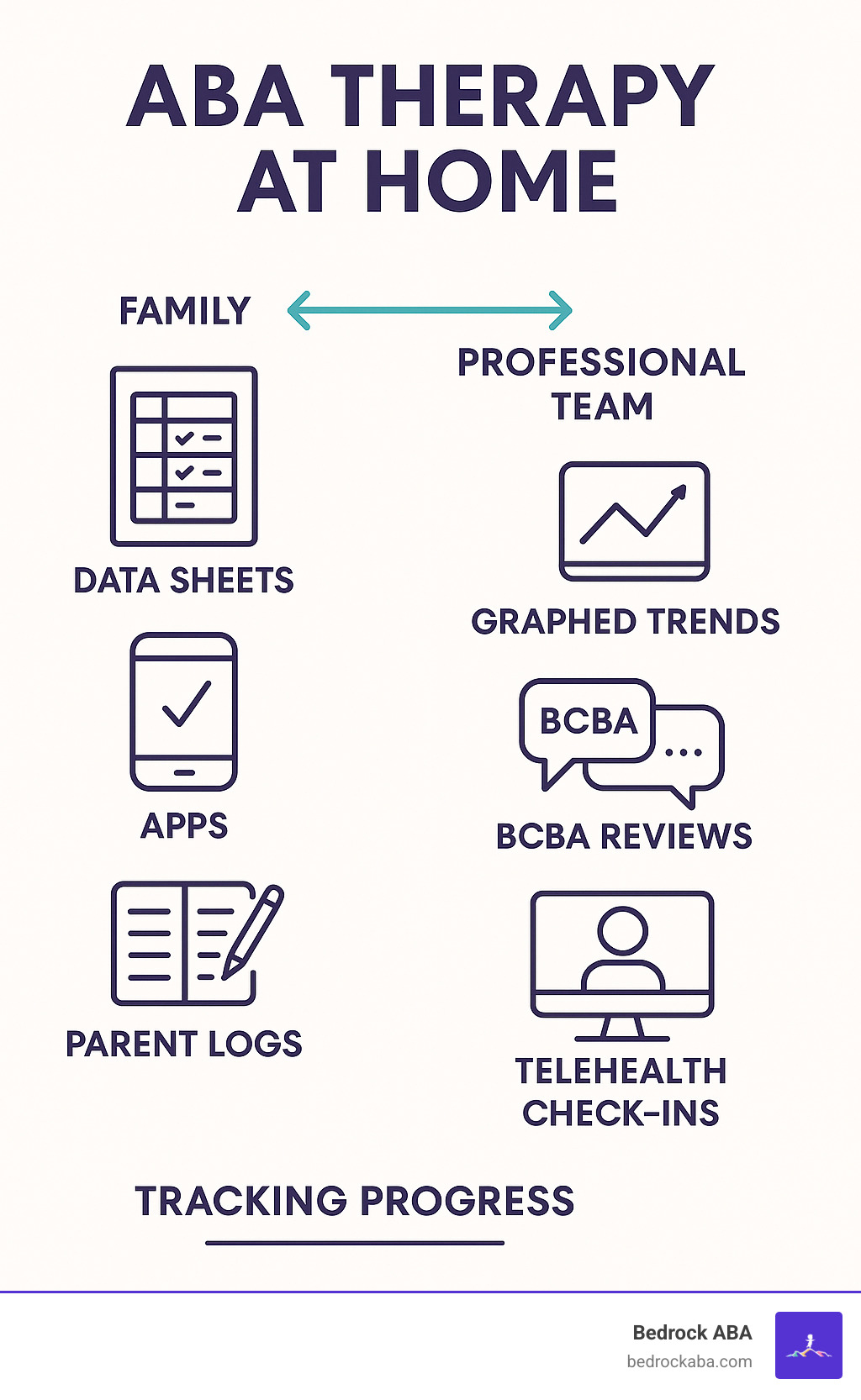
Data sheets work best when simple – a basic plus/minus system gives your BCBA valuable information. Apps designed for ABA can make tracking feel natural, creating graphed trends automatically.
BCBA reviews should feel like productive conversations. Parent logs capture context behind the numbers. Telehealth check-ins allow your BCBA to observe sessions remotely and provide real-time coaching.
Scientific research on parent training confirms that parent-implemented interventions can be highly effective when supported by professional guidance.
Insurance mandates vary by state, but many private insurers must cover ABA services. State waivers may provide additional funding for qualifying families.
More info about ABA Telehealth Therapy
Measuring Skill Acquisition
Frequency counts track how often positive behaviors happen. Task probes show whether your child can perform skills independently. Mastery criteria define what success looks like, while maintenance checks ensure skills don’t fade.
Working With Your Care Team
Weekly meetings keep everyone aligned. A communication notebook creates a bridge between sessions. Goal revisions happen naturally as your child grows.
Navigating Insurance & Financial Options
Coverage requirements typically include medical diagnosis and prescription. Medical necessity letters help secure coverage, while cost comparison helps families make informed decisions.
Frequently Asked Questions about ABA Therapy at Home
How many hours per week does home-based ABA usually require?
Comprehensive programs typically range from 25-40 hours per week and address multiple skill areas. Focused programs usually involve 10-20 hours per week targeting specific behaviors.
Your BCBA will assess your child’s unique situation and recommend the right intensity level. These recommendations can evolve as your child progresses.
Do parents need formal training to implement strategies?
You don’t need formal education, but you’ll become a learning partner. Parent coaching forms the backbone of successful home programs through modeling during sessions and hands-on practice with expert guidance.
You’ll receive written materials and regular check-ins with your BCBA to ensure you never feel overwhelmed.
Can telehealth supplement in-person home sessions?
Hybrid models blending in-person visits with telehealth sessions offer flexibility. Remote supervision allows your BCBA to observe sessions and provide real-time coaching without being physically present.
Flexible scheduling becomes easier when some sessions can happen virtually, and you can access specialized providers regardless of geography.
Conclusion
ABA therapy at home has the power to transform not just your child’s development, but your entire family’s daily experience. When you bring evidence-based strategies into your living room and kitchen, ordinary moments become extraordinary opportunities for growth.
The beauty of this approach lies in its simplicity. You don’t need expensive equipment or major renovations. You need understanding, consistency, and the willingness to see learning opportunities in everyday activities.
Empowering families to become confident partners creates ripple effects that extend far beyond formal therapy sessions. Parents who understand ABA principles naturally reinforce positive behaviors throughout the day.
Your collaboration with professional BCBAs and RBTs ensures that home-based strategies remain effective. Regular data collection becomes incredibly rewarding when you see concrete evidence of your child’s progress.
Measurable growth happens when families commit to the process. The parent who told us “Andrew had zero words at Halloween 2000; after one year of home ABA he spoke over 200 words” reminds us that consistent intervention creates remarkable changes.
At Bedrock ABA, our Family Integration ABA services recognize that you know your child best, and we provide the professional guidance that helps your family succeed.
The path forward starts with small, manageable steps. Maybe it’s creating a visual schedule for bedtime routines or practicing turn-taking during family game night. Each positive interaction builds momentum toward lasting change.
Ready to begin this journey? Contact Bedrock ABA today to find how our personalized approach can support your family’s unique needs and help your child thrive in the comfort of home.