


Understanding ABA Therapy for Autism: A Complete Guide for Parents
ABA therapy for autism is a scientifically-proven treatment that helps children with autism learn new skills and reduce challenging behaviors through positive reinforcement and structured teaching methods.
Quick Overview: What You Need to Know About ABA Therapy for Autism
- What it is: An evidence-based therapy using learning principles to teach skills and modify behavior.
- How it works: Uses positive reinforcement and breaks down skills into small, manageable steps.
- Who it helps: Children with autism spectrum disorder, typically starting as early as age 2.
- Where it happens: Home, clinic, school, or community settings.
- Time commitment: Usually 10-40 hours per week, depending on individual needs.
- Providers: Board Certified Behavior Analysts (BCBAs) and Registered Behavior Technicians (RBTs).
If you’re a parent navigating autism therapy, you’re not alone. Research shows that intensive and long-term ABA therapy can lead to significant improvements in communication, social interaction, and daily living skills.
Modern ABA has evolved significantly. Today’s approach focuses on play-based learning, respects your child’s individual needs, and emphasizes building skills that matter for their happiness and independence. The goal isn’t to change who your child is, but to help them develop the tools they need to thrive.
As Mayer Kulefsky, Director of Operations at Bedrock ABA, I’ve seen how the right approach can open up a child’s potential and strengthen entire families. We are dedicated to expanding access to high-quality ABA therapy for autism and helping families steer this journey.
Related content about aba therapy for autism:
What is Applied Behavior Analysis (ABA)?
At its core, Applied Behavior Analysis is the science of learning and behavior put into practice. It provides a way to understand why a child engages in certain behaviors and then uses that understanding to teach new, helpful skills. The focus is always on socially significant behavior—skills that genuinely improve a child’s happiness, independence, and ability to connect with their community.
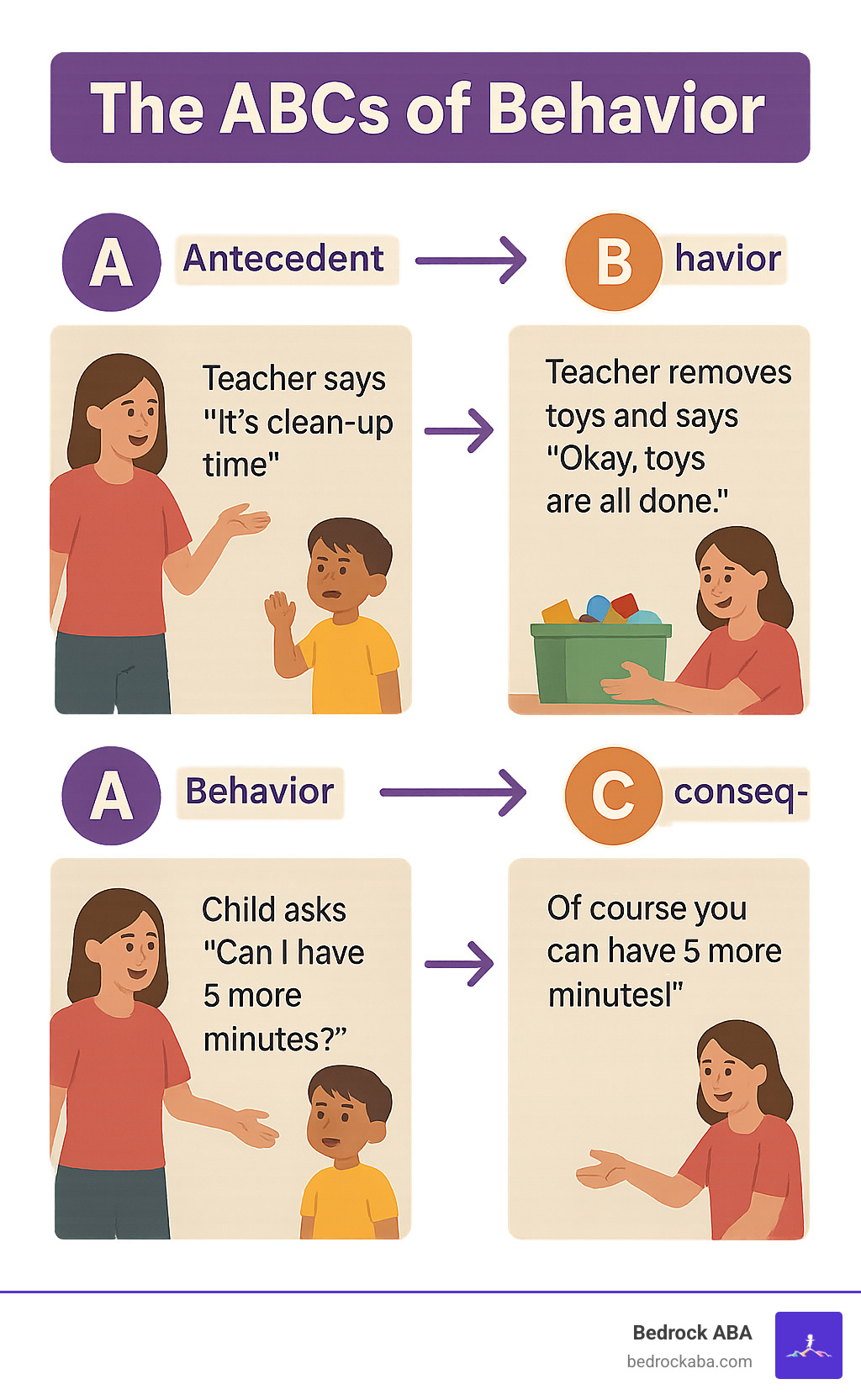
ABA is built on the Antecedent-Behavior-Consequence (ABC) model. We look at what happens right before a behavior (Antecedent), the behavior itself, and what happens right after (Consequence). By understanding this pattern, we can use positive reinforcement—providing a rewarding consequence for a desired behavior—to make learning feel fun and motivating. This commitment to objective data helps us track what’s working and adjust our approach to best support your child.
If you’re interested in diving deeper into the research foundation, you can explore the scientific research on ABA’s foundational principles.
Core Principles in Practice
An effective ABA therapy for autism program uses several key principles:
- Positive Reinforcement: Providing something rewarding (praise, a toy, a fun activity) immediately after a desired behavior to encourage it to happen again.
- Prompting and Fading: Offering temporary help (like a verbal cue or gesture) to teach a new skill and then gradually reducing that help as the child becomes more independent.
- Generalization: Ensuring skills learned in therapy can be used in different settings, like at home, school, and in the community.
- Task Analysis: Breaking down complex skills (like getting dressed) into small, achievable steps to make learning less overwhelming.
- Data Collection: Objectively tracking progress to ensure the therapy is effective and to guide decisions about the treatment plan.
- Functional Behavior Assessment (FBA): Investigating the “why” behind a challenging behavior to teach a more effective and appropriate way for the child to meet their needs.
The History and Evolution of ABA
The story of ABA therapy for autism began in the 1960s with pioneers like Dr. O. Ivar Lovaas, whose work showed that intensive intervention could lead to remarkable improvements. However, it’s crucial to acknowledge that early ABA models had significant limitations. The focus was often on compliance and making children appear “indistinguishable from their peers,” and some historical practices were problematic.
The field has undergone a profound change. Modern ABA therapy for autism looks completely different. Today’s approach is compassionate, client-led, and neurodiversity-affirming. We prioritize a child’s happiness and quality of life, using play-based methods to build meaningful skills. The goal is not to change who a child is, but to empower them with the tools to thrive as their authentic selves.
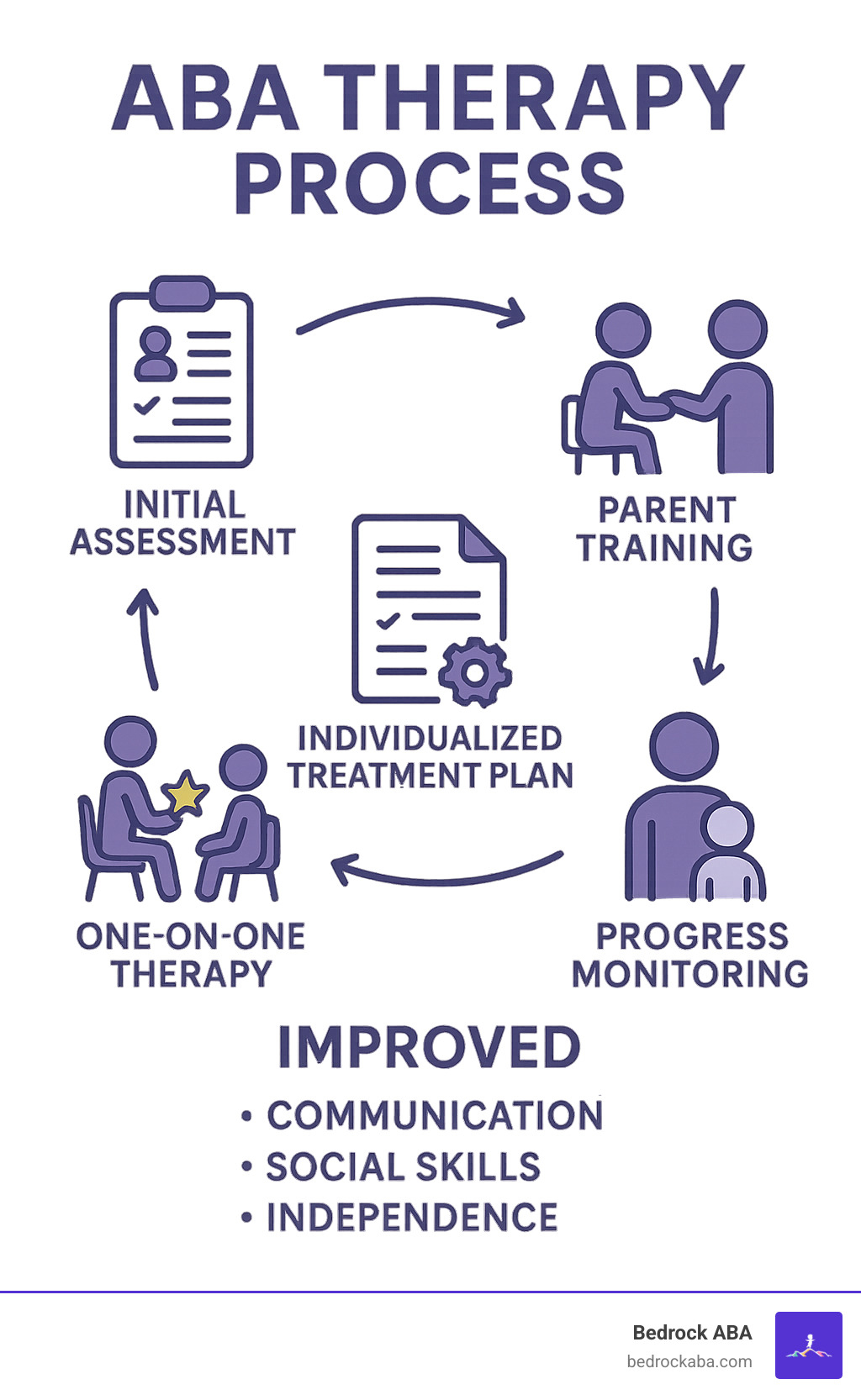
How an ABA Therapy Program is Structured
Starting ABA therapy for autism is a guided, collaborative process. No two programs are identical because no two children are. Your child’s program will be uniquely designed around their interests, strengths, and the goals that matter most to your family.

The process generally follows these steps:
- Initial Assessment: We start by getting to know your child through comprehensive skills assessments (like the VB-MAPP or ABLLS-R) and a Functional Behavior Assessment (FBA) to understand the reasons behind any challenging behaviors.
- Individualized Treatment Plan: We work collaboratively with you to set meaningful goals. This leads to a Behavior Intervention Plan (BIP) that serves as our roadmap, outlining specific strategies custom to your child.
- One-on-One Therapy: Most therapy occurs in one-on-one sessions with a trained therapist. This allows us to move at your child’s pace and adapt to their learning style.
- Parent and Caregiver Training: We equip you with the tools and knowledge to support your child’s learning at home, turning everyday moments into learning opportunities.
- Ongoing Progress Monitoring: We constantly collect data to review what’s working and make adjustments as needed. This ensures the program evolves with your child’s growth.
Common Methodologies and Approaches Within ABA
ABA therapy for autism isn’t a single method but a collection of teaching approaches. We blend these to create a program that best fits your child:
- Discrete Trial Training (DTT): A structured approach that breaks skills into small, manageable steps. Modern DTT is playful and always uses positive reinforcement.
- Natural Environment Teaching (NET): Uses everyday situations and a child’s natural motivation as learning opportunities, helping skills generalize to the real world.
- Pivotal Response Training (PRT): A child-led approach that focuses on pivotal areas like motivation and self-initiation, using natural rewards.
- Early Start Denver Model (ESDM): A play-based approach for very young children that integrates multiple developmental goals into fun activities.
- Verbal Behavior (VB) Therapy: Focuses on teaching language by its function—helping children learn not just words, but how to use them to request, comment, and interact.
The Goals and Proven Benefits of ABA Therapy for Autism
At its heart, ABA therapy for autism is about opening doors—helping your child develop the skills they need to connect with others, express themselves, and steer their world with greater confidence and independence.

The primary goals of ABA therapy focus on building a foundation for lifelong success and happiness. Key areas of improvement include:
- Improved Communication: Helping children find their voice, whether through words, signs, or a communication device. This often reduces frustration for the entire family.
- Improved Social Skills: Teaching the building blocks of friendship, such as turn-taking, sharing, and starting conversations.
- Increased Independence: Building confidence through daily living skills like dressing, grooming, and preparing simple snacks.
- Academic Readiness: Developing the attention, focus, and learning strategies needed to succeed in school.
- Reduced Challenging Behaviors: Teaching effective ways to communicate needs, which in turn reduces behaviors that interfere with learning and safety.
Scientific Evidence Supporting Effectiveness
The time and energy you invest in ABA therapy for autism is backed by decades of solid science. It is endorsed as an evidence-based best practice treatment by leading health organizations like the US Surgeon General and the American Psychological Association.
Research, including the landmark 1987 Lovaas study, has consistently shown that ABA can lead to significant positive changes. A comprehensive review of studies found that 63-88% of children show meaningful progress across various skill areas, including cognitive, language, and adaptive behavior. This evidence gives families confidence that they are choosing a treatment that is both scientifically sound and practically effective. For more details, you can explore this review of evidence-based best practice treatment.
The Role of Early Intensive Behavioral Intervention (EIBI)
For younger children, Early Intensive Behavioral Intervention (EIBI) can be particularly powerful. EIBI typically involves intensive therapy of 25-40 hours per week for children between ages two and six. This approach creates a rich, supportive learning environment during a child’s most critical developmental years.
Studies show that children in EIBI programs often experience significant gains in IQ, adaptive behavior, and language outcomes. Early intervention builds a strong foundation that supports all future learning and development. At Bedrock ABA, we work with families to determine the right intensity for each child, balancing therapeutic goals with the joy of childhood.
Understanding the Criticisms and Evolution of ABA
It’s important to have an honest conversation about ABA therapy for autism. The field has a complex history, and it’s crucial to acknowledge where we’ve come from and where we are today.
Early ABA practices were very different from modern approaches. The historical focus was often on compliance and making autistic children appear “neurotypical.” Some early models included the use of aversives (punishments), a practice that is now condemned and strictly prohibited. Autistic adults who experienced these outdated methods have shared that they felt rigid and dehumanizing, and their voices have been vital in pushing the field to evolve.
| Feature | Historical ABA (e.g., Lovaas 1960s-1980s) | Modern ABA (2000s-Present) |
|---|---|---|
| Primary Goal | “Normalizing” behavior, “indistinguishable from peers” | Improving quality of life, increasing independence, fostering meaningful connections, respecting neurodiversity |
| Teaching Methods | Often rigid, highly structured DTT, repetitive, desk-based | Mix of DTT, NET, PRT, ESDM; play-based, naturalistic, child-led elements, fun, engaging |
| Reinforcement | Often extrinsic, sometimes punishment/aversives (early) | Primarily positive reinforcement, natural consequences; strict ethical bans on aversives |
| Focus of Intervention | Reducing “problem” behaviors, suppressing stims | Teaching functional skills, communication, social engagement; understanding function of behaviors; respecting self-stimulatory behaviors unless harmful |
| Client Involvement | Limited, compliance-focused | Emphasis on assent, client choice, collaboration with families, trauma-informed care |
| Ethical Standards | Emerging, less formalized | Rigorous ethical codes (BACB), ongoing training, focus on client dignity and rights |
How Modern ABA Has Evolved for the Better
Modern ABA therapy for autism has changed remarkably by listening to autistic individuals and their families.
Today’s ABA puts Quality of Life (QoL) at the center of everything. We ask, “How can we help this child be happier and more independent?” Assent-based learning is now a cornerstone; we want your child to be an enthusiastic participant. If a child is unhappy, we adjust our approach. We also accept trauma-informed care, creating a safe and supportive environment.
Learning is now integrated into play and daily routines through naturalistic teaching. We work hand-in-hand with families, and the Behavior Analyst Certification Board enforces rigorous ethical guidelines that prohibit aversives and mandate client dignity.
Navigating Criticisms of ABA Therapy for Autism
As an informed parent, it’s natural to have questions. When evaluating providers, here’s what to look for:
- Positive Signs: A focus on your child’s happiness, play-based and naturalistic methods, and collaborative goal-setting with your family.
- Red Flags: Any provider who promises to “cure” autism, focuses on eliminating harmless stimming, forces eye contact, uses punishment, or is unwilling to involve you in the process.
The goal is happiness, not “normalcy”. A quality provider aims to empower your child with skills for a fulfilling life while embracing who they are. The field has grown tremendously, and today’s practice reflects a deep commitment to dignity, respect, and compassionate care.
Finding and Funding ABA Therapy: A Practical Guide for Families
Finding the right ABA therapy for autism provider is about finding a partner for your family—someone who will understand your child’s unique needs and help them flourish.

When researching providers, it’s important to verify their credentials, understand their approach, and ensure they are a good fit for your family’s values.
Who Provides ABA Therapy and What Are Their Qualifications?
Your child’s therapy team will consist of highly trained professionals:
- Board Certified Behavior Analyst (BCBA): The lead clinician who holds a master’s degree or PhD, has completed extensive supervised fieldwork, and passed a national certification exam. The BCBA designs and oversees your child’s individualized treatment plan.
- Registered Behavior Technician (RBT): The person who works one-on-one with your child during daily therapy sessions. RBTs are trained and supervised by the BCBA to implement the treatment plan effectively.
In addition to national certification from the Behavior Analyst Certification Board (BACB), many states have their own licensing requirements, adding another layer of professional oversight. At Bedrock ABA, our entire therapy team consists of these highly qualified professionals who are committed to ongoing supervision and training.
Practical Considerations: Cost and Insurance Coverage for aba therapy for autism
Understanding the costs and insurance coverage for ABA therapy for autism is a crucial step for families.
Quality ABA therapy typically costs between $70 to $85 per hour. The total investment depends on the number of hours recommended for your child, which can range from 10-20 hours per week to more intensive programs of 25-40 hours. This recommendation is always based on a thorough assessment of your child’s medical needs.
Fortunately, insurance coverage has become much more common. Most private health insurance plans are now required to cover ABA services due to state mandates. Additionally, all Medicaid plans must cover medically necessary treatments for children under 21, which includes ABA therapy.
Navigating insurance claims and prior authorizations can be complex. That’s why our team is here to help you understand your coverage and assist with the necessary paperwork to maximize your benefits. We are committed to making high-quality ABA therapy for autism accessible to as many families as possible. For specific questions about your insurance options, please contact our team.
Frequently Asked Questions about ABA Therapy
We know you might have more questions about ABA therapy for autism. Here are some brief answers to the most common inquiries.
How old should a child be to start ABA therapy?
Research consistently shows that early intervention is key. The sooner a child begins, the greater the potential for significant improvement. We begin working with children at Bedrock ABA starting at age two.
However, ABA is effective for individuals of all ages. Programs are always adapted to the developmental stage and goals of toddlers, children, teens, and even adults.
How many hours of ABA therapy does a child need?
The number of hours is highly individualized. It depends on your child’s specific needs and the goals in their treatment plan. A BCBA will recommend a number of hours that is medically necessary for progress.
- Common ranges are typically between 10-20 hours per week.
- Intensive programs of 25-40 hours per week may be recommended for younger children or those with more significant needs.
The focus is always on the quality of each session, not just the quantity.
Is ABA therapy only for autism?
While ABA therapy for autism is its most well-known application, the principles of Applied Behavior Analysis are used in many other areas. Because ABA is the science of learning, its strategies can also help individuals with ADHD, other developmental disorders, and even in rehabilitation after a traumatic brain injury.
This versatility shows how powerful the science of behavior is. Our focus at Bedrock ABA remains on using these evidence-based strategies to help children with autism learn, grow, and thrive.
Conclusion: Taking the Next Step
We hope this guide has provided a clear picture of modern ABA therapy for autism. The most important thing to remember is that you are not alone on this journey, and there is genuine hope for your child’s future.
At Bedrock ABA, we believe every child deserves to thrive as their authentic self. Our personalized, family-centered approach means we take the time to understand your child’s unique personality and work with your entire family. We offer both in-person and remote services to fit your lifestyle.
Our goal is not to change who your child is, but to open up their potential by helping them communicate, connect, and steer their world with greater confidence and joy. We focus on improving quality of life in ways that matter to you.
Choosing a provider is a significant decision. Look for a qualified, compassionate team that prioritizes your child’s happiness, upholds the highest ethical standards, and respects neurodiversity. The science behind ABA therapy for autism is solid, but it’s the provider who brings that science to life.
If you’re ready to explore how our approach might help your child flourish, we would love to hear from you. Contact us to learn more about our ABA therapy services – we’re excited to meet you and your amazing child!