


Why Behavior Analysts Are Essential for Children with Autism
A behavior analyst is a trained professional who uses evidence-based methods, like Applied Behavior Analysis (ABA) therapy, to help people develop life skills and reduce challenging behaviors. They work with individuals with autism, developmental disabilities, and other conditions to create positive change.
Quick Answer for Parents:
- What they do: Assess behaviors, create treatment plans, teach new skills, and train families
- Who they help: Children with autism, ADHD, developmental delays, and behavioral challenges
- Where they work: Homes, schools, clinics, and community settings
- Education needed: Master’s degree and Board Certification (BCBA)
- Why it matters: ABA is proven effective by 20+ studies and endorsed by the US Surgeon General
If you’re a parent wondering if your child could benefit from a behavior analyst, you’re not alone. Many families want clear answers about what these professionals do day-to-day. Essentially, behavior analysts are problem-solvers who use a scientific approach to help children learn essential skills like communication, social interaction, and daily living tasks.
The field has grown rapidly because research shows that intensive ABA therapy can lead to significant improvements in intellectual functioning, language, and social skills for many children with autism.
As Mayer Kulefsky, director of operations at Bedrock ABA, I’ve seen how skilled behavior analysts transform lives with individualized, evidence-based care. My experience has shown me the importance of qualified professionals who help children reach their full potential.
Important behavior analyst terms:
What is a Behavior Analyst and Applied Behavior Analysis (ABA)?
A behavior analyst is a scientist and caring guide who uses proven learning principles to create positive change. They focus on “socially significant behaviors”—skills that help people participate more fully in their community. Their goal is not just to stop difficult behaviors but to teach new, positive skills.
The main approach is Applied Behavior Analysis (ABA), a therapy that uses systematic techniques to improve life skills. For example, a behavior analyst might use positive reinforcement to help a child learn to communicate, develop social skills, or master daily tasks like getting dressed. While widely known for helping children with autism spectrum disorder (ASD), ABA principles apply to many situations.
If you’re curious about how this process works, you can learn more in our guides on Applied Behavior Analysis Therapy and What is ABA Therapy and How Does it Work?.
The Science Behind ABA
Behavior analysis has scientific roots in behaviorism—the study of observable behaviors and environmental influences. Behavior analysts act like detectives, collecting and analyzing data to understand why behaviors occur. A key tool is the functional behavior assessment (FBA), which helps determine the purpose of a behavior so a more effective intervention can be designed.
This data-driven approach is why ABA is an evidence-based practice. In fact, more than 20 studies have established that intensive and long-term therapy using ABA principles improves outcomes for many with autism.
The effectiveness of ABA is so well-proven that major organizations like the US Surgeon General and the American Psychological Association recognize it as a best practice treatment.
Who Behavior Analysts Help
While commonly associated with autism, behavior analysts help a wide range of people and organizations. Their expertise is valuable in many areas:
- Children and Adults: Assisting individuals with ADHD, Oppositional Defiant Disorder (ODD), and other behavioral challenges.
- Organizations: Improving workplace safety and performance through organizational behavior management (OBM).
- Healthcare: Aiding in addiction treatment and helping individuals with impulse control, such as pathological gamblers.
- Education and Sports: Helping teachers with classroom management and athletes with performance improvement.
Essentially, wherever a behavior needs to be understood or changed, a behavior analyst can provide valuable strategies.
The Core Responsibilities and Daily Life of a Behavior Analyst
A behavior analyst is a professional problem-solver specializing in human behavior. They work closely with families to understand a child’s unique needs and create lasting, meaningful change.
The core of the work involves:
- Patient Assessment: Getting to know each child through observations, family interviews, and standardized assessments to identify strengths, preferences, and motivations.
- Individualized Treatment Plans: Developing flexible, unique plans that fit a family’s daily life and reflect their goals. Our Behavior Support Plan ABA guide explains this family-centered approach.
- Data Analysis and Progress Monitoring: Tracking what works and adjusting the approach based on data to ensure real progress.
- Caregiver Training: Empowering families with practical ABA skills to support their child’s growth in everyday moments.
- Supervision and Ethics: Board Certified Behavior Analysts (BCBAs) often supervise team members like RBTs and BCaBAs, ensuring all interventions follow strict ethical guidelines that put the child’s interests first.

A Typical Day for a Behavior Analyst
No two days are the same, but a day often includes a mix of direct and indirect work. A behavior analyst might spend time on client observation in homes or schools, conduct direct therapy sessions, and collaborate in team meetings. Parent communication is a constant, from quick check-ins to formal training.
Behind-the-scenes work is also crucial. This includes report writing, creating materials like visual supports for skill acquisition programs, and data graphing and analysis. This data analysis tells the story of each child’s progress, guiding every decision whether the goal is building communication skills or focusing on behavior reduction.
For more insight into how these responsibilities play out in practice, check out The Role of a Certified ABA Therapist in Providing Therapy.
Essential Skills for a Successful Behavior Analyst
An effective behavior analyst blends scientific thinking with strong people skills. Key qualities include:
- Patience and Empathy: Behavior change takes time, and families need to feel understood and supported during challenging moments.
- Communication Skills: Explaining complex concepts simply and collaborating effectively with families and other professionals is vital.
- Building Rapport: Trust is fundamental. Children learn best from someone they trust, and parents are more likely to implement strategies when they feel connected to the therapist.
- Analytical and Problem-Solving Skills: Sharp observation and analytical skills are needed to identify behavioral patterns and create effective solutions.
- Ethical Judgment: Every decision must be guided by sound ethics, prioritizing the child’s well-being and maintaining professional boundaries.
The Path to Becoming a Certified Behavior Analyst
Becoming a certified behavior analyst is a journey requiring dedication, education, and hands-on experience. The process is overseen by the Behavior Analyst Certification Board (BACB), which ensures practitioners meet high standards of competence and ethics. Each step builds the skills needed to help families with confidence and compassion. The career path offers multiple entry points and opportunities for advancement.

Levels of Certification in Behavior Analysis
The field has a tiered system, allowing individuals to enter at various levels and advance with experience.
- Registered Behavior Technician (RBT): The entry-level position, requiring a high school diploma and 40 hours of training. RBTs implement behavior plans under close supervision.
- Board Certified Assistant Behavior Analyst (BCaBA): Requires a bachelor’s degree and specific ABA coursework. BCaBAs can conduct assessments and design interventions but must work under a BCBA’s oversight.
- Board Certified Behavior Analyst (BCBA): The gold standard, requiring a master’s degree and extensive supervised experience. BCBAs practice independently, conduct comprehensive assessments, design complex treatment plans, and supervise others.
- BCBA-Doctoral (BCBA-D): A designation for BCBAs with doctoral-level training, often leading to research, teaching, and leadership roles. You can learn more about these credentials at the Behavior Analyst Certification Board website.
How to Become a Board-Certified Behavior Analyst (BCBA)
The path to becoming a BCBA typically takes 2-4 years and involves several key steps:
- Education Requirements: Earn a master’s degree from an accredited program with specific ABA coursework covering ethics, assessment, intervention design, and research methods. The Association for Behavior Analysis International (ABAI) offers resources for students.
- Supervised Fieldwork Experience: Complete 1,500-2,000 hours of supervised practice. This hands-on experience allows you to apply classroom knowledge to real-world situations under the guidance of an experienced BCBA. You’ll work with clients, conduct assessments, and train families.
- BCBA Examination: Pass a comprehensive exam that tests your knowledge across all domains of behavior analysis.
After certification, you must maintain it through continuing education and may need state licensure, depending on your location. The process requires perseverance, but the reward is a career making a meaningful difference. For details, you can visit the BACB’s official requirements page.
Career Outlook: Where Behavior Analysts Work and What They Earn
The future for behavior analysts is bright, with explosive growth, high demand, and excellent salary potential. The career also offers immense satisfaction from making a real difference in people’s lives.
Job growth for BCBAs is surging, with the U.S. Bureau of Labor Statistics projecting a 22% increase in employment for behavior analysts from 2020 to 2030—much faster than average. This is largely driven by the growing recognition of ABA therapy’s effectiveness for children with autism.

Common Work Settings and Industries
A key benefit of being a behavior analyst is the variety of environments where your skills are valued.
- Healthcare: Clinics, therapy centers, and hospitals provide structured settings for intensive therapy.
- Education: Schools are a common setting, where analysts support students with disabilities or behavioral challenges. Our School-Based ABA Therapy programs show how this works.
- Home and Community: In-home therapy is core to family-centered care, helping generalize skills to daily routines.
- Residential and Corporate: Analysts work in group homes and in corporate settings through Organizational Behavior Management (OBM) to improve performance and safety.
- Telehealth: The rise of telehealth has expanded access to care through services like ABA Telehealth Therapy.
Even non-traditional industries like retail, family services, and software companies are leveraging behavioral expertise.
Salary and Job Growth for a Behavior Analyst
The financial outlook for behavior analysts is positive, reflecting high demand. Salaries vary by certification, experience, and location.
- RBTs: Typically earn around $33,000 annually.
- BCaBAs: Earn an average of $45,000 annually.
- BCBAs: See significant earning potential, with a median annual salary of $82,816. Indeed.com reports over $97,600 for BCBAs, with ranges from $66,500 to $94,000.
- Doctoral-level analysts: Can expect to earn around $85,000 annually.
For comparison, The BLS reports that substance abuse, behavioral disorder, and mental health counselors earn a median salary of approximately $48,500. The combination of strong job growth and competitive wages makes this a well-rewarded profession.
Key Principles and Techniques in ABA Therapy
The effectiveness of ABA therapy lies in its scientific foundation and individualized approach. At Bedrock ABA, we build every intervention on proven core principles of learning theory to create effective behavior modification. Every program is customized to a child’s unique strengths and goals.
To understand how we create these personalized programs, you can explore our detailed guide on Key Principles Behind ABA Therapy: Reinforcement, Behavior, and Learning and learn about our varied ABA Behavioral Programs.
Core Principles of ABA
These practical tools are used by behavior analysts every day to help children thrive.
- Positive Reinforcement: The cornerstone of ABA. When a desired behavior is followed by a reward, it becomes more likely to happen again.
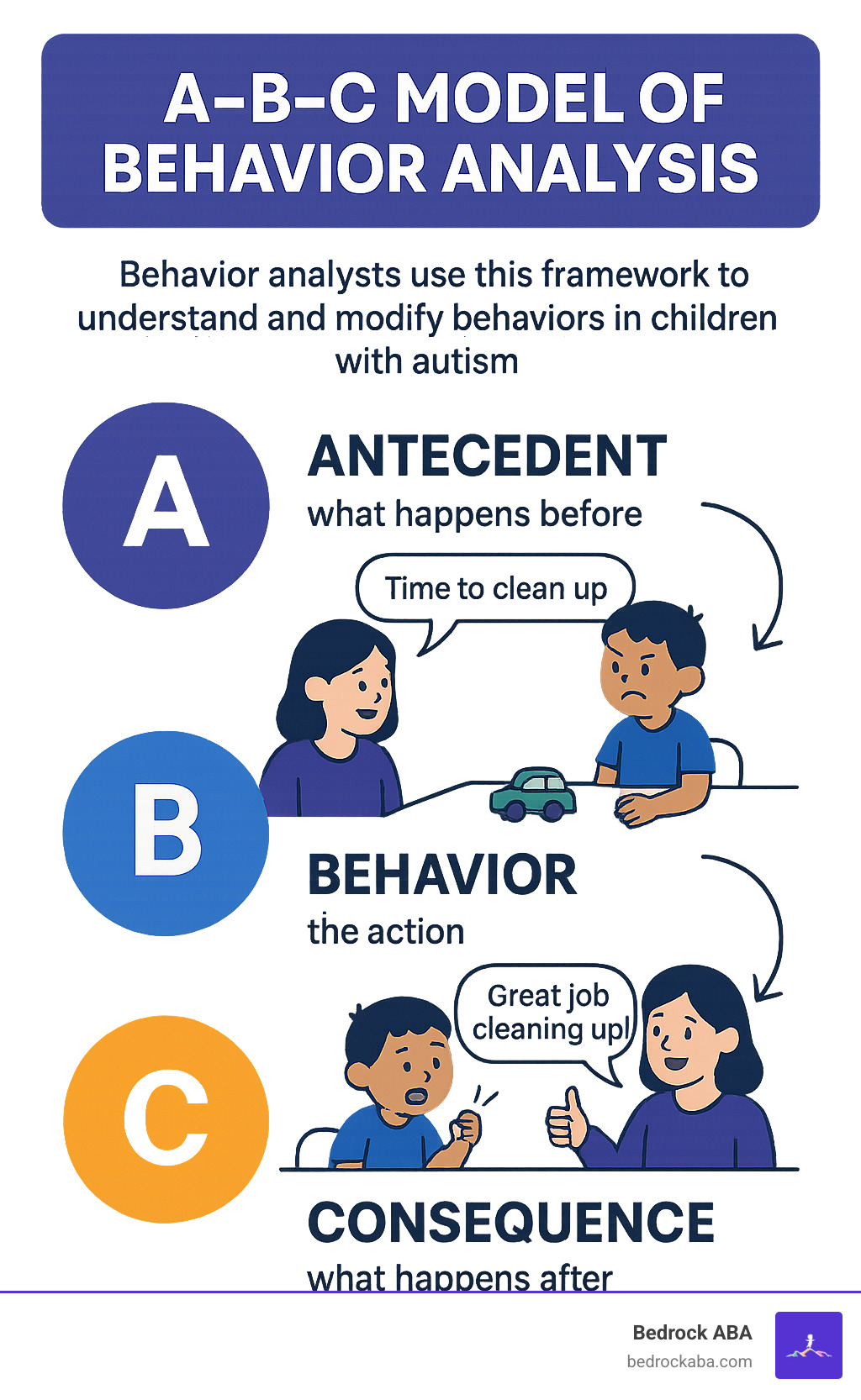
- Antecedent-Behavior-Consequence (A-B-C): This model helps us understand why a behavior occurs by looking at what happens before (antecedent) and after (consequence). By changing the antecedent or consequence, we can change the behavior.
- Prompting and fading: Like training wheels, we provide prompts to help a child succeed and then gradually fade them as the child becomes more independent.
- Shaping: We reward small steps in the right direction, building on successive approximations toward a larger goal.
- Generalization: We ensure skills learned in therapy are used in real-life settings, like at home and school.
- Maintenance: We build systems to ensure that learned skills are maintained over time.
Common ABA Techniques
Behavior analysts use various techniques to put these principles into action. We choose the best methods for each child, as detailed in our article on The Different Types of ABA Therapy Techniques.
- Discrete Trial Training (DTT): Breaks skills into small, manageable steps that are taught one by one in a structured manner.
- Natural Environment Teaching (NET): Weaves learning into everyday activities and play, making it feel more natural and functional.
- Pivotal Response Training (PRT): Focuses on pivotal areas like motivation and self-initiation, which can lead to widespread improvements in other skills.
- Token economy systems: Children earn tokens for positive behaviors, which they can exchange for rewards. This system, explained in resources like token economy systems, motivates good choices.
- Verbal Behavior (VB) therapy: Treats language as a behavior that can be taught. It helps children understand that communication is powerful—that using words gets their needs met.
Today’s behavior analysts blend structured and naturalistic techniques to create programs that are both effective and enjoyable for children and families.
Conclusion
Being a behavior analyst is a calling to create meaningful change in the lives of children and families. Professionals in this growing field witness daily breakthroughs—a child’s first words, a new skill mastered—that make the dedication worthwhile.
As more families find the power of Applied Behavior Analysis, the demand for skilled behavior analysts continues to soar. This is a movement that is genuinely improving lives. What makes this profession special is its focus on family-centered care. At Bedrock ABA, we know therapy is most effective when families are involved. Our behavior analysts empower parents and caregivers with the tools to support growth at home.
The field is flexible and innovative, with therapy offered in clinics, homes, schools, and through telehealth services to meet each child’s unique needs.
For families in Utah wondering if ABA therapy might be right for their child, we encourage you to take that first step. Our team of compassionate behavior analysts is ready to partner with you on this journey, offering both in-person and remote options that fit your family’s lifestyle and needs.
The future of behavior analysis is bright. If you’re considering this career, you’ll be joining a community dedicated to helping children reach their full potential. And if you’re a parent seeking support, skilled behavior analysts are ready to help your child thrive.
Ready to learn more? Find out more about ABA therapy services in Utah and find how our team can support your child’s unique journey.