


Why Utah’s ABA Therapy Job Market is Booming
Your Career Path in ABA: Common Job Roles in Utah
Utah’s ABA therapy field offers a beautifully structured career path that grows with you. Whether you’re fresh out of high school or looking to advance your clinical skills, there’s a place for you in this rewarding field.
The journey typically follows a clear progression: you might start as a Registered Behavior Technician (RBT) working directly with children, advance to a Behavior Analyst in Training (BAIT) role while pursuing your master’s degree, and eventually become a Board Certified Behavior Analyst (BCBA) leading treatment teams.
| Role | Primary Responsibilities | Education Required | Average Pay in Utah |
|---|---|---|---|
| RBT | Direct therapy implementation, data collection, working under supervision | High school diploma + RBT certification | $19-22/hour |
| BAIT | Gaining supervised experience, working toward BCBA certification | Master’s program enrollment | $30+/hour |
| BCBA | Conducting assessments, designing treatment plans, supervising RBTs | Master’s degree + BCBA certification | $87,000-100,000/year |
Registered Behavior Technician (RBT)
Think of the RBT position as your gateway into ABA therapy jobs in Utah. This entry-level role puts you right where the magic happens – working one-on-one with children to help them build essential life skills.
As an RBT, you’ll spend your days implementing therapy programs that BCBAs have carefully designed for each child. You’re not just following instructions – you’re becoming part of a child’s support team, celebrating their victories and helping them steer challenges.
Your daily work includes collecting behavioral data (which might sound boring but is actually fascinating when you see patterns emerge), coordinating with supervising BCBAs, and sharing insights with families about their child’s progress. You’ll also implement behavior plans and maintain safety protocols, ensuring every session is both productive and secure.
The path to becoming an RBT is refreshingly straightforward. Most Utah employers provide comprehensive training that includes a 40-hour training course, hands-on competency assessment, and preparation for the RBT exam. The entire process typically takes under three months, making it one of the most accessible entry points into healthcare.
What makes this work truly special? One Utah RBT recently shared: “A big moment for me has been seeing a client I work with who started with an extremely limited diet of foods she would eat, through ABA be able to try all kinds of foods.” These breakthrough moments happen regularly, turning everyday work into something deeply meaningful.
Behavior Analyst in Training (BAIT) / ABA Intern
The BAIT role is perfect if you’re ready to take the next step in your ABA career. This position serves as a bridge between hands-on therapy work and clinical leadership, offering you the chance to develop advanced skills while earning competitive pay.
As a BAIT, you’ll gain supervised experience working toward your BCBA certification while enrolled in a master’s program. This isn’t just about checking boxes – you’re building the clinical expertise that will define your future career.
The role offers several compelling advantages. You’ll earn paid indirect hours that count toward your BCBA certification requirements, typically at $30+ per hour. More importantly, you’ll receive direct mentorship from experienced BCBAs who are invested in your professional growth.
Your daily responsibilities expand beyond direct therapy to include hands-on experience with assessment and treatment planning. You’ll work closely with supervising BCBAs to develop your clinical skills, learning to analyze complex behavioral patterns and contribute to treatment decisions.
Many Utah providers actively seek BAIT candidates, recognizing the value of supporting future BCBAs through their certification journey. This creates a win-win situation where you receive excellent training while employers invest in developing their future clinical leaders.
Board Certified Behavior Analyst (BCBA)
The BCBA role represents the pinnacle of ABA therapy careers, combining clinical expertise with leadership responsibility. In Utah’s thriving market, BCBAs enjoy excellent compensation and the deep satisfaction of leading comprehensive autism treatment programs.
As a BCBA, you’ll conduct comprehensive behavioral assessments that form the foundation of each child’s treatment plan. This involves analyzing complex behavioral patterns, identifying intervention targets, and designing individualized ABA curricula that address each child’s unique needs.
Your leadership responsibilities include supervising and training RBTs and other staff members, ensuring quality implementation of treatment plans. You’ll collaborate closely with families and other professionals, serving as the clinical expert who guides treatment decisions and monitors progress.
The role also involves writing detailed progress reports and conducting clinical reviews, helping families understand their child’s growth and adjusting treatment plans as needed. You’ll ensure compliance with ethical and regulatory standards while maintaining the highest quality of care.
The educational path to becoming a BCBA requires dedication but offers substantial rewards. You’ll need a master’s degree in behavior analysis, psychology, or related field, plus completion of supervised fieldwork hours (typically 1,500-2,000 hours). After passing the BCBA certification exam, you’ll also need Utah’s Licensed Behavior Analyst (LBA) credential.
This investment in education pays off significantly in Utah’s market, with salaries ranging from $87,000 to $100,000 annually, plus comprehensive benefits packages. More importantly, you’ll have the opportunity to shape treatment programs that transform children’s lives and support entire families on their autism journey.
Getting Qualified: Requirements for ABA Therapy Jobs in Utah
Getting started in ABA therapy jobs in Utah might seem overwhelming at first, but the requirements are more straightforward than you might expect. The beauty of this field lies in its accessibility – you don’t need years of specialized education to begin making a difference in children’s lives.

Foundational Requirements for All Roles
Whether you’re aiming to become an RBT or eventually a BCBA, certain baseline requirements apply across all positions. These aren’t meant to be barriers – they’re simply practical necessities for working effectively with children and families.
Age and education form the foundation: you must be at least 18 years old and have a high school diploma or GED. That’s it for educational requirements at the entry level. The field values life experience, compassion, and dedication just as much as formal credentials.
Background and safety considerations are equally important. You’ll need to pass a comprehensive criminal background check – this protects the vulnerable children you’ll be working with. Having reliable transportation and a valid driver’s license is essential since many positions involve traveling between homes, schools, or community settings.
The physical aspects of the job require some consideration too. You should be able to lift up to 50 pounds and have the flexibility to kneel, stand, and move in various positions. This isn’t about being an athlete – it’s about being able to engage with children at their level, whether that’s sitting on the floor for play therapy or helping with mobility needs.
Communication skills round out the core requirements. You’ll need strong verbal and written abilities to document progress, collaborate with families, and work effectively with your clinical team. Understanding HIPAA compliance and maintaining client confidentiality isn’t just a legal requirement – it’s fundamental to building trust with families.
What really matters beyond these basics? Patience, empathy, and a genuine positive attitude toward working with children. Previous experience with children or individuals with disabilities helps, but many successful ABA professionals started with no direct experience. Strong observational and organizational skills will serve you well, along with the ability to be flexible and adaptable in dynamic situations.
Specific Qualifications for RBT and BCBA Roles
The path to becoming an RBT is refreshingly accessible. The RBT certification process begins with a 40-hour training course that covers ABA principles, ethics, and hands-on techniques. Most Utah employers provide this training at no cost to you, and you’ll typically earn $13-14 per hour during the training period.
After completing your coursework, you’ll undergo a competency assessment where an experienced supervisor evaluates your ability to implement ABA techniques with actual clients. This isn’t meant to be intimidating – it’s quality assurance to ensure you’re prepared for success.
The RBT exam comes next, testing your understanding of core competencies through a national certification test. Once certified, you’ll work under ongoing supervision from qualified BCBAs who provide guidance and support. Your certification requires annual renewal with continuing education to keep your skills current.
The BCBA educational path requires more commitment but opens doors to clinical leadership roles. You’ll need a master’s degree in behavior analysis, psychology, education, or a related field with specific coursework requirements. This isn’t just any master’s degree – the coursework must align with BCBA certification standards.
Supervised fieldwork forms a crucial component, requiring 1,500-2,000 hours of supervised experience depending on your degree type. This hands-on training bridges the gap between academic knowledge and real-world application. Many Utah employers provide supervision support to help employees meet these requirements.
The BCBA exam represents a comprehensive test of your clinical knowledge and skills. After passing, you’ll need Utah Licensed Behavior Analyst (LBA) credentials to practice in the state. Like RBT certification, maintaining your BCBA status requires ongoing continuing education to stay current with best practices.
The investment in BCBA education pays dividends in Utah’s growing market. Many employers offer tuition assistance and structured supervision programs to support your certification journey, recognizing that developing skilled BCBAs benefits everyone – the professionals, the organizations, and most importantly, the children and families receiving services.
A Day in the Life: Work Environments and Schedules
One of the most appealing aspects of ABA therapy jobs in Utah is the incredible variety of work environments and scheduling flexibility available. This diversity means you can find a setting that truly matches your personality and lifestyle needs, whether you thrive in structured environments or prefer the thrill of community-based work.
Common Work Environments
Clinic-based therapy offers the comfort of a structured, predictable environment. Many therapists love the collaborative atmosphere where you’re surrounded by other professionals, specialized equipment, and consistent resources. There’s something reassuring about having everything you need within arm’s reach, plus the built-in support of colleagues nearby.
In-home therapy brings a completely different dynamic to your workday. You’ll get to see children in their natural environment, which often leads to more authentic interactions and faster progress. Working in homes also means building stronger relationships with families – you become part of their support system in a very personal way. The bonus? Most providers offer mileage reimbursement and paid drive time between sessions, so your commute becomes part of your paid workday.
School settings offer another unique opportunity, where you’ll collaborate with teachers and special education teams. This environment lets you see how children steer their educational world and help them succeed in those specific contexts.
Community integration might be the most dynamic and rewarding setting of all. Picture this: you’re helping a child practice ordering food at a restaurant, navigating a grocery store, or developing social skills at a playground. These remote RBT job opportunities exist too, expanding your options even further.

At Bedrock ABA, we understand that different people thrive in different environments. That’s why we offer both in-person and remote therapy options, giving our team members maximum flexibility while ensuring every child receives the highest quality care.
Schedules and Availability for ABA therapy jobs in utah
The scheduling flexibility in Utah’s ABA market is honestly one of its biggest selling points. Whether you’re a student, parent, or someone with other commitments, there’s likely a schedule that works for you.
Part-time positions typically require a minimum of 21 hours per week, making them perfect for students or those transitioning into the field. Full-time opportunities start at 30+ hours per week and come with comprehensive benefits packages that make the commitment worthwhile.
The beauty of ABA scheduling is that high demand exists for afternoon and evening hours – exactly when many people prefer to work. Those crucial after-school time slots from 3:00 PM to 7:00 PM are when most therapy happens, along with early evening sessions from 5:00 PM to 8:00 PM. This means you can often have your mornings free for other activities, appointments, or simply enjoying a slower start to your day.
Weekend options are increasingly available, especially Saturday morning sessions that work well for families and therapists alike. Summer brings additional opportunities with day programs during school breaks, offering more traditional daytime hours.
What makes the scheduling even better is the paid drive time between client sessions. Instead of rushing unpaid from one location to another, you’re compensated for travel time. Add in mileage reimbursement, and suddenly those drives become a peaceful transition between sessions rather than a stressful race against time.
Most providers offer advance scheduling so you can plan personal commitments around your work schedule. Many also allow you to request preferred time slots and provide coverage support for planned time off. This level of flexibility makes it possible to balance work with education, family responsibilities, or other professional pursuits – something that’s not always easy to find in healthcare careers.
Compensation, Benefits, and Career Growth in Utah
A career in ABA therapy offers both emotional rewards and competitive financial compensation. Utah’s growing market has driven up wages and benefits as providers compete for qualified professionals.
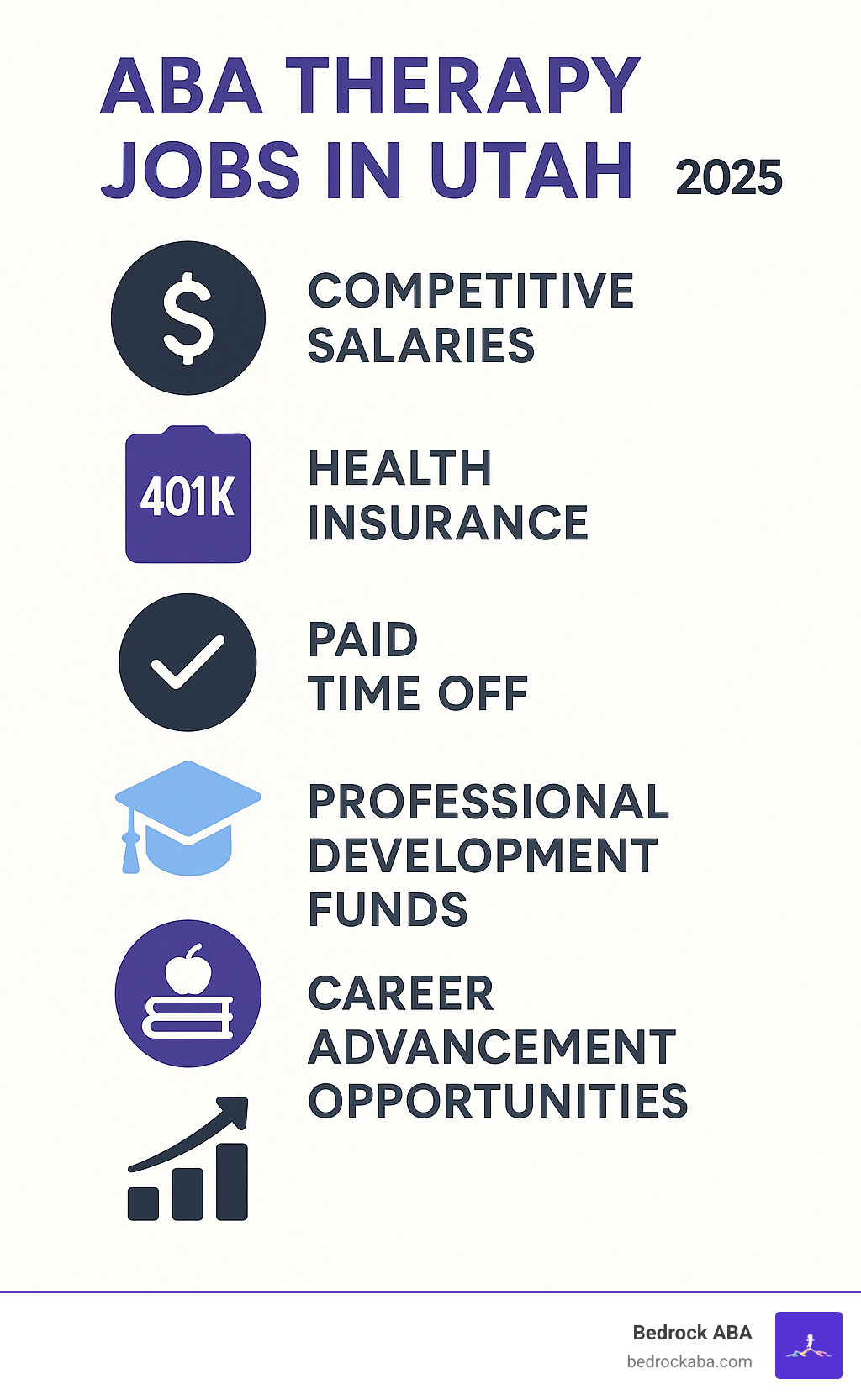
Typical Compensation and Benefits Packages
The financial rewards for ABA therapy jobs in Utah are genuinely competitive, especially considering the meaningful nature of the work. RBT positions start at $19-22 per hour, which sits well above Utah’s average hourly wage of $17.82. When you’re working toward your BCBA certification as a BAIT, you can expect $30+ per hour – a significant jump that reflects the increased responsibility and clinical skills you’re developing.
BCBA salaries range from $87,000 to $100,000 annually, with senior positions reaching up to $151,000 in specialized roles. These aren’t just numbers on paper – they represent real earning potential that can support a comfortable lifestyle while making a difference in children’s lives.
The benefits packages are where Utah employers really shine. For full-time positions (30+ hours per week), you’ll typically receive comprehensive health insurance covering medical, dental, and vision. Most providers offer 401K matching up to 6%, helping you build long-term financial security while you’re building your career.
Paid time off policies are generous, recognizing that this work requires mental and emotional energy. You’ll get vacation days, sick leave, and personal time to recharge. Many employers also provide tuition assistance – a game-changer if you’re working toward your BCBA certification or continuing your education.
Utah’s market offers some unique perks you won’t find everywhere. Relocation assistance helps out-of-state candidates make the move, while mileage reimbursement ensures you’re not paying out of pocket for client visits. Some providers even offer childcare assistance and mental health support, including free counseling sessions – because taking care of yourself helps you take care of your clients.
Opportunities for Growth and Mentorship
What makes ABA therapy special is the clear path forward. Unlike many healthcare fields where advancement feels uncertain, ABA offers a structured progression from RBT to BAIT to BCBA – and beyond into leadership roles like clinical directors or program managers.
The mentorship aspect is particularly strong in Utah’s market. Experienced BCBAs actively guide newcomers, providing one-on-one support that goes beyond basic supervision. You’ll receive paid supervision hours that count toward your certification requirements, making professional growth both accessible and financially sustainable.
Continuing education is actively supported through CEU funding and conference attendance. This isn’t just about meeting requirements – it’s about staying current with best practices and expanding your skill set. Many providers offer specialization training in areas like early intervention, adolescent services, or feeding therapy, allowing you to develop expertise that increases both your impact and earning potential.
The growth statistics tell an impressive story. According to the Behavior Analyst Certification Board, demand for behavior analysts increased by 1,942% between 2010 and 2018, with 22% projected job growth over the next decade. Utah’s market reflects this national trend, with consistent expansion creating new opportunities for advancement.
Specialization opportunities are abundant, whether you’re drawn to working with toddlers in early intervention programs, supporting school-age children with academic goals, or helping adolescents develop independence skills. Some professionals focus on parent training programs, teaching families how to support their children’s progress at home.
The career timeline typically follows a natural progression: 0-2 years as an RBT building foundational skills, 2-4 years as a BAIT working toward certification, then 4+ years as a BCBA with increasing specialization and leadership opportunities. What’s beautiful about this path is that each step builds on the previous one, creating a cohesive career journey rather than disconnected job changes.
Frequently Asked Questions about ABA Jobs in Utah
Do I need a degree to start working in ABA therapy in Utah?
Here’s the great news: you don’t need a college degree to begin your career in ABA therapy. You can start as a Behavior Technician with just a high school diploma or GED, making this one of the most accessible pathways into healthcare.
Most Utah employers understand that passion and dedication matter more than formal education at the entry level. They’ll provide comprehensive training to help you become a Registered Behavior Technician (RBT), typically covering the 40-hour training course, competency assessment, and certification exam at no cost to you.
During your training period, you’ll earn $13-14 per hour while learning – so you’re getting paid to develop new skills that will serve you throughout your career. This approach makes ABA therapy jobs in Utah incredibly welcoming to career changers, recent graduates, and anyone looking to make a meaningful impact without years of prior education.
The beauty of this field is that you can start helping children immediately while building toward advanced certifications if that’s where your interests lead you. Many successful BCBAs started exactly this way – as RBTs who finded their passion for behavior analysis on the job.
What is the demand like for ABA therapy jobs in utah?
The demand is honestly overwhelming – in the best possible way for job seekers. Utah’s ABA therapy market is experiencing unprecedented growth, creating abundant opportunities at every level.
Current market indicators paint a clear picture: major Utah providers are actively recruiting for 57+ open positions, with new openings appearing regularly. The Behavior Analyst Certification Board reports a staggering 1,942% increase in BCBA demand nationally between 2010 and 2018, and Utah’s market mirrors this explosive growth.
What’s driving this demand? Several factors are converging to create perfect conditions for job seekers. Insurance mandates are expanding coverage for ABA services, more families are seeking early intervention, and awareness of autism spectrum disorders continues to grow. The field also experiences natural turnover as professionals advance their careers or relocate.
The numbers tell the story: behavior analyst positions are projected to grow 22% over the next decade – much faster than the average for all occupations. This isn’t just a temporary spike; it’s a sustainable trend driven by genuine need in Utah’s communities.
For job seekers, this high demand translates to job security, competitive wages, and opportunities for rapid advancement. It also means you’ll be entering a field where your skills are truly valued and desperately needed.
What are the most important soft skills for an ABA therapist?
Success in ABA therapy jobs in Utah depends heavily on who you are as a person, not just what you know technically. The most crucial quality is genuine patience – you’ll be working with children who learn differently and may need extra time to master new skills.
Empathy runs a close second. Understanding what a child or family is experiencing, even when you haven’t walked in their shoes, helps you provide truly supportive care. This isn’t about feeling sorry for anyone; it’s about recognizing strengths and celebrating small victories that might seem insignificant to others.
Communication skills matter enormously because you’re constantly translating between different audiences. You’ll explain complex behavioral concepts to parents in everyday language, document progress for insurance companies, and collaborate with teachers, speech therapists, and other professionals.
Your observational skills will become your superpower. Noticing that a child’s eye contact improved slightly, or that they’re using a new word spontaneously, helps you adjust therapy approaches and celebrate meaningful progress. These subtle changes often indicate major breakthroughs.
Creativity and flexibility keep your work engaging and effective. Every child responds differently, so you’ll need to adapt activities, try new approaches, and think on your feet when standard techniques need modification.
Professional qualities like reliability and cultural sensitivity round out your toolkit. Families depend on consistent support, and Utah’s diverse communities require therapists who work respectfully with people from all backgrounds.
The wonderful thing about these skills is that they can be developed through experience. If you naturally enjoy working with children and families, you already have the foundation for a successful ABA career.
Conclusion
The field of ABA therapy in Utah offers a dynamic and fulfilling career path with numerous opportunities for entry-level and experienced professionals alike. From the hands-on work of an RBT to the clinical leadership of a BCBA, you can make a profound impact on the lives of children and families while building a stable, rewarding profession.
What makes ABA therapy jobs in Utah particularly attractive right now is the perfect combination of meaningful work and excellent career prospects. With competitive pay ranging from $19-22/hour for entry-level positions to $87,000-100,000/year for BCBAs, you’re not just choosing a job that feels good – you’re choosing one that pays well too. The 22% projected job growth over the next decade means job security, while comprehensive benefits packages and flexible work arrangements create an environment where you can truly thrive.
The career path is refreshingly clear and accessible. You can start as an RBT with just a high school diploma, gain experience while earning competitive wages, and advance through structured mentorship programs toward BCBA certification if you choose. Many professionals find this progression naturally rewarding, as each step brings new challenges and opportunities to make an even greater impact.
At Bedrock ABA, we’re committed to fostering growth for both our clients and our team members. We provide personalized Applied Behavior Analysis therapy with flexible, family-centered care that includes both in-person and remote options custom to each child’s unique needs. Our supportive work environment in Salt Lake City and throughout Utah emphasizes professional development, mentorship, and work-life balance – because we know that happy, supported therapists provide the best care for children and families.
Whether you’re just starting your career journey or looking to transition into something more meaningful, ABA therapy offers the rare opportunity to wake up each day knowing your work makes a real difference. Every breakthrough moment, every skill mastered, every family supported – these experiences create a career that’s not just sustainable, but genuinely fulfilling.
If you’re ready to build a rewarding career helping children reach their full potential, explore our ABA therapy services in Utah to learn more about our approach and current opportunities. The children and families in Utah need dedicated professionals like you – and there’s never been a better time to answer that call.