


Why ABA Therapy Evidence Based Practice Matters for Your Child
ABA therapy evidence based approaches have become the gold standard for supporting children with autism – and for good reason. Here’s what makes ABA truly evidence-based:
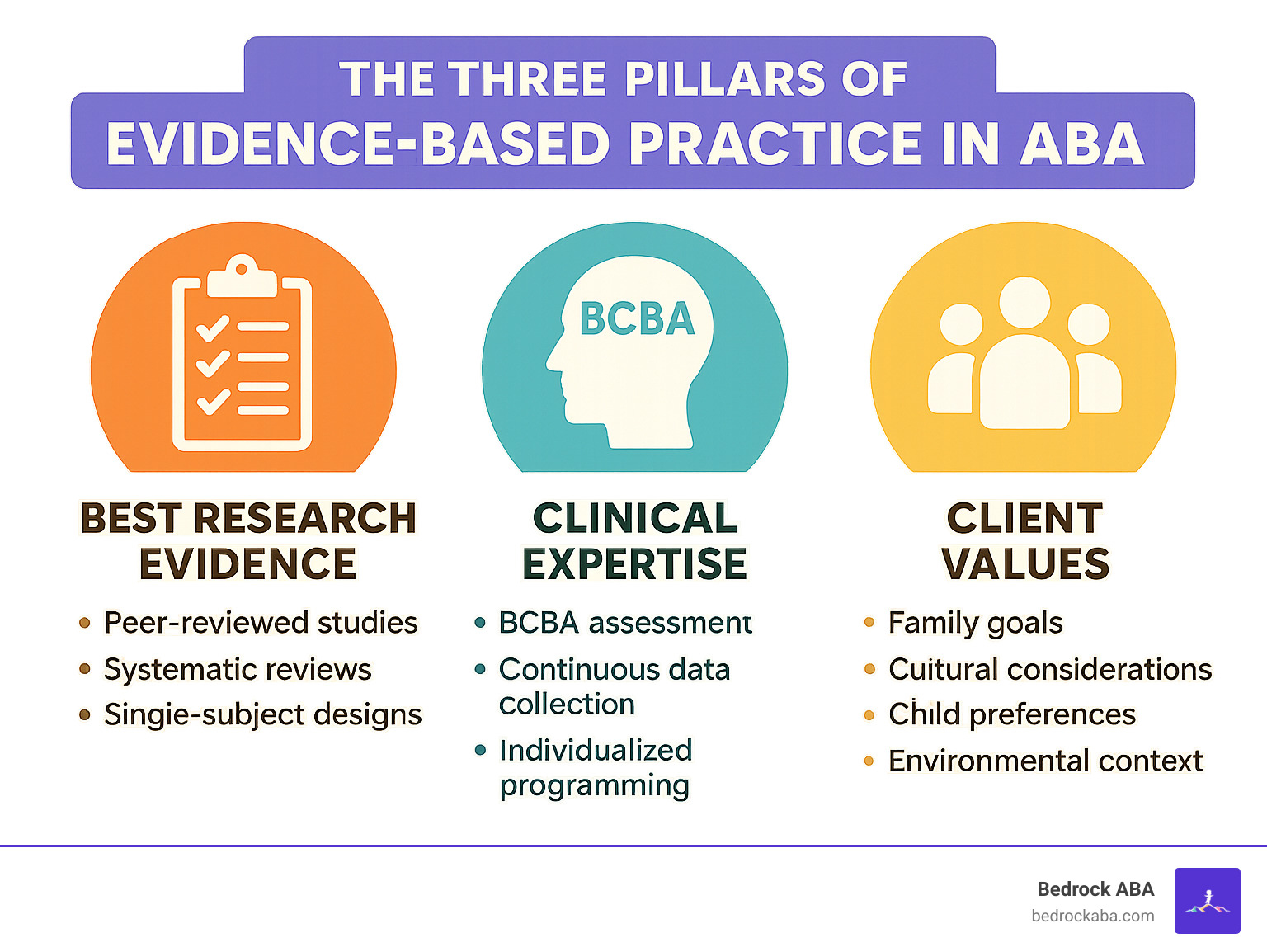
The Three Pillars of Evidence-Based ABA:
- Best Research Evidence – Over 20 studies show intensive ABA improves outcomes across intellectual functioning, language, and daily living skills
- Clinical Expertise – Board Certified Behavior Analysts (BCBAs) use ongoing data collection to customize interventions
- Client Values & Context – Treatment plans honor your family’s goals, culture, and your child’s unique needs
Key Evidence:
- ABA is recognized as evidence-based best practice by the US Surgeon General and American Psychological Association
- Studies show 40-50% of children receiving high-quality, intensive ABA can return to mainstream classrooms
- Modern ABA focuses on natural learning, positive reinforcement, and building independence
As one parent shared about their experience: “We get so many questions from families wondering how ABA therapy works! The most common question is about what strategies we use with your child.”
The reality is simple: ABA works because it’s built on science, shaped by expertise, and driven by what matters most to your family.
I’m Mayer Kulefsky, Director of Operations at Bedrock ABA, where I’ve helped expand ABA therapy evidence based services across multiple states including Utah and North Carolina. My experience has shown me that when families understand the research behind ABA, they feel more confident in their treatment decisions.
Simple aba therapy evidence based glossary:
What is ABA Therapy? A Look at its Evolution and Core Principles
Applied Behavior Analysis (ABA) is the science of learning and behavior – and it’s far more intuitive than it might sound. Think about it this way: every day, we naturally observe what happens before a behavior, the behavior itself, and what follows. ABA simply makes this process scientific and systematic.
This is called the Antecedent-Behavior-Consequence (ABC) model:
- Antecedent: What happens right before a behavior (like offering a snack)
- Behavior: The action itself (like your child saying “please”)
- Consequence: What follows (like receiving the snack)
When we understand these patterns, we can help children learn new skills and reduce challenging behaviors. The beauty of ABA therapy evidence based practice is that it focuses on improving socially significant behaviors – the skills that truly matter for your child’s daily life, relationships, and happiness.
Modern ABA has transformed dramatically from its early days. Today’s approach emphasizes positive reinforcement, natural learning environments, and genuine collaboration with families. We’ve moved far beyond rigid, clinical settings to accept play-based, child-led learning that honors each child’s unique interests and personality.
The Historical Roots of ABA
The story of ABA begins with B.F. Skinner and his groundbreaking work in behaviorism during the mid-20th century. Skinner finded that behaviors followed by positive consequences were more likely to happen again – a principle we now call positive reinforcement.
In the 1960s, Dr. O. Ivar Lovaas began applying these principles to help children with autism. While his early work showed promise, many of his methods included approaches we now recognize as inappropriate and overly harsh.
The field truly found its scientific footing with a landmark 1968 article by Baer, Wolf, and Risley. This foundational JABA article established the seven dimensions of ABA that still guide our work today. These dimensions ensure that ABA interventions are applied (focused on meaningful behaviors), behavioral (observable and measurable), analytic (scientifically sound), technological (clearly defined), conceptually systematic (theory-based), effective (produces real change), and promote generality (skills transfer to real life).
These principles transformed ABA from a collection of techniques into a true science of behavior change.
The Shift to Modern, Compassionate ABA
Today’s ABA looks nothing like those early models – and that’s exactly how it should be. We’ve acceptd a client-centered approach that puts your child’s happiness and dignity first.
Modern ABA prioritizes assent-based learning, which means we make sure children are willing participants in their therapy, not just compliant ones. We use trauma-informed care principles, recognizing that stress and past experiences deeply impact how children learn and grow.
Our focus on quality of life means we target skills that improve your child’s happiness, relationships, and sense of belonging. Whether it’s learning to communicate their needs, playing with friends, or gaining independence in daily routines, every goal serves a meaningful purpose.
Perhaps most importantly, we’ve shifted to true collaboration with families. Parents aren’t just observers – they’re partners in setting goals, celebrating progress, and ensuring therapy fits seamlessly into family life. This partnership approach recognizes that families know their children best and that lasting change happens when everyone works together.
This evolution reflects our growing understanding that effective therapy must honor the whole child – their communication style, their cultural background, their sensory needs, and their individual path to growth.
The Three Pillars of Evidence-Based Practice in ABA

When families ask me what makes ABA therapy evidence based, I like to think of it as a three-legged stool. Take away any one leg, and the whole thing falls over. Evidence-Based Practice (EBP) in ABA brings together research, clinical expertise, and your family’s unique values to create treatment that actually works in real life.
This approach, supported by the APA policy on evidence-based practice, ensures that every decision about your child’s therapy is grounded in solid science while honoring what matters most to your family. It’s not about following a cookie-cutter manual – it’s about making smart, individualized choices for your child.
Pillar 1: Best Available Research Evidence
The research backing ABA is impressive. We’re talking about more than 20 studies showing that intensive, long-term ABA therapy leads to significant improvements in intellectual functioning, language development, daily living skills, and social functioning. The National Autism Center reviewed 775 studies spanning 50 years and consistently found ABA-based interventions to be the most effective approach for autism spectrum disorder.
But here’s something interesting: Of the 11 interventions for Autism Spectrum Disorder identified in the National Autism Center’s 2009 report, only three were considered practices that had been standardized in manuals. This actually highlights why individualized programming is so crucial – research gives us the foundation, but every child needs their own unique approach.
The research evidence comes from many sources. Systematic reviews and meta-analyses combine results from multiple research projects to give us the big picture. Randomized controlled trials compare ABA to other treatments using gold-standard research designs. Single-subject designs provide detailed studies of individual children’s progress over time, while peer-reviewed journals ensure that all this research meets rigorous scientific standards.
What makes this research particularly compelling is its focus on real-world outcomes. We’re not just looking at test scores – we’re measuring whether children can communicate their needs, make friends, and participate more fully in family and community life.
Pillar 2: Clinical Expertise and Data Collection
This is where the science meets the art of therapy. Our Board Certified Behavior Analysts (BCBAs) bring years of specialized training to every treatment decision. They conduct thorough assessments, including Functional Behavior Assessments (FBAs), to understand exactly what’s driving your child’s behavior patterns.
But clinical expertise goes far beyond credentials. It includes ongoing assessment to continuously evaluate your child’s progress and changing needs. Every session involves data-driven decision making using objective measurements to guide treatment choices. Our BCBAs become experts at visual analysis – reading graphs and charts to spot patterns and trends that might not be obvious day-to-day.
Perhaps most importantly, clinical expertise means knowing when and how to modify interventions based on what the data shows. At Bedrock ABA, we collect data in every session. This isn’t just paperwork – it’s our compass. When we see a child struggling with a particular skill, the data tells us exactly when to try a different strategy, adjust our approach, or celebrate a breakthrough.
Continuous data tracking allows us to make small adjustments before small problems become big ones. It’s like having a GPS for your child’s learning journey – we always know where we are and can adjust the route as needed.
Pillar 3: Client Values, Preferences, and Context
This pillar is what transforms good research and clinical skills into truly personalized care. We recognize that every family brings their own cultural background and values, communication preferences, daily routines and priorities, and long-term goals and dreams to the therapy process.
The family-centered approach means we work as partners with you to ensure that therapy goals are socially significant – meaning they matter in your child’s real life. Whether that’s learning to communicate basic needs, developing friendships, or preparing for independence, the goals must align with what’s most important to your family.
Cultural considerations play a huge role in treatment planning. What works in one family’s context might not fit another’s lifestyle or values. We take time to understand your family’s unique environmental fit and make sure our interventions make sense in your world.
Collaborative goal setting ensures that we’re all working toward the same outcomes. We regularly ask ourselves: Are these goals meaningful to the child and family? Are our procedures respectful and acceptable? Are the outcomes making a real difference in daily life?
This focus on social significance means we’re not just teaching skills for the sake of teaching skills. We’re building capabilities that will help your child participate more fully in family life, school, and their community. That’s what makes ABA therapy evidence based – it’s grounded in research, guided by expertise, and driven by what matters most to your family.
Key Strategies: How is ABA Therapy Evidence Based in Practice?

Here’s where the science of ABA therapy evidence based practice really comes alive. We take decades of research and transform it into strategies that work in your child’s everyday world. It’s not about choosing just one approach – it’s about skillfully combining multiple evidence-based techniques to create something uniquely effective for your child.
Think of it like cooking. You might have a fantastic recipe (the research), but a great chef knows how to adjust the ingredients and techniques based on what’s in the pantry and who’s coming to dinner. That’s exactly how we approach ABA therapy.
Discrete Trial Training (DTT)
DTT has come a long way from its early days of rigid table work. Today’s DTT is structured but warm, data-driven but flexible. We break complex skills into bite-sized pieces that make sense to your child.
The magic happens in the details. When we’re teaching a child to identify colors, we don’t just drill flashcards. We use their favorite dinosaurs, their beloved stuffed animals, or whatever captures their interest. Every response gets tracked, but more importantly, every success gets celebrated.
The beauty of modern DTT is that it moves at your child’s pace. If they master red and blue quickly, we add green. If they need more time, we stick with what’s working. The data shows us exactly when they’re ready for the next step, and when we need to try a different approach.
Natural Environment Teaching (NET)
This is where ABA therapy evidence based practice gets really exciting. NET follows your child’s natural interests and motivations, turning everyday moments into powerful learning opportunities.
Picture this: Your child loves playing with bubbles. Instead of putting the bubbles away to do “therapy,” we use that motivation to teach communication. They learn to say “more” when they want more bubbles, “help” when they can’t open the container, and “my turn” when they want to blow bubbles themselves.
The research is clear – when children learn skills in natural contexts, those skills stick. They generalize better to other situations because they were learned in the real world from the start. Plus, when learning is fun and meaningful, children are naturally more engaged and motivated.
Other Core Evidence-Based Techniques
Our toolkit includes several other proven strategies that we weave together based on your child’s needs. Pivotal Response Training helps us focus on key areas like motivation and self-initiation – the skills that open up other learning. Token economies provide visual reward systems that help children stay motivated during longer learning sessions.
Functional Communication Training is particularly powerful for children who struggle with challenging behaviors. Instead of just trying to stop the behavior, we teach appropriate ways to communicate the same need. Positive Behavior Support takes this even further, preventing challenging behaviors by addressing the underlying needs before problems arise.
The real skill lies in knowing when and how to combine these techniques. Your child might benefit from structured DTT for academic skills, NET for social communication, and a token economy to stay motivated throughout their session. That’s where clinical expertise meets research evidence to create truly personalized programming.
Addressing the Conversation: Criticisms and Modern ABA’s Response
Let’s talk honestly about ABA therapy. The field has faced real criticisms over the years, and we believe these conversations are important. At Bedrock ABA, we’re committed to listening, learning, and continuously improving our practice based on feedback from the autism community and families we serve.
The neurodiversity movement has brought valuable perspectives to our field, emphasizing the importance of assent-based learning and moving beyond simple compliance. We’ve learned that effective therapy must honor each child’s voice and preferences, not just change their behavior.
Common Criticisms of ABA
Some of the concerns about ABA stem from older practices that we now recognize as problematic. These include worries about creating robotic behavior rather than authentic learning, the historical use of punishment in some programs, and practices that discouraged natural behaviors like stimming or other self-regulatory actions.
Perhaps most importantly, many criticized the lack of client autonomy in older ABA models. Too often, children weren’t included in decisions about their own therapy goals or given meaningful choices about their learning.
These concerns reflect real issues with how ABA was sometimes practiced in the past. We take these criticisms seriously because they’ve helped shape better, more ethical approaches.
How Today’s ABA Practices Promote Ethical and Effective Care
Modern ABA therapy evidence based practice looks dramatically different from those early models. We’ve fundamentally shifted how we approach therapy.
Positive reinforcement is now the cornerstone of everything we do. We celebrate successes and build on strengths rather than focusing on what’s “wrong.” At Bedrock ABA, we’ve moved completely away from any punitive measures – our programs are built around joy, engagement, and natural learning.
We now understand that teaching self-advocacy is just as important as teaching any other skill. Children learn to express their preferences, ask for breaks when they need them, and make meaningful choices about their learning. This builds the independence and self-determination that leads to lifelong success.
Honoring all forms of communication has become central to our practice. Whether a child communicates through words, gestures, behavior, or assistive technology, we meet them where they are. Our goal isn’t to force specific types of communication – it’s to help each child express themselves effectively in their own way.
Most importantly, we prioritize client happiness and dignity in everything we do. If a child isn’t enjoying their therapy sessions, that tells us we need to adjust our approach. Engagement and joy aren’t just nice-to-haves – they’re indicators that our programming is working effectively.
Our commitment to trauma-informed care means we recognize that some children may have had difficult experiences with therapy or other interventions in the past. We work carefully to build trust and ensure that every therapy session feels safe, supportive, and respectful.
Goals and Outcomes: Measuring Success in ABA Therapy

When parents ask me about success in ABA therapy evidence based practice, I always start with this truth: success isn’t about making your child look “typical.” It’s about meaningful progress toward goals that actually matter in their daily life.
Real success means your child can communicate their needs, build relationships, and gain independence in ways that bring them joy and confidence. Every child’s journey looks different, and that’s exactly how it should be.
What are the Overarching Goals of ABA Therapy?
The beauty of individualized ABA programming is that goals are chosen collaboratively with families, focusing on what matters most in your child’s real world.
Communication skills often top the priority list. Whether we’re working toward first words, complex conversations, or effective use of communication devices, the goal is helping your child express their thoughts, needs, and feelings. Some children learn to speak, others master sign language, and still others become skilled communicators through tablets or picture systems.
Social skills development helps children build meaningful relationships. This might mean teaching a shy child how to join playground games, helping a teenager steer lunch conversations, or supporting a young child in understanding when friends need space. We focus on genuine connection, not just following social rules.
Daily living skills build the foundation for independence. From brushing teeth and getting dressed to eventually managing money and cooking meals, these skills directly impact quality of life. We celebrate every step toward self-sufficiency, whether that’s a preschooler learning to zip their jacket or a teenager mastering grocery shopping.
Academic and pre-academic skills support success in school and beyond. This includes everything from sitting and attending during circle time to complex problem-solving strategies. We work closely with teachers to ensure skills learned in therapy transfer to the classroom.
When challenging behaviors interfere with learning or safety, we focus on understanding why they’re happening and teaching better alternatives. Rather than just stopping unwanted behaviors, we teach children more effective ways to communicate their needs and cope with difficult situations.
How is Progress Measured and What are the Expected Outcomes?
We measure progress through multiple lenses because data tells only part of the story. Continuous data collection happens in every session, giving us objective measurements of how your child is progressing on specific skills. This data acts like a GPS for therapy – showing us when to celebrate breakthroughs and when to adjust our approach.
Standardized assessments like the Vineland Adaptive Behavior Scales provide broader pictures of development across key areas. These formal evaluations help us track progress over time and identify new areas to target.
But here’s what really matters: family and teacher input. Regular conversations with parents and teachers tell us whether skills are actually showing up in real life. If your child is mastering skills in therapy but not using them at home or school, we need to adjust our approach.
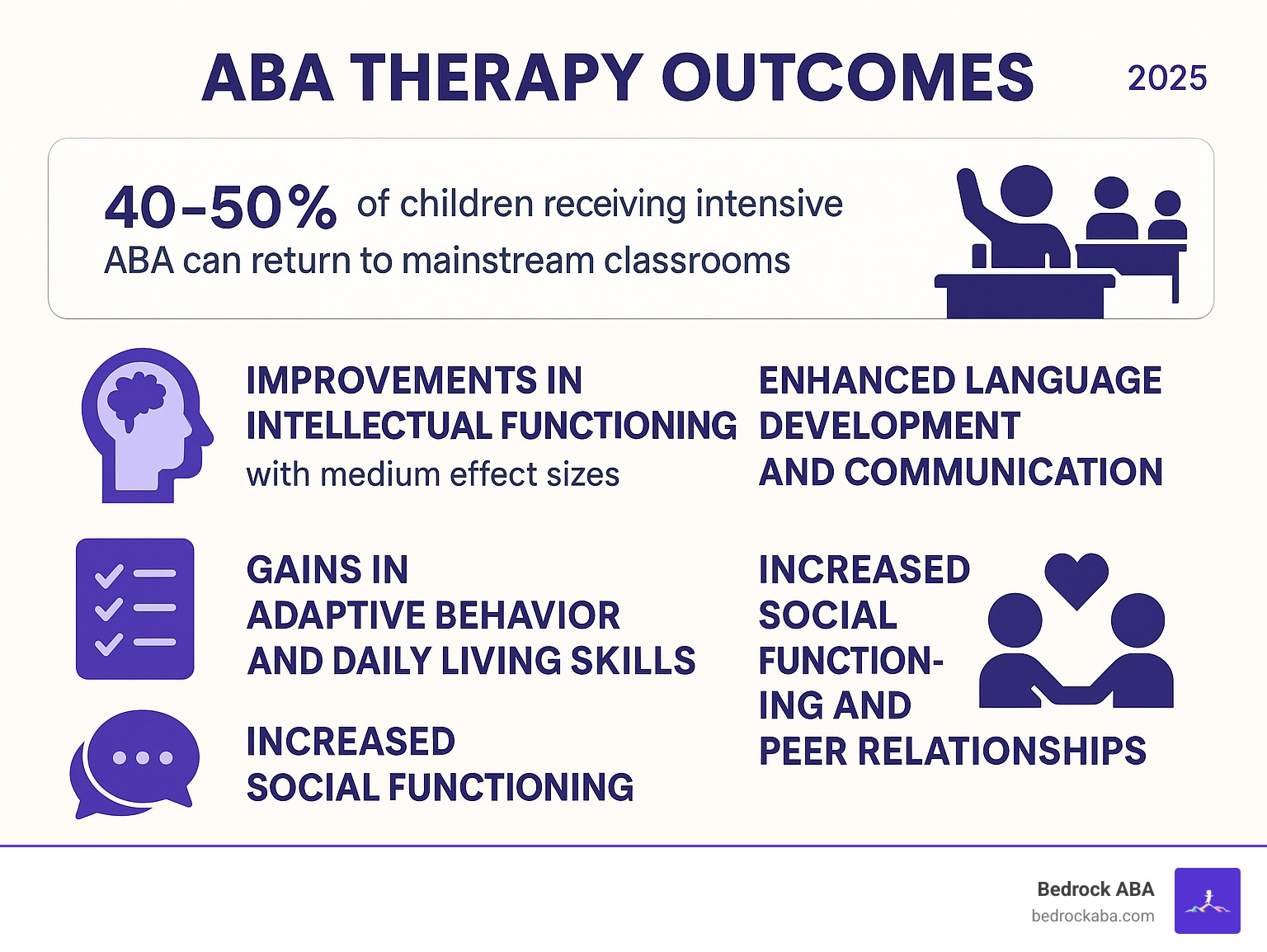
The research backing ABA therapy evidence based outcomes is compelling. Studies show that 40-50% of children receiving intensive, high-quality ABA services develop skills that allow them to succeed in mainstream classrooms. Meta-analyses demonstrate medium effect sizes for improvements in intellectual functioning and adaptive behavior. Long-term studies reveal that gains from early intensive intervention are maintained years later.
However, I want to be completely honest with you: success looks different for every child. For some families, success means their child speaks their first word. For others, it’s watching their teenager steer a part-time job or seeing their child make their first real friend.
The true measure of effective ABA isn’t whether your child fits someone else’s definition of “normal.” It’s whether they’re happier, more independent, and better able to participate in the life they want to live. That’s the kind of progress that matters most.
Conclusion
The evidence is clear: ABA therapy evidence based practice works because it brings together three powerful elements – solid research, skilled clinical expertise, and genuine respect for what matters most to your family. This dynamic field continues to evolve, always adapting to better serve children and families.
What makes ABA truly evidence-based isn’t just the impressive research studies or the clinical expertise of our BCBAs. It’s how these elements come together with your family’s values, your child’s unique personality, and your real-world goals to create something meaningful and effective.
At Bedrock ABA, we’ve seen how this integration creates lasting change. When we combine the latest research with our clinical experience and your family’s insights, we create programs that don’t just teach skills – they open doors to new possibilities for your child.
The proof of ABA’s effectiveness shows up in the small, daily victories that matter most to families. It’s in the moment when a child uses their words instead of tears to ask for help. It’s in the pride on a parent’s face when their child plays with friends at the playground. It’s in the confidence that grows as children master new skills and find their own capabilities.
We believe every child deserves access to interventions that are both scientifically sound and deeply compassionate. That’s why we offer flexible, family-centered care with both in-person and remote options. Whether you’re navigating this journey for the first time or looking for a new approach, we’re here to support you with evidence-based practices that honor your child’s individual path.
The beauty of modern ABA lies in its commitment to continuous improvement. As we learn more about how children learn and grow, our practices evolve too. We’re always refining our approach, always listening to families, and always working to provide the most effective and respectful care possible.
Ready to see how evidence-based ABA can support your child’s unique journey? Learn more about our personalized ABA therapy services and find how we can work together to help your child reach their full potential. Because when research, expertise, and family values come together, amazing things happen.