


Why Positive Behavior Support Changes Everything for Families
Positive behavior support (PBS) is a research-based approach that helps children with autism and developmental disabilities learn new skills and reduce challenging behaviors. It focuses on understanding, prevention, and teaching rather than punishment. Based on Applied Behavior Analysis (ABA) principles, its goal is to improve a child’s quality of life at home, school, and in the community.
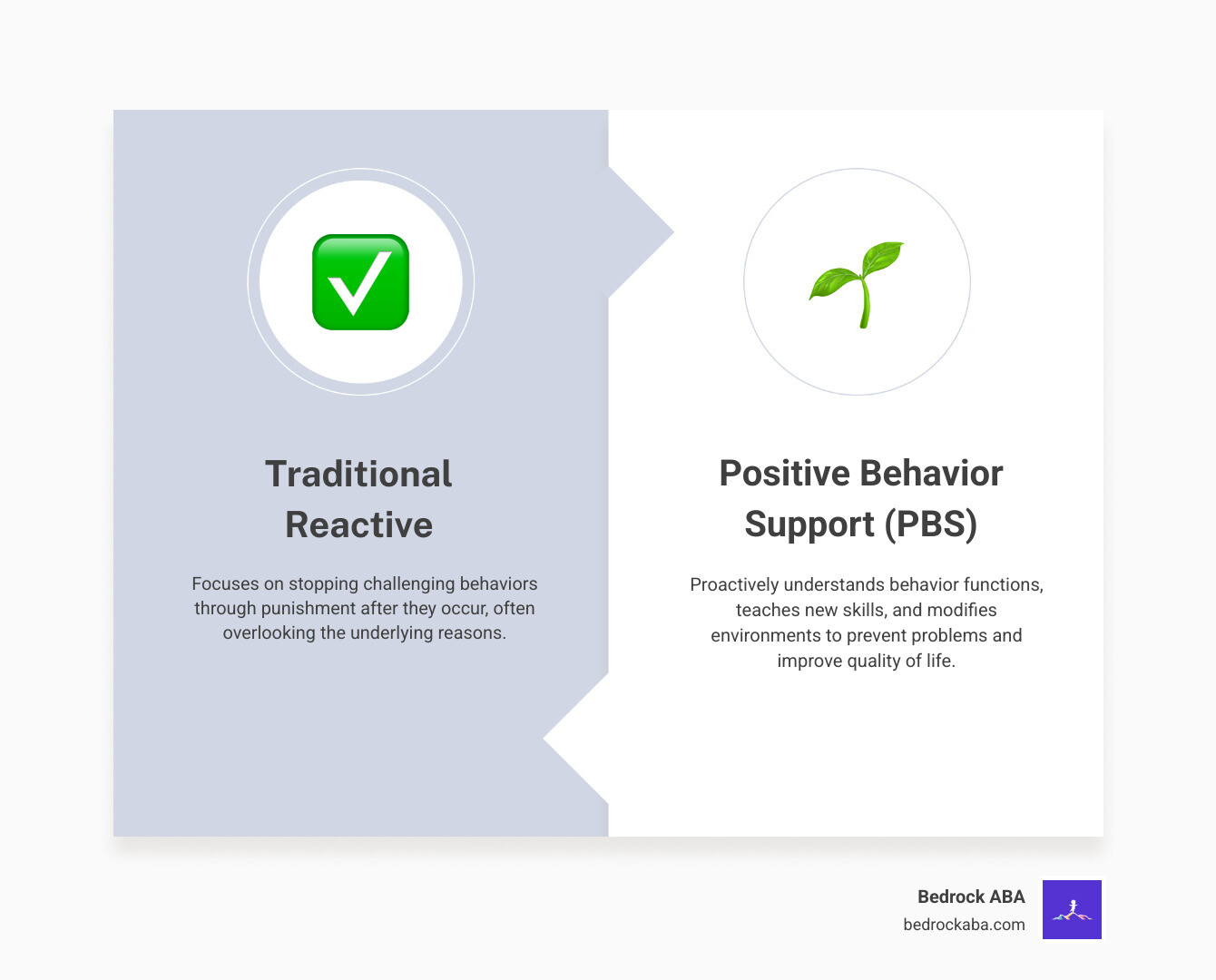
If your child struggles with tantrums or aggression, you know how overwhelming traditional discipline can be. These methods often focus on stopping behaviors without teaching what to do instead.
Positive behavior support takes a different path. It’s a proactive approach that helps you understand why your child behaves in certain ways. Are they trying to escape a difficult task, get attention, or communicate a need they can’t express in words? By understanding the reason, we can teach better alternatives.
This approach emerged in the 1980s as families and researchers sought more respectful and effective methods. Studies show that PBS can reduce problem behaviors by 90% or more in over half of cases. The focus is on prevention and teaching—setting your child up for success by modifying the environment and making appropriate behaviors more rewarding.
At Bedrock ABA, we’ve seen how positive behavior support transforms families by providing practical tools for real-world settings. The most successful interventions empower families with strategies they can use every day.
What is Positive Behavior Support (PBS) and How Did It Evolve?
Positive behavior support provides a roadmap for understanding your child’s challenging behaviors. Instead of just seeing a tantrum, PBS helps you see the why behind it. This person-centered approach improves your child’s quality of life by teaching them better ways to get their needs met.
PBS draws its strength from Applied Behavior Analysis (ABA), using scientific methods to understand behavior patterns. However, PBS wraps these techniques in values of dignity, choice, and inclusion. The Association for Positive Behavior Support offers a detailed guide on What is Positive Behavior Support?, and you can learn more about its foundations in our article What is ABA Therapy and How Does It Work?.
The Origins and Evolution of PBS
In the 1980s, families and researchers grew frustrated with harsh, punishment-based approaches. Disability advocacy groups pushed for methods that respected children’s dignity while helping them succeed. Early PBS pioneers focused on understanding the purpose of behaviors by looking at triggers and consequences. This revealed that most challenging behaviors were communication attempts. What began as individual interventions grew into system-wide approaches, like School-Wide Positive Behavior Interventions and Supports (SW-PBIS), proving the power of these principles on a larger scale.
Core Principles of Positive Behavior Support
The effectiveness of positive behavior support comes from six key principles.
- Understanding the ‘why’: We act as detectives to figure out what a child’s behavior is communicating.
- Being proactive and preventative: We modify environments and create routines to set children up for success before problems arise.
- Teaching replacement skills: We give children better tools to get their needs met, like asking for a break instead of throwing things.
- Environmental modifications: Simple changes, like reducing noise or using visual schedules, can dramatically reduce challenging behaviors.
- Data-driven decisions: We track what works and adjust our approach to ensure interventions are effective.
- Enhancing quality of life: Our ultimate goal is to help children live happier, more fulfilling lives with greater independence.
These principles are directly connected to ABA therapy. Explore these connections in our article Key Principles Behind ABA Therapy: Reinforcement, Behavior, and Learning.
Primary Goals and Desired Outcomes
When we implement positive behavior support, we aim for transformative outcomes.
- Decreasing problem behaviors: Tantrums and aggression lessen as children learn better strategies.
- Increasing appropriate skills: We add positive communication, social, and daily living skills.
- Building self-management: Children learn to recognize their feelings and use coping strategies independently.
- Fostering independence: Children can participate more fully in family, school, and community activities.
- Improving social relationships: Friendships become easier as children learn better ways to interact.
- Academic success: With behavioral challenges reduced, children can focus on learning.
- Community inclusion: The ultimate result is a child who can participate fully in their community.
The Key Components of a PBS Approach
Think of positive behavior support as building a house—it requires a strong foundation and a solid framework. The process is systematic, starting with your child’s unique needs and building from there. At Bedrock ABA, we involve families in this collaborative process to develop practical solutions that fit your daily life.

The Cornerstone: Functional Behavior Assessment (FBA)
Every effective positive behavior support plan begins with understanding the “why” behind a behavior. A Functional Behavior Assessment (FBA) is like solving a puzzle to see the complete picture of what your child is trying to communicate.
We use the ABC model: Antecedent (what happens before the behavior), Behavior (the action itself), and Consequence (what happens after). Tracking ABCs reveals patterns. For example, if a child throws toys when asked to clean up (antecedent) and avoids the task (consequence), the behavior may serve an “escape” function. Data is collected through direct observation and interviews with family and teachers. You can learn more from resources like Understanding Challenging Behaviour.
Developing an Individualized Positive Behavior Support Plan
Once we understand the why, we create a personalized Positive Behavior Support Plan. This roadmap includes:
- Proactive strategies: Environmental tweaks and visual schedules to prevent challenging behaviors.
- Teaching new skills: We teach better ways to communicate needs, such as asking for a break instead of screaming.
- Reinforcement strategies: We use motivators like praise or a favorite activity to encourage the use of new skills.
- Reactive strategies: Safe and effective responses for when challenging behaviors still occur, designed to avoid reinforcing them.
- Contextual fit: We ensure the plan is practical and sustainable for your family’s real life.
Our guide on Behavior Support Plan ABA offers more insight into how these plans are created.
Common PBS Strategies That Make a Difference
The positive behavior support toolkit is filled with practical strategies:
- Environmental modifications: Simple changes like reducing noise or organizing materials can prevent challenging behaviors.
- Providing meaningful choices: Offering options like “pajamas first or brush teeth first?” gives children a sense of control.
- Visual schedules: Pictures showing the day’s activities reduce anxiety about transitions.
- Social stories: Personalized stories describe social situations and appropriate responses.
- Teaching functional communication skills: Giving children effective ways to express their needs reduces frustration.
- Differential reinforcement: We strategically praise appropriate behaviors while carefully avoiding rewarding challenging ones.
Explore more techniques in our overview of The Different Types of ABA Therapy Techniques.
The Multi-Tiered Framework of Positive Behavior Support (PBIS)
In schools, positive behavior support is often implemented as Positive Behavior Interventions and Supports (PBIS). This three-tier pyramid provides different levels of support based on student needs, recognizing that not every child requires the same intervention.
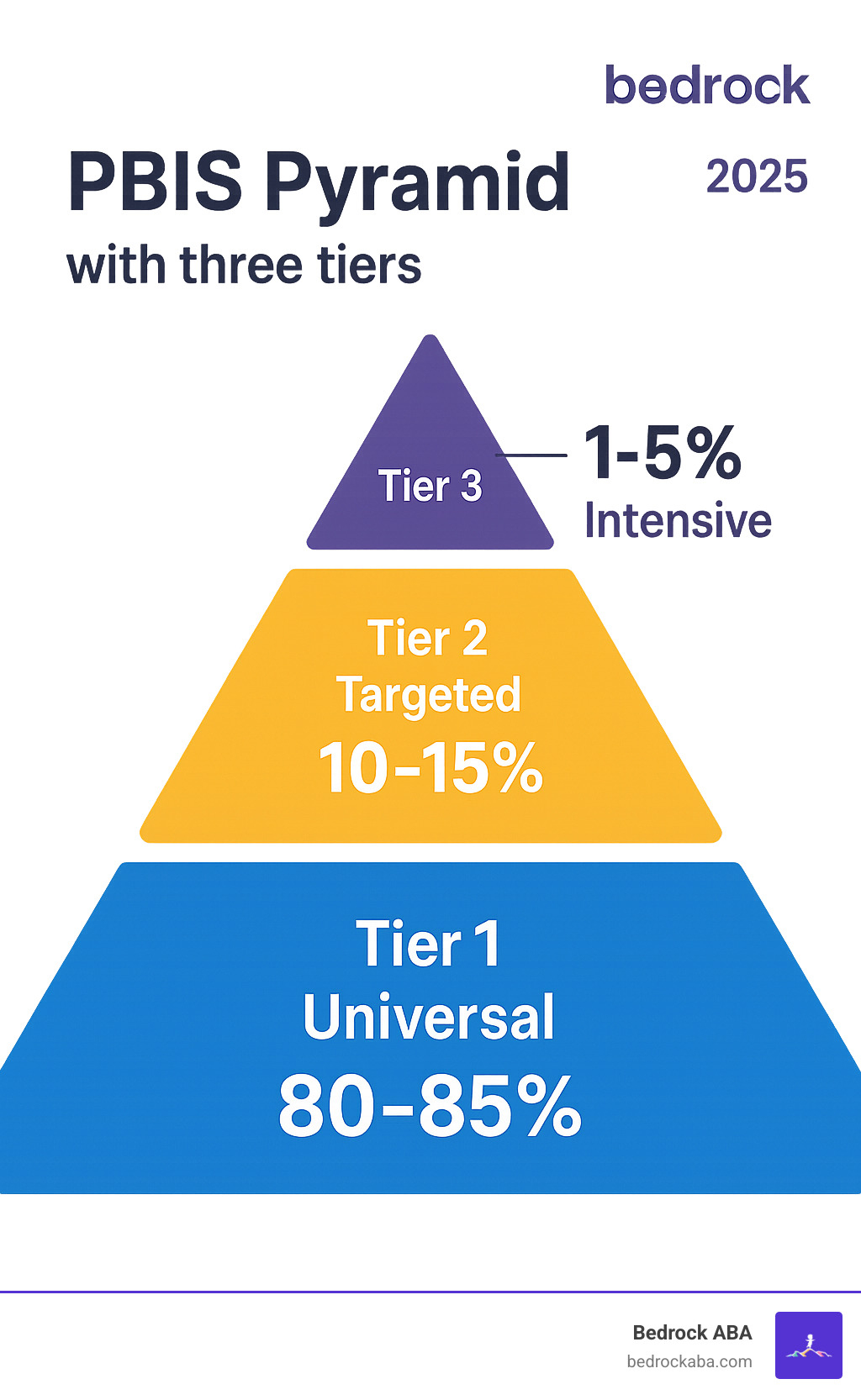
This framework focuses on prevention and data-based decision making. Schools can identify students who need extra help early, preventing small issues from becoming big ones.
Tier 1: Universal Support for All
The foundation of PBIS, Tier 1, creates a positive environment for every student and is effective for about 80-85% of the student population. Key components include:
- School-wide expectations: Simple, positive rules like “Be Respectful, Be Responsible, Be Safe” are actively taught.
- Teaching positive behaviors: Students learn and practice what good behavior looks like in different settings.
- Positive reinforcement: Systems are in place to recognize and reward students for doing the right thing.
- Active supervision: Adults engage with students, offering encouragement and reminders to foster a positive school culture.
Tier 2: Targeted Support for At-Risk Groups
For the 10-15% of students who need more support, Tier 2 offers a boost. These interventions are for students who may be struggling academically or socially. Strategies include:
- Small group interventions: Focused instruction on skills like conflict resolution or organization.
- Social skills training: Explicit, practical lessons on how to interact appropriately with others.
- Check-in/check-out systems: A daily meeting with a caring adult to set goals and celebrate success.
- Academic support: Addressing learning struggles that may be contributing to behavioral issues.
Tier 3: Intensive, Individualized Support
A small group, typically 1-7% of students, requires the most intensive support for significant behavioral challenges. Tier 3 provides comprehensive, customized help:
- Comprehensive FBA: A thorough investigation into all factors influencing a student’s behavior.
- Individualized behavior support plan: A unique plan with specific modifications, skill teaching, and reinforcement strategies.
- Wrap-around services: Collaboration with mental health professionals, community agencies, and other specialists.
- Family collaboration: Parents are active partners in developing and implementing the plan, ensuring consistency between home and school.
How PBS is Applied in Different Settings
One of the greatest strengths of positive behavior support is its adaptability. The same core principles of understanding behavior and teaching skills create a consistent foundation for success, whether at school, home, or in the community.
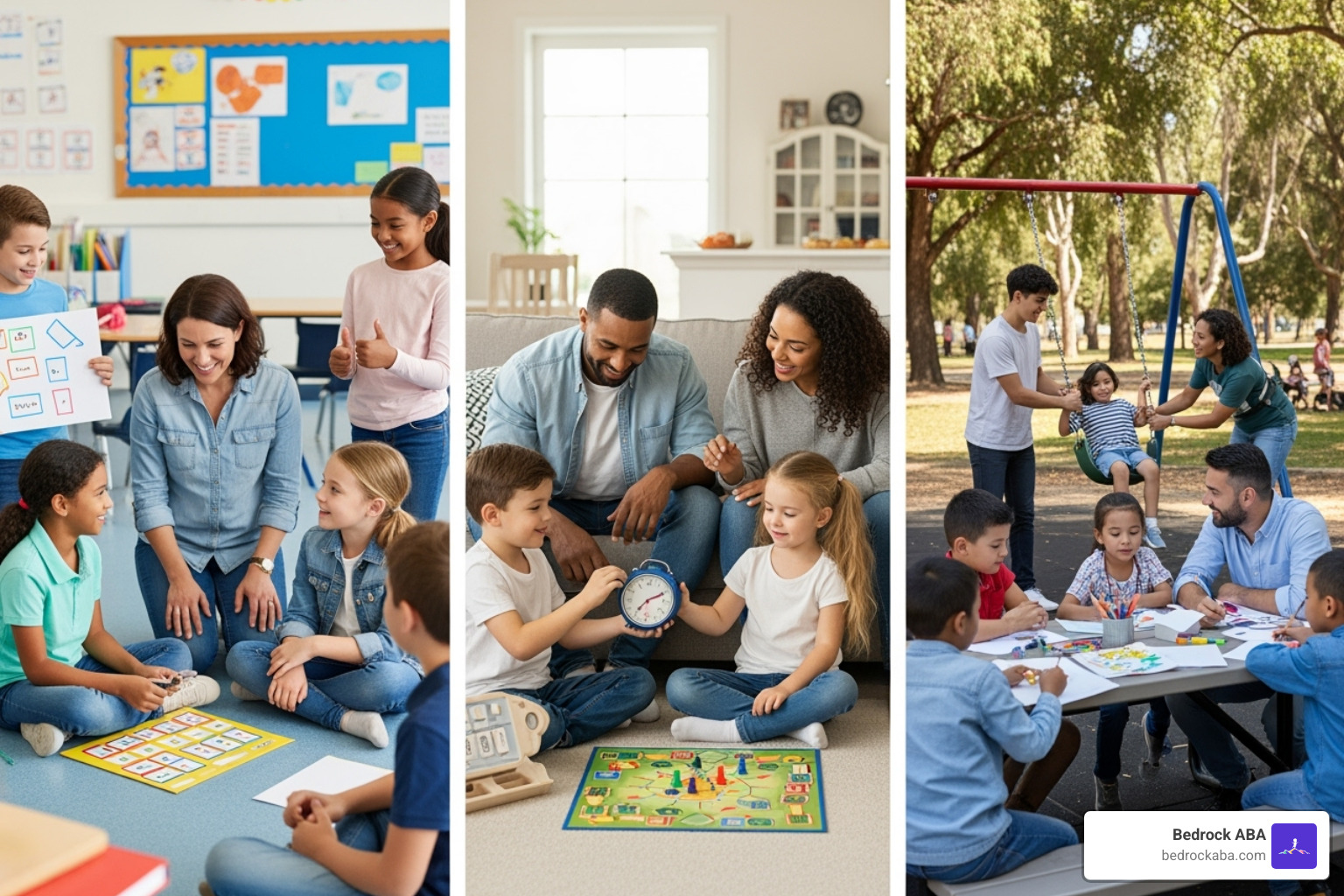
At Bedrock ABA, we know progress happens when everyone in a child’s world works together. Our family-centered approach supports children in their everyday environments where they live, learn, and play.
PBS in Schools
In schools, positive behavior support creates a safe and welcoming learning environment. When students are taught how to manage frustration and resolve conflicts, discipline referrals decrease, and academic outcomes improve. Teachers are trained with proactive tools, and administrative leadership champions a positive culture. This approach allows students to focus their energy on learning. Learn more about How ABA Behavioral Programs in Schools Can Benefit Children and our School-Based ABA Therapy services.
PBS in the Home
At home, positive behavior support can transform daily family life. Understanding the why behind your child’s behavior strengthens parent-child relationships and builds trust. Parents feel empowered with effective strategies, reducing stress. Key benefits include:
- Creating predictable routines to bring peace to the household.
- Teaching daily living skills like getting dressed and brushing teeth to build independence.
- Managing challenging behavior by preventing issues before they start.
Our commitment to Family Integration ABA reflects our belief that parents are their child’s most important teachers.
PBS in the Community
Community settings are where new skills are put to the test. PBS helps children participate confidently in activities alongside their peers. This support promotes inclusion in recreational settings like sports teams or art classes, and it can extend to job coaching for older individuals. By teaching skills for social connection, PBS helps build the friendships and community participation that lead to a rich, meaningful life.
Frequently Asked Questions about Positive Behavior Support
Parents often have thoughtful questions about positive behavior support. Here are answers to some of the most common ones.
Is Positive Behavior Support the same as ABA?
This is a great question. Positive Behavior Support and Applied Behavior Analysis (ABA) are closely related. Both use a scientific foundation to understand why behaviors happen and use strategies like reinforcement to teach new skills.
The key difference is that PBS has a broader vision. It places a strong emphasis on quality of life—helping a child build meaningful relationships and participate fully in their community. PBS also focuses on changing entire systems, like a school or family routine, to create environments that naturally support positive behavior for everyone. It is a highly collaborative and person-centered application of ABA principles. Learn more in our guide to Applied Behavior Analysis Therapy.
How do you know if PBS is working?
Positive behavior support is built on data, so progress is clear. We know it’s working when we see:
- A decrease in challenging behaviors: We track the frequency, duration, and intensity of problem behaviors, and you’ll see these numbers drop.
- An increase in new skills: We celebrate when your child uses words to ask for help, plays cooperatively, or tries new activities.
- Improved quality of life: The most meaningful measure is often feedback from families. Peaceful bedtimes, successful family outings, and better classroom participation are all signs of success.
If a strategy isn’t working, the data tells us to adjust our approach until we find what clicks for your child.
Who can implement a Positive Behavior Support plan?
The beauty of positive behavior support is that it’s a team effort. The people who work with your child every day are key to its success.
- Board Certified Behavior Analysts (BCBAs) design the plans and provide training and supervision.
- Parents and caregivers are essential partners who learn to implement strategies at home and in the community.
- Teachers and school psychologists often lead implementation in school settings.
- Registered Behavior Technicians (RBTs) provide direct therapy under BCBA supervision.
Successful outcomes happen when this collaborative team works together, combining clinical expertise with family insights.
Conclusion
For families feeling overwhelmed by challenging behaviors, positive behavior support offers a clear path forward. It provides hope by fundamentally shifting the perspective. Instead of asking, “How do we stop this behavior?” we ask, “What is this behavior trying to communicate?”
This understanding allows us to build skills rather than just reduce problems. We teach independence, foster relationships, and create environments where success is the natural outcome. This approach respects the dignity of every child while using proven scientific principles to create lasting, positive change.
At Bedrock ABA, our experienced Board Certified Behavior Analysts deliver positive behavior support that meets your family where you are—at home, in school, or through remote services. We believe every child deserves to reach their full potential, and every family deserves support that fits their unique needs.
With the right tools and team, you can create the peaceful, connected family life you’ve been hoping for.
Find out how our comprehensive approach can make a difference for your family: ABA Therapy Services in Utah.