


Why Understanding ABA Therapy Can Transform Your Child’s Future
What is ABA therapy for children is a question many parents ask after their child receives an autism diagnosis. Applied Behavior Analysis (ABA) is an evidence-based therapy that uses the science of learning and behavior to help children with autism develop essential skills while reducing challenging behaviors.
Quick Answer: What is ABA Therapy for Children?
- Definition: A scientific approach that breaks down skills into small steps and uses positive reinforcement
- Who it helps: Primarily children with autism spectrum disorder (ASD)
- Key focus areas: Communication, social skills, daily living skills, and reducing problem behaviors
- Evidence base: Endorsed by the US Surgeon General and American Psychological Association
- Intensity: Typically 15-40 hours per week for maximum benefit
- Best outcomes: When started early (as young as 18 months to 2 years old)
About 1 in every 36 children may have autism spectrum disorder, and more than 20 studies show that intensive ABA therapy can lead to significant improvements in learning, communication, and daily living skills.
The therapy focuses on understanding why behaviors happen and teaching new skills through positive reinforcement – rewarding good behaviors to encourage them. Modern ABA is play-based, fun, and always respects your child’s individual needs and interests.
As Mayer Kulefsky, director of operations at Bedrock ABA, I’ve seen how understanding what is ABA therapy for children helps families make informed decisions about their child’s care.
Why This Guide Matters
With autism spectrum disorder affecting approximately 1 in 36 children in the United States, families need reliable, evidence-based information to make the best decisions for their children. This guide provides clear answers about what ABA therapy involves, how it works, and what you can expect from the process.
At Bedrock ABA, we believe in transparent, family-centered care. Our goal is to explain ABA therapy so you can feel confident about your child’s treatment journey, whether you’re in Salt Lake City, Utah, or exploring options for the first time.
What Is ABA Therapy for Children: Definition & Evidence Base
What is ABA therapy for children at its heart? Applied Behavior Analysis is the science of learning and behavior, carefully applied to help children develop meaningful skills and reduce behaviors that might hold them back. Think of it as breaking down complex skills into manageable steps, then celebrating each small victory along the way.
ABA has been helping children with autism since the 1960s, evolving into today’s positive, play-based approach designed around what makes each child tick. The research backing this approach is impressive and keeps growing stronger.
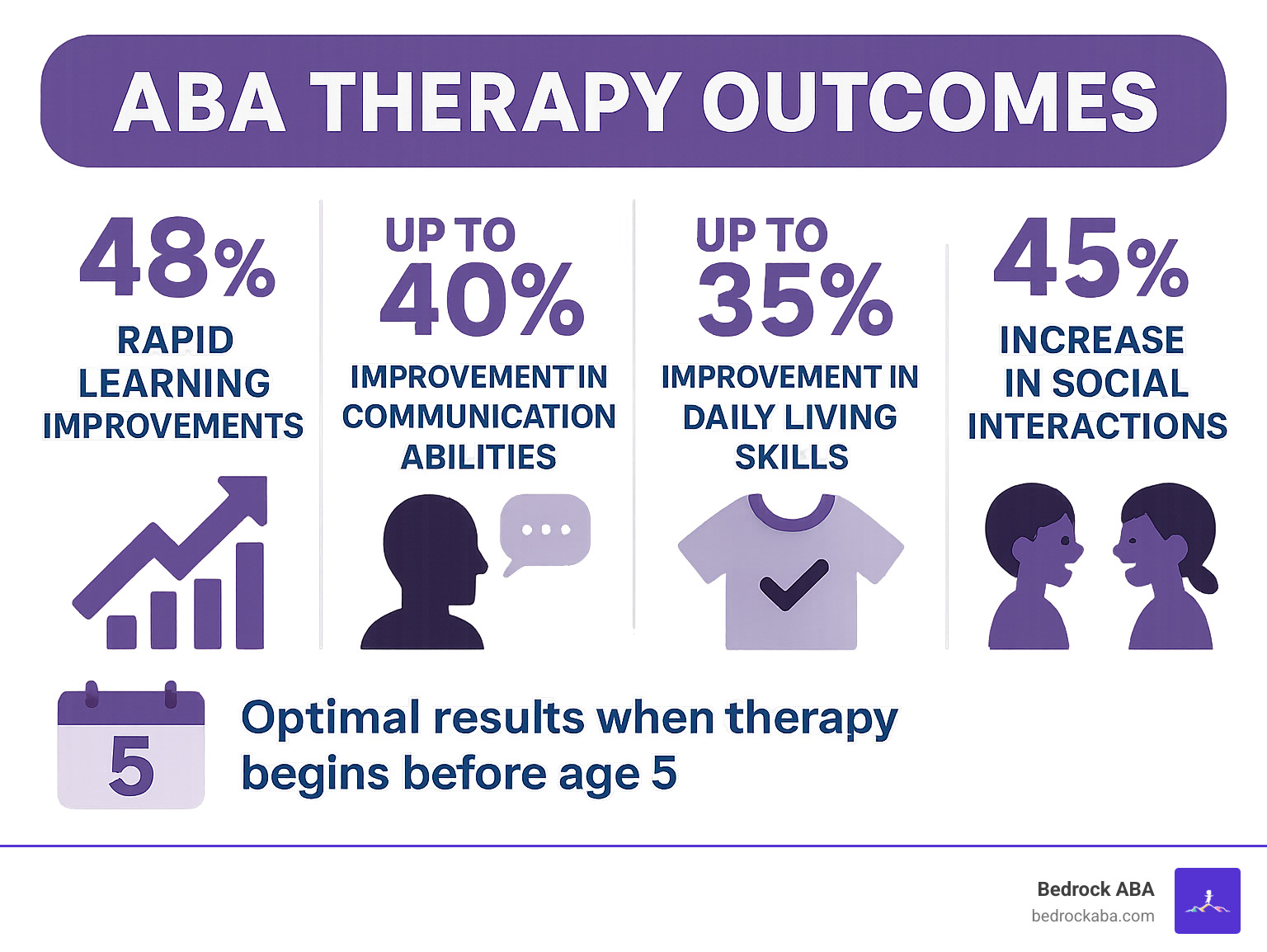
The numbers tell a compelling story. More than 20 studies show that intensive, long-term ABA therapy leads to significant improvements for many children with autism. 48% of children on the autism spectrum show rapid improvements in learning and test scores after ABA therapy. Children who receive at least 25 hours of ABA weekly demonstrate remarkable advances in their ability to learn and study new concepts.
Both the US Surgeon General and the American Psychological Association endorse ABA as an evidence-based treatment. Families looking for detailed scientific research on ABA outcomes will find extensive peer-reviewed studies showing measurable improvements across communication, social skills, and daily living abilities.
Timing matters tremendously in ABA therapy. While the average autism diagnosis happens around age 4, children as young as 18 months can show signs and benefit from early intervention. The research is clear: starting ABA before age 5 produces the most significant developmental gains.
For parents wanting to understand the fundamentals better, more info about ABA basics provides additional insights into how this therapy works.
Core Principles Behind ABA
Positive reinforcement drives everything we do in modern ABA. When your child does something wonderful, we make sure something good follows immediately. This positive experience makes your child want to repeat that behavior.
The ABC Model helps us understand the “why” behind behaviors. Antecedent is what happens right before a behavior, Behavior is what they do next, and Consequence is what follows. By tracking these patterns, we can set up situations that encourage positive behaviors and reduce challenging ones.
ABA therapy follows seven dimensions that keep our work scientifically sound and effective. These ensure we’re applied (focusing on skills that matter in real life), behavioral (targeting specific, measurable actions), and analytic (using data to prove our methods work).
Parents who want to explore these concepts further can dive into more info about reinforcement for additional details.
How ABA Therapy Works Day-to-Day
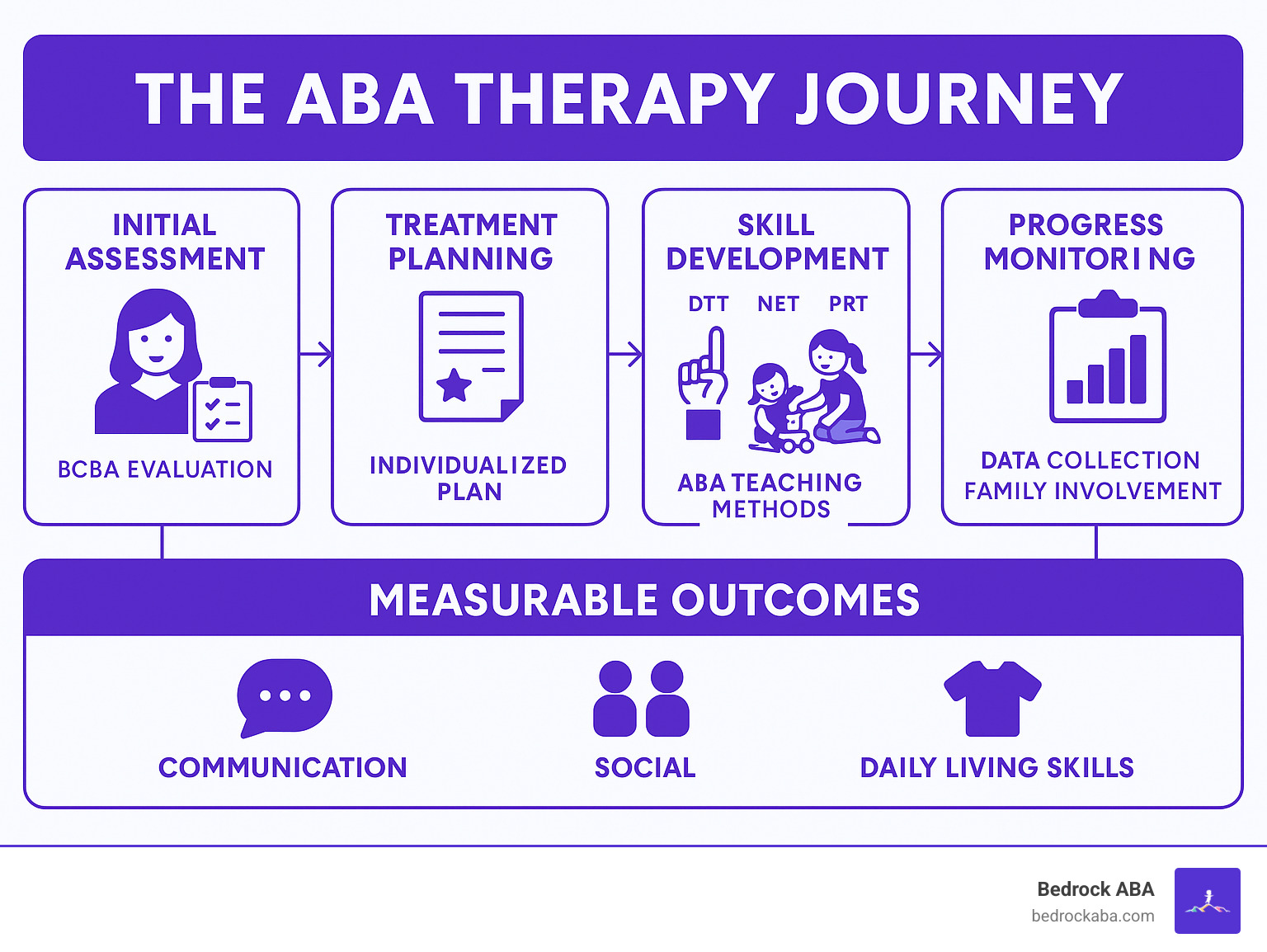
Every ABA program starts with a Functional Behavior Assessment (FBA) – creating a detailed map of your child’s unique strengths and areas where they need support. A Board Certified Behavior Analyst (BCBA) spends time observing your child, talking with family members, and using standardized tools to get a complete picture.
The BCBA is like the architect of your child’s program. They’ve earned a master’s degree, completed extensive training, and passed a challenging national exam. Your BCBA designs the treatment plan, trains the therapy team, and regularly reviews progress.
Registered Behavior Technicians (RBTs) work directly with your child during most sessions, bringing the BCBA’s plan to life while carefully tracking progress.
A typical session flows naturally from pairing and rapport building through structured learning to natural environment practice. Throughout it all, the therapist is quietly collecting data to track progress and celebrate wins.
What is ABA therapy for children in terms of where it happens? Modern ABA offers flexibility. Some families prefer home-based therapy for natural environment practice, while others choose clinic-based sessions for specialized equipment. Many programs include school-based support and community-based practice.
At Bedrock ABA, we also offer telehealth options for parent training and consultation sessions.
What Is ABA Therapy for Children in Practice?
Modern ABA is engaging and playful. Pairing and rapport building is where the magic begins – your child’s therapist becomes a detective, figuring out what makes your child light up.
Discrete Trial Training (DTT) is often disguised as games. Teaching colors might involve a treasure hunt, while learning directions could happen through an obstacle course.
Natural Environment Teaching (NET) takes advantage of your child’s interests. If your child loves trains, that’s where learning happens – counting train cars, identifying colors, practicing social phrases.
Pivotal Response Treatment (PRT) focuses on skills that open up other skills. Teaching a child to ask questions often leads to improved social connections and reduced frustration.
The Early Start Denver Model (ESDM) is designed for toddlers and preschoolers, combining ABA principles with developmental approaches through play-based activities.
Qualified Providers & Credentials
Board Certified Behavior Analysts (BCBAs) hold a master’s degree in behavior analysis, complete specific coursework, gain 1,500 hours of supervised fieldwork experience, and pass a comprehensive national examination. They must complete ongoing continuing education to maintain certification.
Registered Behavior Technicians (RBTs) complete a 40-hour training program, pass a competency assessment, and receive regular supervision from a BCBA.
The scientific research on credential standards shows these requirements are essential for ensuring ABA providers have the knowledge and skills to help children succeed.
Skills & Behaviors ABA Improves & How Progress Is Measured
When families wonder what is ABA therapy for children in terms of real-world impact, the answer lies in the incredible range of meaningful skills children develop through this evidence-based approach.

Communication breakthroughs often bring the most joy to families. We’ve seen non-verbal children learn to express their wants and needs clearly, while others develop rich conversational skills. ABA helps children learn to request their favorite snacks, follow instructions, answer questions, and engage in precious back-and-forth conversations.
Social connections flourish as children learn the unwritten rules of friendship. Simple skills like making eye contact or taking turns open doors to deeper relationships. Children learn to share toys naturally, recognize emotions, and join group activities with confidence.
Daily living independence transforms family life. Parents often share excitement when their child successfully completes toilet training, gets dressed independently, or tries new foods. ABA breaks down complex routines into manageable steps while teaching crucial safety skills.
Academic success builds through ABA’s systematic approach. Before tackling reading and math, children master foundational skills like matching colors, sorting objects, and identifying letters. The therapy helps develop attention and focus needed for classroom learning.
Self-management abilities empower children to handle life’s ups and downs with greater resilience. Learning to cope when plans change, express feelings appropriately, and solve problems independently builds confidence.
Challenging behavior reduction happens naturally as children learn better ways to communicate their needs. Rather than simply stopping unwanted behaviors, ABA teaches replacement skills that serve the same purpose.
The magic of ABA lies in generalization – ensuring skills transfer seamlessly to home, school, and community settings. Caregiver training makes this possible by teaching parents, teachers, and others to use ABA strategies consistently.
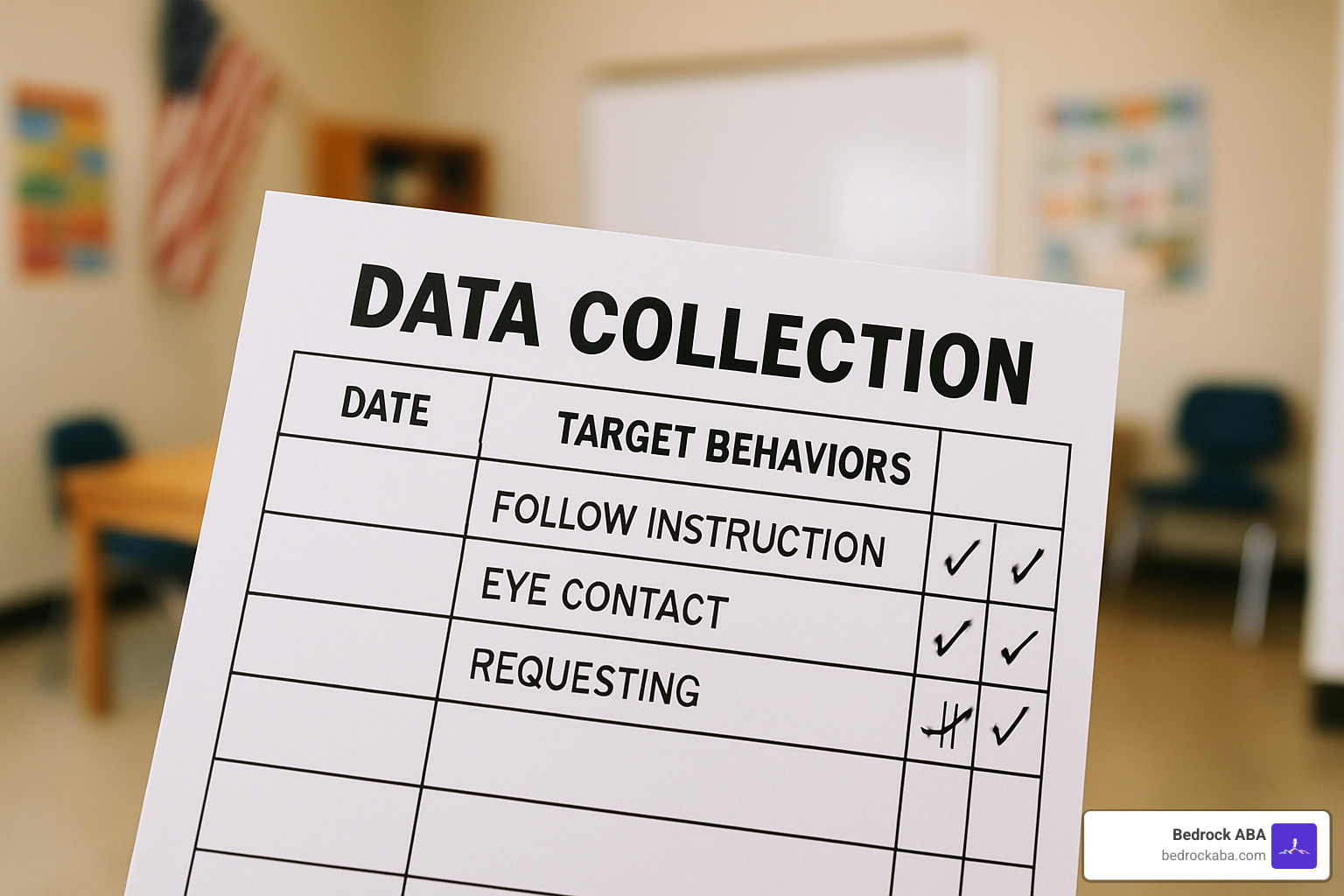
Data collection transforms good intentions into measurable progress through frequency recording, duration recording, and latency recording. This information gets transformed into clear graphs and charts that show progress over time.
Mastery criteria provide clear targets for each goal, while goal adjustment happens regularly based on what the data reveals.
For families wanting to explore specific examples of gains children make through ABA, we encourage reading more info about child gains.
Starting Your Child’s ABA Journey
Taking the first steps toward ABA therapy can feel overwhelming, but the process is more straightforward than it might seem, with qualified professionals guiding you every step of the way.

Diagnosis and referral often serve as the starting point, though a formal autism diagnosis isn’t always required to begin services. While autism can be reliably diagnosed as early as 18 months, many children don’t receive their diagnosis until around age 4.
Insurance authorization is often easier than families expect. Most state health plans, including Medicaid, now cover ABA therapy when medically necessary. Contact your insurance provider to understand your specific benefits and authorization requirements.
The intake evaluation includes direct observation of your child, parent interviews to understand your family’s priorities, standardized assessments to measure current skills, and record review from other providers.
Goal setting emerges from this evaluation. The BCBA partners with your family to identify what matters most, creating goals that are meaningful, measurable, achievable, and relevant to your child’s needs.
Treatment hours vary based on individual needs. Early intensive programs often involve 20-40 hours per week, while school-age children might receive 10-25 hours weekly. Focused interventions might require just 5-15 hours per week.
Early intervention benefits are compelling – children who begin ABA before age 5 show significantly better outcomes than those who start later.
The home versus center choice depends on your family’s needs. Home-based therapy allows practice in natural environments, while center-based therapy provides specialized equipment and peer interaction opportunities.
State mandates have improved access to ABA therapy, with most states now requiring insurance coverage. Funding options include Medicaid waivers, educational funding through IEPs, grants and scholarships, and FSAs or HSAs.
Your parent role is crucial for success. Training modules typically cover understanding ABA principles, implementing strategies at home, collecting data, generalizing skills, and managing challenging behaviors.
For families ready to explore ABA options in detail, we recommend reading more info about starting ABA.
What Is ABA Therapy for Children & Family Involvement
Parents and caregivers are the secret ingredient that makes ABA therapy truly effective. The magic happens when skills extend beyond formal therapy sessions into daily family life.
Home practice transforms therapy concepts into real-world abilities through visual schedules, communication practice during dinner, consistent behavior strategies, and social skill opportunities with siblings.
Consistency across all settings accelerates progress dramatically. Data sharing keeps everyone informed, while IEP collaboration ensures ABA goals align with educational objectives.
Community outings provide invaluable real-world practice opportunities, bridging the gap between therapy sessions and everyday life.
Frequently Asked Questions about ABA Therapy for Children
When should my child start ABA?
The golden rule of what is ABA therapy for children is simple: the earlier, the better. If you’re wondering when to start, research gives us a clear answer – children who begin ABA therapy before age 5, and especially before age 3, show the most remarkable improvements.
Here’s the encouraging news: autism can be reliably diagnosed as early as 18 months. Some children even show early warning signs before their first birthday. This early window is precious because young brains are incredibly adaptable and ready to learn new skills.
But let’s address the worry many parents have – it’s never “too late” to start ABA therapy. While early intervention provides the greatest benefits, we’ve seen children of all ages learn new skills and overcome challenging behaviors through ABA. The approach simply gets adapted based on where your child is developmentally and what your family needs most.
You might wonder if your child could benefit from ABA therapy. Common signs include delays in communication or language development, where your child might not be reaching typical milestones for talking or understanding others. Difficulty with social interactions is another indicator – perhaps your child struggles to play with others or doesn’t seem interested in social games.
Repetitive behaviors that interfere with daily activities can also signal that ABA might help. Maybe your child gets stuck on certain routines or behaviors that make family life challenging. Challenges with daily living skills like toilet training, eating a variety of foods, or getting dressed can be addressed through ABA techniques.
If your child has frequent tantrums or other challenging behaviors that seem beyond typical childhood struggles, or difficulty following instructions or transitioning between activities, ABA strategies can make a real difference for your whole family.
How many hours per week are ideal?
When families ask “what is ABA therapy for children” in terms of time commitment, there’s no one-size-fits-all answer. The “ideal” number of hours depends on your child’s unique needs, age, and what works for your family’s life.
Research gives us some helpful guidelines to start the conversation. Early intensive intervention for children ages 2-5 often involves 25-40 hours per week. This might sound like a lot, but this intensive approach takes advantage of rapid early brain development and can lead to life-changing improvements in multiple skill areas.
For school-age children between 6-12 years old, 15-25 hours per week may be more appropriate. This often gets combined with school-based services, creating a comprehensive support system. The focus might shift to addressing specific skill gaps or challenging behaviors that interfere with learning.
Adolescents and teens typically benefit from 10-20 hours per week, with therapy often focusing on independence skills, social relationships, and preparing for adult life. At this stage, quality and relevance matter more than quantity.
Some children need focused interventions of just 5-15 hours per week when they’re doing well overall but need support in specific areas like communication or social skills.
Here’s something important to remember: “more is not always better.” The key is finding the right intensity that addresses your child’s specific needs while fitting within your family’s capacity and schedule. Your child also needs time for other important activities like family time, free play, and simply being a kid.
Your BCBA will work closely with you to determine the appropriate intensity and will adjust the hours as your child progresses. Some families start with higher intensity and gradually reduce hours as skills develop, while others begin with fewer hours and increase as needed.
Is ABA therapy covered by insurance?
The good news is that ABA therapy is covered by most insurance plans, though coverage can vary significantly depending on where you live and your specific plan. Understanding your benefits helps you plan for your child’s care without financial stress.
Federal requirements under the Affordable Care Act mandate that most insurance plans cover autism treatments, including ABA therapy, when they’re deemed medically necessary. This federal protection has been a game-changer for families seeking ABA services.
State mandates add another layer of protection. Most states have passed laws requiring insurance companies to cover autism treatments, though the details vary. Some states have age limits for coverage, while others provide benefits throughout childhood and even into adulthood. Annual or lifetime benefit caps differ by state, as do requirements for physician referrals or pre-authorization.
Medicaid coverage is often the most comprehensive option available. All state Medicaid programs must cover medically necessary ABA services for children under 21. If your family qualifies for Medicaid, this can provide extensive coverage with minimal out-of-pocket costs.
Private insurance coverage has improved dramatically over the past decade. Many plans now include robust ABA benefits covering assessment and treatment planning, direct therapy services, parent training and consultation, and progress monitoring and reporting.
To understand your specific coverage, start by contacting your insurance provider directly. Ask about any pre-authorization requirements – some plans require approval before services begin. Understanding limits on hours, providers, or duration of services helps you plan effectively. Don’t forget to ask about co-pays, deductibles, and out-of-pocket maximums so you can budget accordingly.
When working with insurance, keeping detailed records of all communications protects your family’s interests. Understanding the appeals process can be helpful if coverage is initially denied – many denials get overturned on appeal. Working with providers experienced in insurance authorization makes the process much smoother.
At Bedrock ABA, we work closely with families to steer insurance coverage and ensure that financial barriers don’t prevent children from accessing the services they need. Our team understands the ins and outs of insurance authorization and can help guide you through the process.
Conclusion
Understanding what is ABA therapy for children is the first step in a journey that can transform your child’s future. Throughout this guide, we’ve explored how ABA therapy uses positive reinforcement and evidence-based teaching methods to help children with autism develop the skills they need to thrive in their daily lives.
The science speaks for itself. With backing from the US Surgeon General and American Psychological Association, plus decades of research showing meaningful improvements in communication, social connections, and independence skills, ABA offers both hope and proven results for families facing autism.
What makes ABA truly powerful isn’t just the research – it’s the real-world changes families see every day. When a child says “please” for the first time, successfully uses the bathroom independently, or plays cooperatively with a sibling, those moments represent more than skill acquisition. They represent increased confidence, reduced family stress, and expanded possibilities for the future.
At Bedrock ABA, we understand that every family’s journey is unique. That’s why our approach centers on flexibility and genuine partnership with parents. Whether you’re in Salt Lake City, Utah, or connecting with us remotely, we work together to create programs that fit your child’s learning style, your family’s schedule, and your priorities for growth.
What is ABA therapy for children ultimately comes down to this: it’s about giving kids the tools they need to communicate what they want, connect with people they care about, and steer their world with greater independence. It’s also about empowering parents with strategies and confidence to support their child’s continued growth long after formal therapy sessions end.
The path forward doesn’t have to feel overwhelming. With the right support team, clear information, and evidence-based interventions, children with autism can develop skills that seemed impossible just months earlier. Every child has unique strengths and potential – ABA therapy helps open up those possibilities.
If you’re ready to explore how ABA therapy might help your child flourish, we’re here to guide you through the process. Learn more about our comprehensive ABA Services for Children or reach out today to discuss your child’s specific needs and how we can support your family’s journey toward meaningful growth and lasting success.