


Why ABA Telehealth is Changing Autism Care
ABA telehealth delivers Applied Behavior Analysis therapy through secure video platforms, bringing evidence-based autism treatment directly to your home. Here’s what you need to know:
Key Benefits:
– Accessibility – Reach qualified BCBAs regardless of location
– Flexibility – Schedule sessions around your family’s routine
– Cost-effective – 66% reduction in therapy costs compared to in-person
– Proven results – 86% of families report improved behaviors
– Continuity – Maintain therapy during disruptions or illness
How It Works:
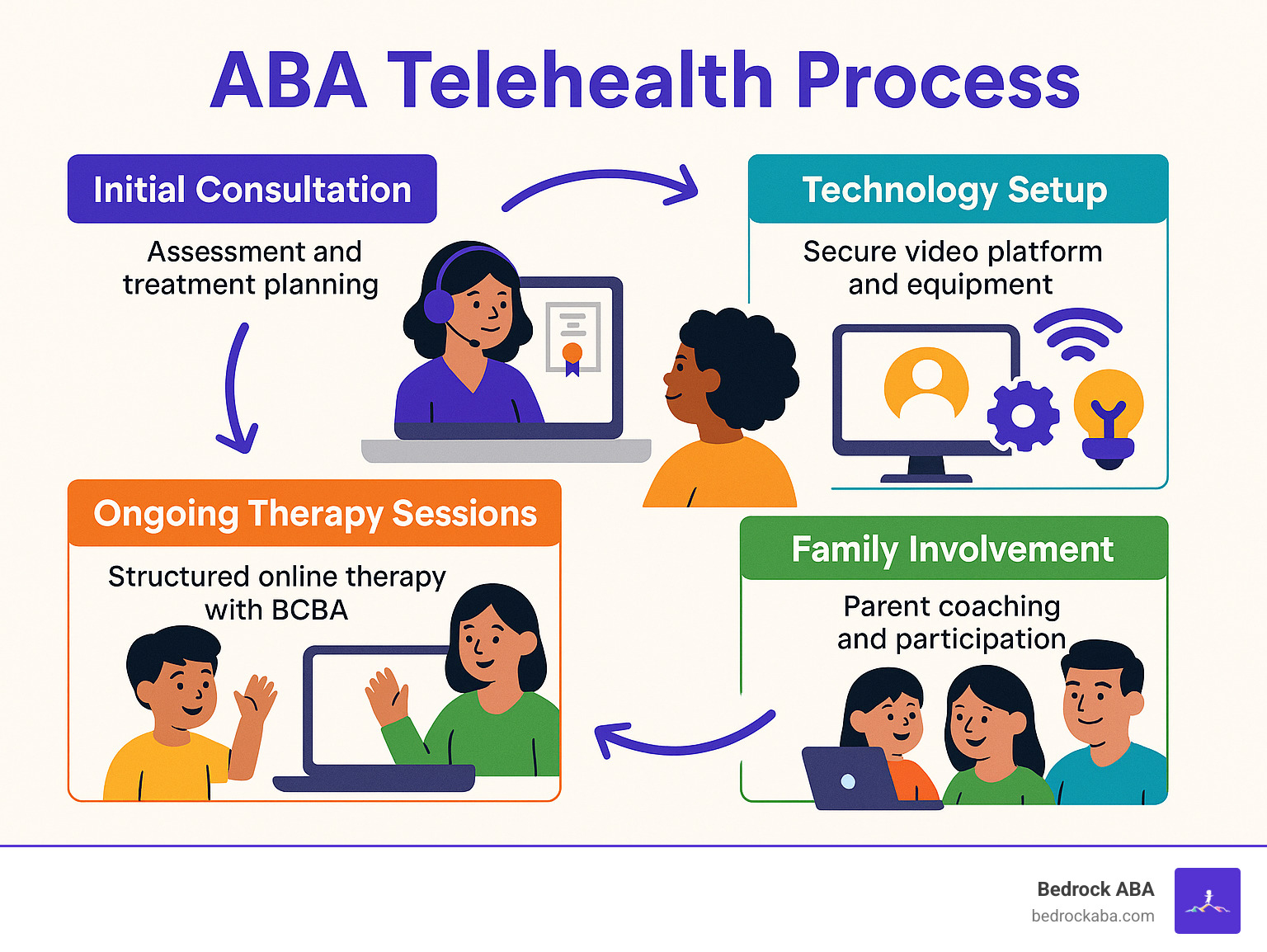
1. Initial assessment and treatment plan via video call
2. Live therapy sessions using HIPAA-compliant platforms
3. Real-time BCBA supervision and parent coaching
4. Data collection and progress monitoring
5. Skills practiced in your child’s natural environment
The COVID-19 pandemic accelerated telehealth adoption across healthcare, with ABA therapy leading the charge. Research shows that telehealth direct therapy can be just as effective as in-person treatment for teaching new skills to individuals with autism spectrum disorder.
For busy parents juggling work, school, and multiple appointments, ABA telehealth offers a lifeline. No more driving across town twice a week or rearranging your entire schedule around clinic hours. Your child receives the same quality intervention – sometimes even better outcomes – right from your living room.
As Mayer Kulefsky, Director of Operations at Bedrock ABA, I’ve witnessed how ABA telehealth transforms families’ access to quality behavioral health services across multiple states including North Carolina and Utah. My experience expanding telehealth programs has shown me that remote delivery often increases parent engagement and accelerates skill generalization in the home environment.
What Is ABA Telehealth?
Imagine your child learning to communicate, play, and steer daily routines – all while sitting comfortably at your kitchen table. That’s the power of ABA telehealth.
ABA telehealth brings Applied Behavior Analysis therapy directly to your home through secure video conferencing platforms. Your child receives the same evidence-based treatment they’d get in a clinic, but through a computer, tablet, or smartphone screen. No waiting rooms, no traffic, no rushing across town twice a week.
This approach connects your family with Board Certified Behavior Analysts (BCBAs) and Registered Behavior Technicians (RBTs) through HIPAA-compliant technology. They provide real-time instruction, coaching, and supervision – just like they would sitting across from you. The difference? Your child learns in their natural environment, where they’ll actually use these skills every day.
The timing couldn’t be better. A nationwide shortage of ABA therapists means many families wait months for services or drive hours to reach qualified providers. Telehealth bridges this gap by letting experienced BCBAs serve families across state lines, bringing specialized care to areas that desperately need it.
Here’s something that might surprise you: scientific research on telehealth ABA shows that remote functional assessments cost about one-fifth as much as in-person services. That’s real money back in your pocket while your child receives the same quality care.
How ABA Telehealth Compares to In-Person ABA
The heart of ABA therapy remains exactly the same whether delivered in person or through telehealth. Your child still receives discrete trial training (DTT), natural environment teaching (NET), and positive reinforcement – all the evidence-based strategies that make ABA effective.
The American Medical Association uses identical CPT billing codes for both delivery methods. This isn’t just administrative convenience – it reflects that telehealth and in-person services provide equivalent therapeutic value.
What changes is where learning happens. In traditional ABA, your child might practice asking for help in a clinic playroom. With telehealth, they practice that same skill while actually needing help with their homework or getting a snack. This real-world practice often leads to better generalization because they’re learning exactly where they’ll use the skill.
The Council of Autism Service Providers made this crystal clear in 2020: telehealth is simply a method of healthcare delivery, not a different service. Your child gets the same quality programming whether their BCBA is sitting across the table or appearing on screen.
Evidence Base Supporting ABA Telehealth
The research tells a compelling story. Systematic reviews consistently show that ABA telehealth services – including diagnostic assessments, functional behavior assessments, and caregiver training – work just as well as in-person services.
One particularly impressive study followed seven individuals with varying autism severity levels. Every single participant mastered and maintained all their target skills through telehealth direct therapy alone. These results held across language, social, and adaptive behaviors.
The numbers speak for themselves: maintenance probes in telehealth studies average 100% performance, while generalization probes succeed 88.89% of the time. These outcomes rival or exceed traditional in-person results, suggesting that learning in your child’s natural environment might actually improve how well they remember and use new skills.
Benefits and Effectiveness of ABA Telehealth
Imagine living in a small town where the nearest autism specialist is three hours away. For countless families, this isn’t imagination – it’s reality. ABA telehealth transforms this challenging situation by bringing world-class behavioral analysts directly into homes, regardless of zip code.
Rural families especially benefit from this approach. We’ve worked with families in remote areas who previously had zero access to qualified BCBAs. Now their children receive the same high-quality intervention as families living next to major medical centers. Geography no longer determines the quality of care your child receives.
When life throws curveballs – and it always does – continuity of care becomes invaluable. Your child gets sick the morning of therapy? No problem, the session continues from their bedroom. Snowstorm makes driving dangerous? Therapy happens as scheduled from your warm living room. This consistency matters enormously for children with autism who depend on predictable routines.

The magic happens when caregiver training occurs in real-time within your actual daily routines. Instead of trying to remember techniques demonstrated in a sterile clinic room, parents learn while helping their child brush teeth, prepare breakfast, or play with siblings. This natural learning environment leads to better skill retention and faster progress.
Cost efficiency extends far beyond the obvious savings on gas and parking. Families report saving hundreds of dollars monthly by eliminating travel expenses and reducing time off work. When you’re not spending two hours driving to appointments, that’s two hours you can spend earning income or simply being present with your family.
Virtual ABA Therapy: How Online ABA Services Work provides additional insights into the practical aspects of remote therapy delivery.
Key Advantages for Families
Schedule flexibility revolutionizes how therapy fits into real life. Traditional clinic-based ABA often forces families to rearrange their entire world around rigid appointment slots. Telehealth flips this dynamic, allowing therapy to adapt to your family’s natural rhythm.
Early morning sessions work perfectly for children who are most alert before school. Evening appointments accommodate working parents without the stress of rushing across town. Weekend sessions become possible when they make the most sense for your child’s learning and your family’s schedule.
Reduced travel stress eliminates one of the biggest barriers to consistent therapy. No more meltdowns triggered by unfamiliar clinic environments or disrupted routines. Your child can transition seamlessly from breakfast into therapy without leaving their comfort zone.
Real-time coaching transforms parent confidence and competence. When your BCBA can observe and guide you through challenging moments as they happen, learning accelerates dramatically. You’re not trying to implement strategies from memory – you’re receiving expert guidance in the moment when you need it most.
Measured Outcomes & Statistics
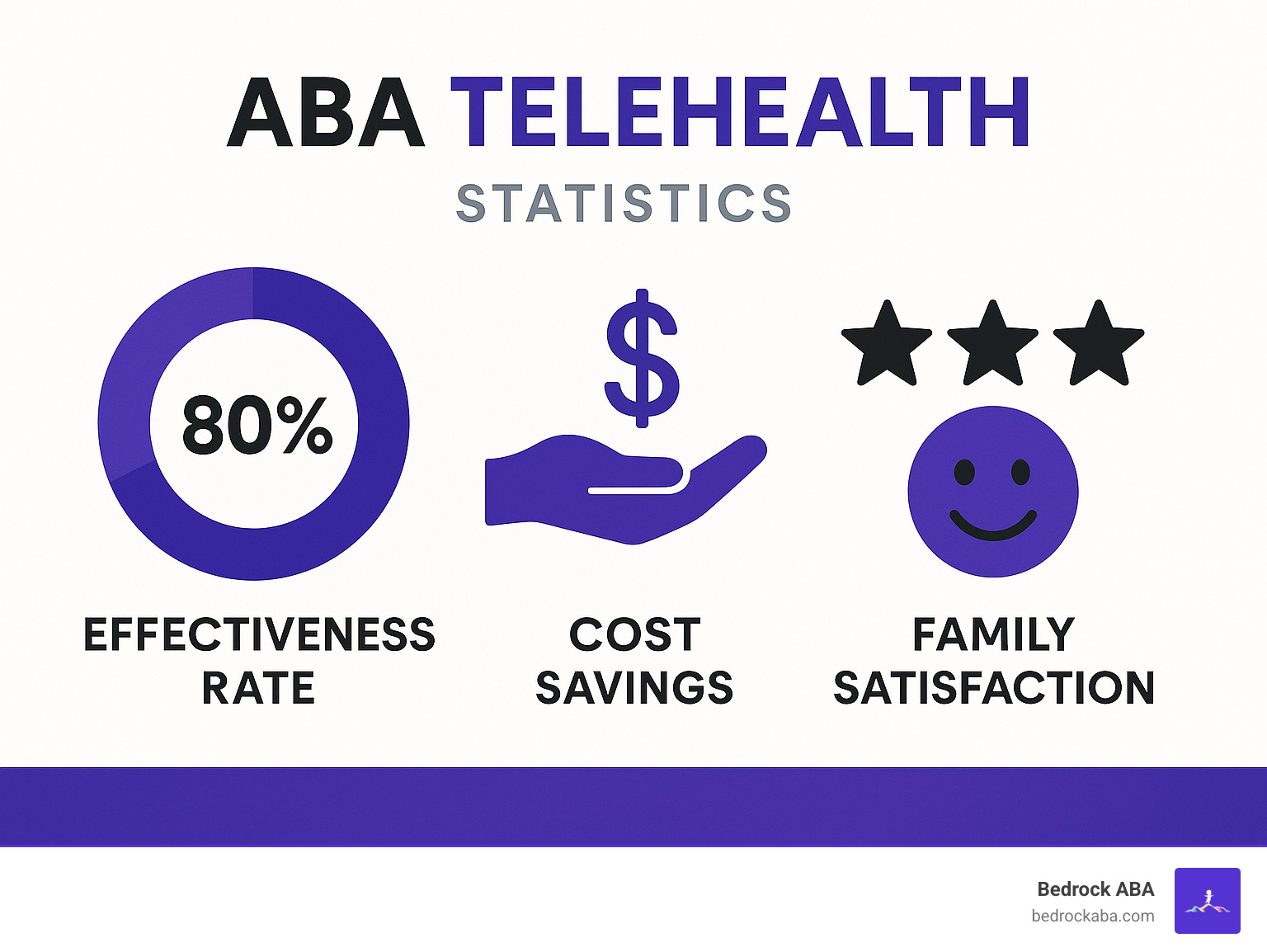
The research backing ABA telehealth effectiveness is compelling and continues growing stronger. 86% of families report significant behavior improvements when receiving telehealth services, demonstrating that remote delivery achieves the same positive outcomes as traditional in-person therapy.
Cost reduction averages 66% compared to clinic-based services, making quality ABA therapy accessible to families who previously couldn’t afford intensive intervention. These savings come from eliminated overhead costs, reduced travel expenses, and increased provider efficiency.
Interobserver agreement scores average 96.28% in telehealth studies, with treatment integrity maintaining 97.42% fidelity. These impressive numbers prove that remote delivery maintains the same rigorous clinical standards as in-person therapy. Quality doesn’t decrease when therapy moves online – it often improves due to the natural learning environment.
How ABA Telehealth Sessions Work
When your child sits down for their first ABA telehealth session, you might wonder how therapy through a screen could possibly work. The truth is, these sessions are surprisingly interactive and engaging – often more so than traditional clinic visits.
Each session starts with a friendly check-in where your therapist assesses how your child is feeling and reviews any changes since last time. Think of it like a warm-up before exercise. From there, the session flows naturally between discrete trial training (DTT) for focused skill-building and natural environment teaching (NET) where your child practices new abilities during everyday activities like snack time or play.
What makes telehealth special is how data collection happens seamlessly in the background. Your therapist tracks responses and progress in real-time, just like they would sitting across the table. The difference? All this information travels through secure platforms that keep your family’s privacy protected under HIPAA regulations.
Don’t worry about your child staring passively at a screen. These sessions are genuinely interactive. Kids show their artwork to the camera, participate in virtual games, and receive immediate high-fives and praise. Many children actually prefer their “computer time” with their therapist because the technology feels fun and modern.
ABA Therapy Online Programs: What to Expect provides more detailed information about how these programs are structured and what families can expect week to week.

Technology & Environment Checklist
Setting up for successful ABA telehealth sessions doesn’t require expensive equipment or a complete room makeover. Most families already have everything they need right at home.
Your internet speed should support clear video calls – if you can stream Netflix without buffering, you’re probably fine. Any device with a webcam and microphone works perfectly, whether that’s a laptop, tablet, or even your smartphone. The key is choosing something your child can see and interact with comfortably.
Creating a quiet space makes the biggest difference in session quality. This doesn’t mean building a soundproof room – your kitchen table, living room couch, or even outdoor patio can work beautifully. The goal is minimizing distractions so your child can focus on their therapist’s voice and instructions.
Safety items deserve special attention when therapy moves into your home environment. Before each session, quickly scan the area for anything potentially dangerous within your child’s reach. Secure wobbly furniture, move breakable items, and ensure you can supervise throughout the entire session. Your BCBA will provide specific safety guidelines custom to your child’s unique needs and behaviors.
Roles During a Telehealth Visit
The magic of telehealth happens when everyone on the team adapts their role while keeping the same high standards of care. Your BCBA supervision continues through the video platform, with your behavior analyst observing sessions, providing real-time feedback, and adjusting programs based on what they see working (or not working) for your child.
RBT implementation looks a bit different on screen, but remains just as hands-on. Your Registered Behavior Technician guides your child through planned activities, demonstrates new techniques, and provides immediate reinforcement for good attempts. They become experts at engaging children through the camera and making every session feel personal and connected.
Caregiver support takes on new importance in telehealth sessions. Parents often become the “hands” of the therapist, helping with materials, providing gentle physical prompts when needed, and ensuring everyone stays safe. This increased involvement actually leads to better results because you’re learning the techniques alongside your child.
| Delivery Model | BCBA Role | RBT Role | Caregiver Role |
|---|---|---|---|
| Direct Therapy | Remote supervision | Direct instruction via video | Minimal assistance, safety monitoring |
| Caregiver-Assisted | Real-time coaching | Session support | Active participation, implements prompts |
| Caregiver-Implemented | Training and guidance | Consultation support | Primary implementer of interventions |
The beauty of this team approach is how it strengthens your family’s ability to support your child’s progress between sessions. Instead of wondering if you’re doing techniques correctly, you learn them with expert guidance right in your own home.
Requirements, Eligibility & Delivery Models
Good news for families wondering if their child qualifies: ABA telehealth has no age restrictions. Whether your toddler is just learning to communicate or your teenager is developing workplace skills, telehealth can adapt to meet them where they are. The key isn’t how old your child is – it’s whether they can benefit from remote instruction and engage with the technology.
Most insurance plans require an autism diagnosis for coverage, though some families choose private pay options when formal diagnoses aren’t available yet. The beauty of telehealth lies in its geographic reach – state lines don’t matter anymore. If you’re living in a small Utah town hours from the nearest ABA provider, you can still access top-tier BCBAs who understand your child’s unique needs.
We’ve found that different families thrive with different approaches. Technician-delivered sessions work wonderfully for children who can follow instructions independently and enjoy interacting through the screen. Some kids absolutely love showing their work to their “computer teacher” and get excited about their virtual sessions.
For younger children or those needing more support, caregiver-assisted models bring parents directly into the action. You become your child’s learning partner, helping with materials and providing gentle guidance while the therapist coaches you both through the screen. Many parents tell us this approach helps them feel more confident using ABA strategies throughout the day.
Caregiver-implemented approaches take this partnership even further. Your BCBA trains you to deliver specific interventions, then provides ongoing guidance and support as you practice new techniques. This model works especially well for teaching daily living skills like brushing teeth or getting dressed.

Hybrid models offer the best of both worlds by combining telehealth with occasional in-person visits. Maybe you meet with your BCBA in person once a month for assessments, then have weekly telehealth sessions in between. Or perhaps you alternate between remote and in-person delivery based on what your child is working on that week.
ABA Telehealth Therapy has detailed information about our specific programs and how to determine which approach might work best for your family.
Insurance & Billing for ABA Telehealth
The insurance landscape for telehealth has changed dramatically since 2020. Many states now have parity laws requiring insurers to cover telehealth services at the same rate as in-person care. However, coverage still varies quite a bit depending on where you live, which insurance plan you have, and the specific services your child needs.
The good news is that documentation requirements for telehealth are essentially the same as in-person services. Your treatment plans, progress notes, and medical necessity justifications follow the same standards. Prior authorization processes typically haven’t changed much either, though some insurers have actually made approval faster for telehealth services.
State mandates play a huge role in what gets covered. Some states require all insurers to cover telehealth ABA, while others leave it up to individual insurance companies to decide. Scientific research on telehealth cost shows the economic benefits of remote delivery, which is gradually influencing more insurers to expand their coverage.
Our team handles the insurance paperwork and prior authorization process, so you don’t have to steer these complexities alone. We’ll work directly with your insurance company to ensure you get the coverage you’re entitled to.
Ethical and Privacy Considerations
The Behavior Analyst Certification Board (BACB) actually requires us to maintain therapy services during disruptions whenever possible. This ethical guideline supports using telehealth to keep your child’s progress on track when in-person sessions aren’t feasible.
Informed consent for telehealth covers some unique territory. We’ll walk you through technology requirements, privacy considerations, and what to do if your internet cuts out mid-session. It’s important that you understand exactly how your family’s information stays protected and what your options are if technical issues arise.
HIPAA security gets extra attention in telehealth. All our platforms use end-to-end encryption and secure data storage. We’ll also teach you simple steps to protect your privacy during sessions – things like making sure other family members aren’t visible in the background if they prefer not to be.
Your caregiver rights remain exactly the same whether your child’s therapist is sitting at your kitchen table or appearing on your laptop screen. You can observe every session, request changes to your child’s program, and discontinue services whenever you choose. Remote delivery should never compromise your family’s involvement in treatment decisions – if anything, it often increases parent engagement and confidence.
Frequently Asked Questions about ABA Telehealth
What equipment do we need for sessions?
The good news? You probably already have everything you need sitting in your living room right now. Any computer, tablet, or smartphone with a working camera and microphone will do the trick. We’ve had successful sessions with families using everything from brand-new iPads to older laptops that have seen better days.
Your internet connection matters more than having the fanciest device. Most home broadband plans provide plenty of speed for smooth video calls. If you can stream Netflix without constant buffering, you’re likely all set for ABA telehealth sessions.
Beyond technology, you’ll need some basic supplies that are probably already in your junk drawer. Think paper, crayons, small toys, and everyday household items like spoons, cups, or blocks. Your BCBA will send you a personalized list based on your child’s specific goals, but don’t worry about buying anything expensive or specialized.
The beauty of telehealth is that it works with what you have. We’ve run fantastic sessions using cardboard boxes as sorting bins and kitchen utensils as counting tools. Your child’s natural environment often provides the best learning materials anyway.
Is ABA telehealth effective for severe behaviors?
This question comes up a lot, and it’s completely understandable. Parents worry that serious behaviors need hands-on intervention that a screen just can’t provide. The reality is more nuanced and often more hopeful than families expect.
Safety always comes first – that’s non-negotiable. Some high-risk behaviors do require in-person support or very careful caregiver-implemented strategies with your BCBA guiding you step-by-step through the screen. But many severe behaviors actually respond beautifully to telehealth approaches.
Here’s something that might surprise you: functional behavior assessments often work better remotely because your BCBA can observe behaviors exactly where they happen naturally. Instead of trying to recreate trigger situations in a clinic, we see the real deal in your kitchen during snack time or in the playroom during transitions.
The key is developing the right intervention approach for your family. Your BCBA might coach you through de-escalation techniques in real-time, help you set up environmental changes, or guide you through positive reinforcement strategies. Many parents find they become more confident handling challenging behaviors when they have expert support just a video call away.
Will my insurance cover telehealth ABA?
Insurance coverage for ABA telehealth has come a long way, especially since the pandemic opened everyone’s eyes to the value of remote healthcare. Many insurance companies now cover telehealth services at exactly the same rate as in-person therapy, which is fantastic news for families.
Coverage varies by state and individual plan, so there’s no one-size-fits-all answer. Some states have parity laws that require insurers to treat telehealth and in-person services equally. Others leave it up to individual insurance companies to decide their policies.
The best approach is to contact your insurance provider directly to ask about telehealth ABA coverage. Have your plan details handy and ask specifically about remote Applied Behavior Analysis services. Don’t be surprised if the first person you talk to needs to transfer you to someone who specializes in behavioral health benefits.
Our team at Bedrock ABA is here to help steer this process with you. We can verify your benefits, work directly with your insurance company, and help ensure you get the coverage your child deserves. Insurance paperwork can be confusing, but you don’t have to figure it out alone.
Conclusion
ABA telehealth represents a fundamental shift toward more flexible, family-centered care that meets families where they are – literally and figuratively. The evidence is clear: remote delivery can be just as effective as traditional in-person therapy while offering significant advantages in accessibility, cost, and convenience.
Service continuity becomes possible regardless of weather, illness, or other disruptions that might interrupt traditional therapy. Your child can maintain their progress and continue learning new skills even when circumstances prevent in-person appointments.
The technology that once seemed daunting has become second nature for most families. Children often adapt quickly to the video format, and parents appreciate the opportunity to observe and participate in their child’s therapy more directly than ever before.
As we continue to refine and expand our telehealth offerings, we remain committed to providing the highest quality ABA services regardless of delivery method. Whether your family chooses in-person, telehealth, or a hybrid approach, our goal remains the same: helping your child reach their full potential through evidence-based, compassionate care.
Ready to explore how ABA telehealth might benefit your family? More info about telehealth ABA services provides detailed information about our programs and how to get started. At Bedrock ABA, we’re here to support your family’s journey toward greater independence and success, no matter where that journey takes you.