


Why ABA Therapy Parent Training is Essential for Your Child’s Success
ABA therapy parent training teaches parents and caregivers specific strategies from Applied Behavior Analysis to support their child’s development at home. This training focuses on hands-on skill development, data collection, consistency, problem-solving, and communication techniques.
The difference between active training and passive education is significant. Research shows that parent training, which teaches specific behavioral techniques, results in a 47.7% decrease in challenging behavior, compared to just 31.8% from parent education alone.
As a parent, you spend the most time with your child, making you the most important person in their therapy journey. Parent training transforms you from an observer into an active partner, empowering you to practice new skills and maintain progress. This not only benefits your child but also reduces parental stress, increases confidence, and strengthens family bonds.
My name is Mayer Kulefsky, director of operations at Bedrock ABA. I have seen how ABA therapy parent training empowers families in North Carolina, Utah, and beyond to create lasting, positive change.
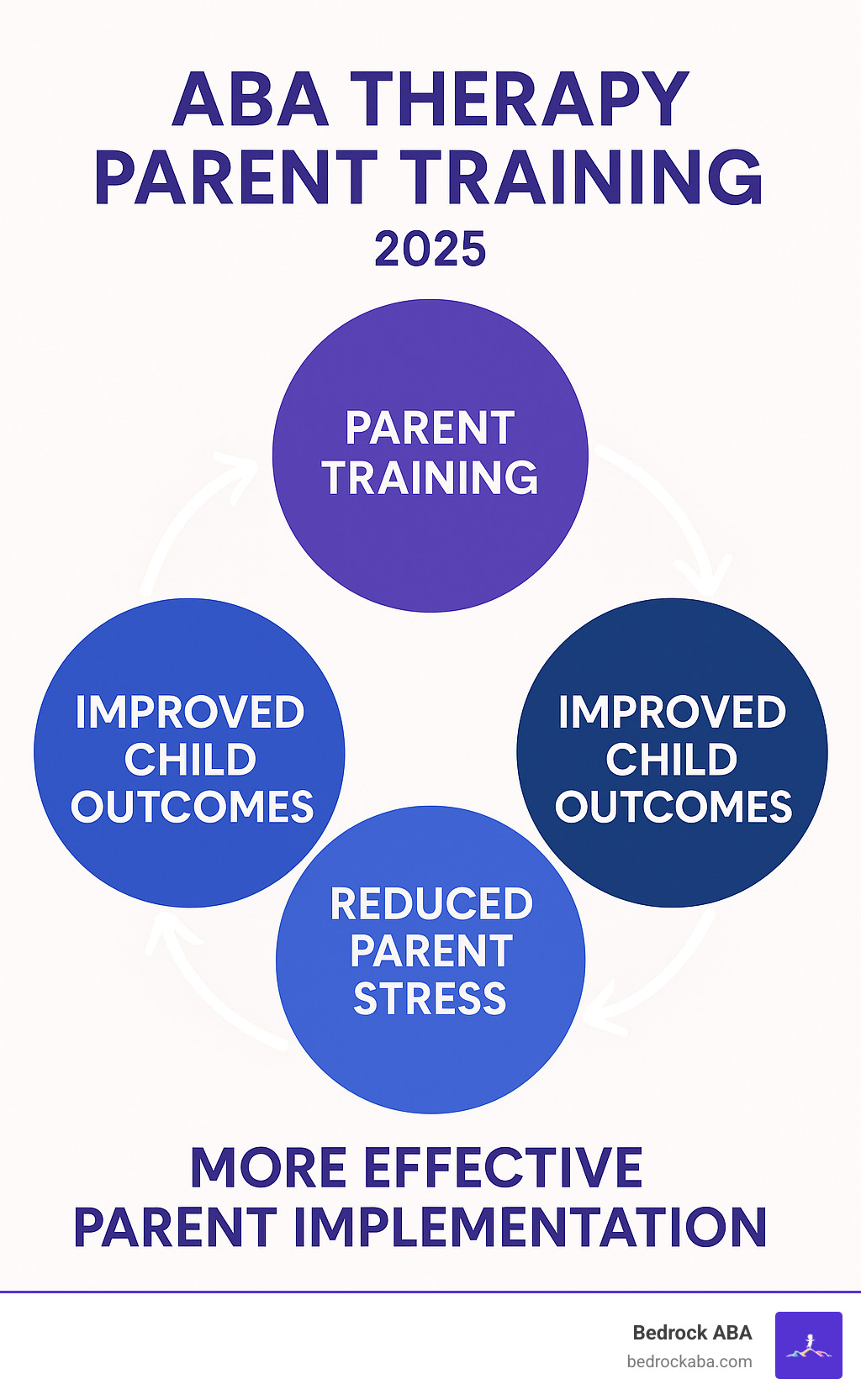
Aba therapy parent training definitions:
Understanding the ‘Why’: The Crucial Role of ABA Parent Training
When a child learns a new skill in therapy, it needs to be practiced at home to become a part of their daily life. This is why ABA therapy parent training is essential. At Bedrock ABA, we see parent training as the bridge connecting therapy to real-world success.
Sometimes called caregiver coaching or family treatment guidance, ABA therapy parent training is a structured process that teaches you the practical skills of Applied Behavior Analysis. By learning the same techniques your child’s therapist uses, you become the most powerful force for your child’s progress.
The goal is generalization of skills, where abilities learned in therapy appear everywhere—at home, school, and in the community. When a child uses new communication skills during homework or coping strategies on a family outing, that is the true measure of success. Without consistent reinforcement at home, therapy’s impact can fade. With trained parents as partners, children make faster, more lasting progress.
To understand the foundations of this approach, see our guide: What is ABA Therapy and How Does It Work?
Key Benefits for the Child, Parents, and Family
ABA therapy parent training creates a ripple effect of positive change throughout the entire family.
For Your Child:
- Faster Skill Acquisition: Learning becomes a natural part of everyday routines, from mealtime communication to morning self-care.
- Reduced Challenging Behaviors: Children learn effective ways to communicate their needs, which naturally decreases frustration and tantrums.
- Generalization of Skills: Consistent strategies at home and in therapy mean skills work everywhere, not just in the clinic.
For You as Parents:
- Reduced Stress: Having concrete, effective strategies for challenging situations reduces feelings of being overwhelmed.
- Increased Confidence: Successfully teaching your child new skills and managing difficult moments builds your confidence as a parent.
- Empowerment: You move from feeling helpless to feeling capable and in control of supporting your child’s needs.
For Your Whole Family:
- Improved Interactions: When everyone, including siblings, learns effective communication strategies, the home environment becomes more harmonious.
- Stronger Bonds: Positive interactions replace stressful ones, making family time more enjoyable. Research confirms that parent training improves overall family well-being. For more details, explore research on the Collateral effects of parent training on family interactions.
Parent Training vs. Parent Education: A Crucial Distinction
There is a key difference between learning about ABA therapy and learning how to do it. Parent education provides valuable information, lectures, and reading materials. It’s a great starting point for understanding your child’s diagnosis and treatment options.
ABA therapy parent training, however, is active and hands-on. You learn to use the strategies through modeling, practice, and direct coaching. Your role shifts from a passive listener to an active participant.
| Aspect | Parent Education | Parent Training |
|---|---|---|
| What You Get | Information and general advice | Specific, hands-on strategies |
| How You Learn | Lectures, readings, discussions | Modeling, practice, direct coaching |
| Your Role | Listening and absorbing information | Actively practicing and implementing |
| Focus | Understanding the diagnosis and options | Learning specific behavioral techniques |
| Outcome | Better awareness and knowledge | Actual skill development and behavior change |
The difference in results is striking. While education is helpful, research shows that the hands-on, skill-based approach of parent training delivers significantly better outcomes in reducing challenging behaviors. You can read more in this Study on parent training vs. education.
At Bedrock ABA, we focus on giving you the tools and training you need to become your child’s most effective teacher, because that’s what creates lasting, meaningful change.
Getting Started: How to Access Training and Set Goals
Taking the first step toward ABA therapy parent training is an empowering decision. It’s about learning the language to understand and support your child’s unique needs.

Who Provides Training and What is the Parent’s Role?
Your training will be led by qualified professionals, typically a Board Certified Behavior Analyst (BCBA). BCBAs develop individualized strategies and teach you how to use them. You may also work with a Board Certified Assistant Behavior Analyst (BCaBA) or a Registered Behavior Technician (RBT) who can help facilitate your learning.
At Bedrock ABA, we prioritize professional development to ensure our team excels at coaching parents. Your role is to be an:
- Active Participant: You’ll practice and implement new techniques in your daily routines.
- Collaborator: Your insights into your child’s personality and preferences are vital to the treatment plan.
- Data Collector: You’ll track simple information to help the team understand what’s working.
- Child’s Expert: Your knowledge is combined with ABA strategies to create a powerful foundation for growth. Research shows that strong parent-therapist collaboration leads to better outcomes. Our Family Integration ABA Therapy approach ensures you’re supported every step of the way.
Available Formats for ABA therapy parent training
ABA therapy parent training is offered in several formats to fit your family’s life.
- In-person training: A BCBA provides hands-on coaching in your home or at the clinic, offering immediate feedback. Our In-Home ABA Therapy Services make this personalized coaching accessible.
- Group workshops: These sessions combine expert instruction with shared experiences from other parents facing similar challenges.
- Telehealth and virtual coaching: Learn from home with flexible scheduling. Research shows that internet-based parent education can be highly effective. Bedrock ABA’s ABA Telehealth Therapy offers this option to families throughout Utah.
- Online courses: Self-paced modules with videos and resources allow you to learn at your own speed.
We work to make ABA therapy parent training accessible and convenient for your family, whether you’re in Salt Lake City or a rural community.
Setting SMART Goals for Your ABA therapy parent training
Just like your child’s program, your training will have clear goals. We use the SMART framework to ensure goals are effective.
- Specific: A clear target, like “I will use the three-step calming sequence during transitions.”
- Measurable: A way to track progress, like “I will use the visual schedule 8 out of 10 times this week.”
- Achievable: A realistic goal that stretches you without causing frustration.
- Relevant: A goal connected to your child’s needs and your family’s priorities.
- Time-bound: A deadline to create momentum, like mastering a skill within two weeks.
Your BCBA will help you develop individualized goals that fit your family’s lifestyle. These goals build your confidence as a parent and strengthen your family’s well-being. For more guidance, you can explore How to use SMART goals.
Core ABA Strategies for Parents to Use at Home
In ABA therapy parent training, you’ll learn practical, evidence-based strategies to use in your daily routines to support your child’s positive behavior and skill development.

Understanding the ABCs of Behavior
A foundational concept in ABA is the “ABCs of Behavior,” a framework for understanding why behaviors occur.
- A – Antecedent: What happens immediately before the behavior (the trigger).
- B – Behavior: The action itself.
- C – Consequence: What happens immediately after the behavior (the response).
Analyzing the ABCs helps identify the function of behavior—the reason it’s happening. The four main functions are to gain attention, to escape a task, to access a desired item, or for automatic/sensory reasons. Understanding the function allows you to teach your child a more appropriate way to get their needs met. Your BCBA will guide you in tracking these patterns. Learn more about Key Principles Behind ABA Therapy: Reinforcement, Behavior, and Learning.
Using Positive Reinforcement Effectively
Positive reinforcement is a cornerstone of ABA. It involves adding something positive immediately after a desired behavior to encourage it to happen again.
- Identify Meaningful Reinforcers: Use what your child values, whether it’s a favorite toy, praise, or extra playtime.
- Be Immediate: Deliver reinforcement right after the desired behavior to build a strong connection.
- Be Consistent: Reinforce the behavior every time it occurs to establish it firmly.
- Be Enthusiastic: Genuine excitement, especially with social praise, is highly motivating.
- Fade Reinforcement: As your child masters a skill, gradually reduce the reinforcement so the behavior becomes more natural.
We teach parents to reinforce replacement behaviors, such as praising successful toilet use instead of punishing accidents.
Practical Teaching Techniques to Implement at Home
Your training will equip you with a toolbox of teaching techniques for daily life.
- Discrete Trial Training (DTT): A structured method that breaks skills into small, manageable steps, each taught with clear instructions and immediate reinforcement.
- Natural Environment Teaching (NET): Teaching skills in natural, everyday situations, like learning colors during playtime. This promotes generalization.
- Functional Communication Training (FCT): Teaching an appropriate way to communicate needs (e.g., tapping a shoulder) to replace a challenging behavior (e.g., screaming for attention).
- Shaping: Reinforcing successive approximations of a target behavior, gradually requiring more accurate responses.
- Chaining: Teaching complex, multi-step tasks like washing hands by breaking them into a sequence of smaller steps.
These methods are taught during our ABA therapy parent training sessions. For more details, see our article: ABA Therapy for Parents.
Creating and Using a Behavior Support Plan (BSP)
A Behavior Support Plan (BSP) is a roadmap for reducing challenging behaviors and teaching alternatives. You will collaborate with your BCBA to create and use a BSP.
- Functional Behavior Assessment (FBA): First, the BCBA conducts an FBA to determine the function of the behavior, using your observations.
- Define Target and Replacement Behaviors: The plan clearly identifies the challenging behavior to decrease and the appropriate replacement skill to teach.
- Proactive Strategies (Antecedent Interventions): These are used before a behavior to prevent it, such as using visual schedules or offering choices.
- Reactive Strategies (Consequence Interventions): These are used after a behavior to ensure it is not reinforced, such as redirecting your child or planned ignoring.
- Data Tracking: Consistent data collection is essential to monitor the plan’s effectiveness and make adjustments.
A BSP empowers you to respond to challenging behaviors in a structured, effective way. We cover this in our article: Behavior Support Plan (BSP) in ABA.
Navigating Common Challenges and Ensuring Success
Starting on ABA therapy parent training is a significant commitment that can come with challenges. We are here to help you overcome obstacles and celebrate every victory.

Overcoming Time Constraints and Burnout
We understand that adding parent training to a busy schedule can feel overwhelming. Research shows that parental stress is common, which can make implementing new strategies difficult.
- Start small: Your BCBA will help you focus on one or two manageable goals at a time. We match our pace to what works for your family.
- Integrate into daily routines: Weave ABA strategies into activities you already do, like using visual schedules during your morning routine or practicing communication at mealtime.
- Prioritize self-care: Taking care of yourself is essential. Interestingly, research shows that ABA therapy parent training actually reduces parental stress over time as you gain confidence and see your child’s progress.
Ensuring Consistency and Follow-Through
Consistency is the backbone of successful ABA. When parents, grandparents, and teachers use different approaches, it can confuse a child and slow progress.
- Create a unified approach: Your BCBA will work with all key caregivers to ensure everyone understands the strategies and why they matter.
- Use visual aids: Picture schedules, rule charts, and reminder cards help everyone, including your child, remember the plan and make expectations clear.
- Communicate openly: Regular check-ins with your BCBA provide a space to discuss what’s working and what isn’t. Understanding barriers to consistency helps us find practical solutions, as noted in research on parental adherence.
Dealing with Setbacks and Celebrating Small Victories
Progress isn’t always a straight line. One common bump is an extinction burst, where a challenging behavior temporarily increases when you stop reinforcing it. This can be discouraging, but it’s often a sign that your new strategies are working.
- Be patient: Learning new skills takes time for both you and your child. Your BCBA will prepare you for these situations.
- Problem-solve with your BCBA: They are your partners in finding solutions. A small adjustment to your approach can often make a big difference.
- Track and celebrate progress: Notice and record every victory, no matter how small. Celebrating milestones—like your child following a new direction or you successfully using a new strategy—is essential fuel for the journey. It maintains motivation and reminds you that your hard work is paying off.
For a balanced view of this journey, see our discussion on ABA Therapy Pros and Cons.
Frequently Asked Questions about ABA Parent Training
Here are answers to the most common questions we hear from families about ABA therapy parent training.
Can parents learn ABA therapy?
Yes, absolutely. ABA therapy parent training is designed specifically to teach parents and caregivers the core principles and practical strategies of ABA. You don’t need a special background to learn these techniques. You are not becoming a certified therapist, but an empowered parent who can support your child’s growth every day. By combining your expert knowledge of your child with ABA tools, you become an essential partner in their therapy.
At what age is ABA therapy most effective?
While early intervention (before age five) often yields the most dramatic results, ABA principles are effective at any age. Whether your child is a toddler or a teenager, the strategies you learn in parent training can make a meaningful difference. We have seen families with teens achieve significant improvements in communication, independence, and family relationships. What matters most is getting started.
Do parents stay during ABA therapy sessions?
Parent involvement is crucial for the best outcomes. Most successful ABA programs encourage parents to participate, though the format is flexible. You might observe sessions to see techniques in action, or you might have separate ABA therapy parent training sessions with your BCBA to practice skills and ask questions. At Bedrock ABA, we work with each family to find a participation style that fits your schedule and comfort level, ensuring you feel equipped to be your child’s most effective teacher.
Conclusion
ABA therapy parent training is about finding your power as your child’s most important teacher and advocate. By becoming an active partner in therapy, you can make a profound difference in your child’s development and your family’s well-being.
Consistency is the key. When you understand the ABCs of behavior, use positive reinforcement, and integrate teaching techniques into your daily routines, you create a supportive environment where your child can thrive. These aren’t just therapy techniques; they become a natural part of how your family connects.
We know the path isn’t always smooth, but parents who receive proper training and support overcome the challenges. Every small victory is a building block toward your child’s independence and your family’s happiness.
At Bedrock ABA, our family-centered approach is designed to empower you with the tools and confidence to support your child’s growth every day. We believe that empowering parents creates lasting change.
Ready to see how ABA therapy parent training can transform your family’s daily life? Learn more about our ABA therapy services in Utah and take the first step toward becoming your child’s biggest champion.