


Why After-School ABA Programs Fill a Critical Gap
ABA therapy after school provides essential support for children with autism who need continued skill development beyond regular school hours. These specialized programs bridge the gap between classroom learning and real-world application, helping children practice social skills, independence, and daily routines in a structured yet natural environment.
Quick Overview of After-School ABA Programs:
- Purpose: Supplement school-day learning with focused skill practice
- Setting: Typically 10-20 hours per week in clinic or community environments
- Focus Areas: Social skills, daily living tasks, homework routines, community integration
- Format: Small group settings with 1-on-1 support from trained therapists
- Age Range: School-aged children (typically 5-18 years old)
- Insurance: Often covered as medically necessary treatment for autism
After-school ABA programs offer a less intensive but highly focused approach compared to comprehensive early intervention programs. Instead of 25-40 hours per week, these programs typically provide 10-20 hours of targeted support. The emphasis shifts from foundational skill building to generalization – helping children use the skills they’ve learned in school within real-world settings like parks, grocery stores, and social activities.
Research shows that 89% of children undergoing ABA experience significant improvements, and after-school programs play a crucial role in maintaining and expanding these gains. As one provider notes, these programs help children “reinforce the social and communication skills your child learns during the day, in a structured and supportive environment.”
I’m Mayer Kulefsky, director of operations at Bedrock ABA, where I’ve helped expand our behavioral health services across multiple states including Utah and North Carolina. Through my experience overseeing ABA therapy after school programs, I’ve seen how these flexible options provide families with the personalized support they need while fitting into their busy schedules.
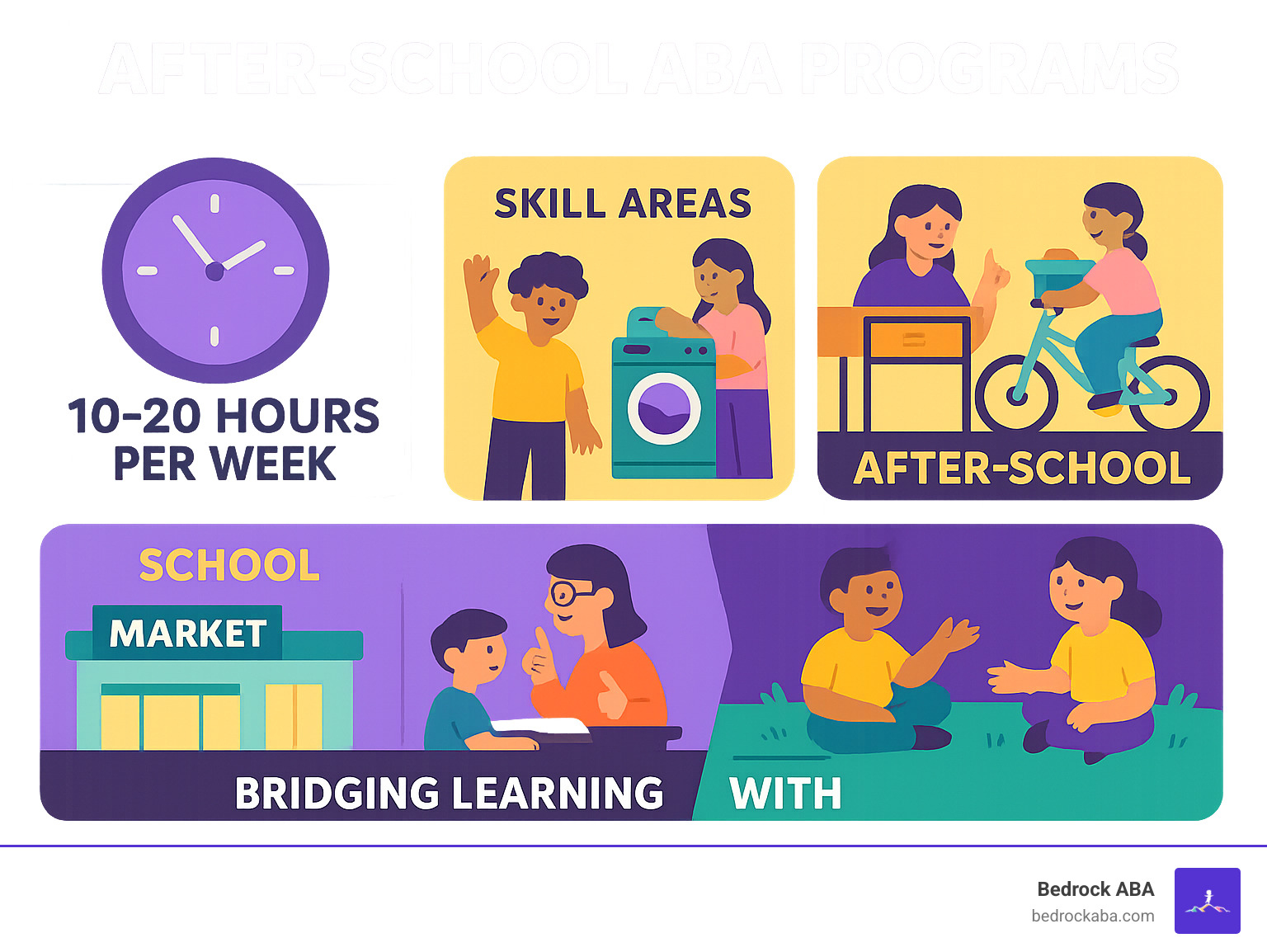
Aba therapy after school terms to know:
What is After-School ABA Therapy and How Does It Help?
ABA therapy after school provides supplemental support for children with autism, helping them generalize skills learned in the classroom to real-world situations. Unlike intensive early intervention (25-40 hours/week), these programs offer a more focused 10-20 hours per week, complementing a child’s school schedule without causing burnout.
The primary goal is skill generalization. A child might follow directions well in class, but after-school ABA helps them apply those skills to chores at home or playdates with friends. The focus is on building functional independence and social skills through structured group activities, community outings, and daily routines that feel more like fun than therapy. The core principles of positive reinforcement are applied through dynamic, real-world practice. To learn more about the foundations, see What is ABA Therapy and How Does It Work?.
How It Differs from Other ABA Programs
It’s helpful to understand how after-school ABA fits with other support options:
- Comprehensive EIBI Programs: These are intensive (25-40 hours/week) for young children (ages 0-6), focusing on building foundational skills in 1-on-1 settings. After-school ABA is less intensive and refines existing skills in school-aged children.
- School-Based ABA: This occurs during the school day to support academic and classroom behaviors. After-school programs happen in clinics or the community, focusing on life skills beyond academics.
- In-Home Therapy: This targets skills specific to the family environment, like personal care routines. After-school programs often leverage group settings to provide peer interaction that can’t be replicated at home.
| Feature | Comprehensive ABA | After-School ABA |
|---|---|---|
| Hours per Week | 25-40+ hours | 10-20 hours |
| Primary Goals | Building foundational skills | Skill generalization and social development |
| Setting | Clinic/home, mostly 1-on-1 | Group settings, clinic/community |
Who is the Ideal Candidate for These Programs?
ABA therapy after school is most effective for:
- School-aged children (5-18) who are managing the school day but need extra support to flourish outside the classroom.
- Children with an autism diagnosis who need help with social skills or daily routines that aren’t fully addressed at school.
- Children with social skill deficits who find peer interaction, reading social cues, or group settings challenging.
- Children with daily living skill challenges who are working on independence with personal hygiene, simple meal prep, or self-care.
- Children who struggle with homework and academic routine transitions and can benefit from building organizational skills and attention strategies.
5 Key Benefits of After-School & Summer ABA Programs
After-school ABA programs are more than just childcare; they are unique environments where children can grow their skills in natural and fun ways. These five key benefits make the programs truly transformative for children and their families.

1. Improves Social and Friendship Skills
For children with autism, the unwritten rules of friendship can be challenging. ABA therapy after school provides a structured setting to practice peer interaction. Through guided play, board games, and group projects, children learn essential skills like initiating conversations, turn-taking, sportsmanship, and understanding social cues. The focus is on building genuine connections with peers by practicing skills like sharing, managing frustration, and understanding different perspectives. For more on our approach, see our guide on ABA Services for Children.
2. Reinforces Academic and School Routines
While not a tutoring service, after-school ABA builds the foundational skills necessary for academic success. We work on homework completion strategies, helping children break down assignments and manage their time. Children also learn organization skills and how to follow multi-step instructions through practical activities like cooking or crafts. A key focus is easing the transition from school to home, which can reduce after-school meltdowns and create a more peaceful routine. Learn more about ABA in schools in our article, How ABA Behavioral Programs in Schools Can Benefit Children.
3. Builds Independence in Daily Living Skills
These programs create natural opportunities for children to practice essential life skills and build confidence.

We focus on self-care routines (like hygiene and dressing), simple chores, and safety skills in the kitchen or community. Community outings are a key component, allowing children to practice ordering food, shopping, or navigating public spaces, helping them generalize skills to their everyday lives.
4. Provides a Structured and Positive Environment
Children with autism often thrive on predictability. Our programs offer structured schedules that feel secure yet flexible. Positive reinforcement is at the core of our approach, celebrating every success to build confidence. We use Natural Environment Teaching (NET), where skills are taught through play and daily activities, not drills. This engaging approach helps reduce challenging behaviors by teaching children more effective ways to communicate their needs. For more on our approach to behavior, explore our guide on Behavior Support Plan ABA.
5. Offers Flexible Support for Families
We understand that modern family life is busy. After-school programs are designed to work with your schedule, offering part-time hours (10-20 per week) that complement the school day. Many programs also include parent training opportunities, giving you tools to support your child’s progress at home. This collaborative approach can significantly reduce family stress, providing peace of mind that your child is in a supportive, enriching environment. Learn more about how we partner with families in our article on ABA Therapy for Parents.
What to Expect from ABA Therapy After School Programs
After-school ABA programs are warm, welcoming environments built around individualized treatment plans. A Board Certified Behavior Analyst (BCBA) designs and oversees your child’s plan, while a skilled Registered Behavior Technician (RBT) works directly with your child, building a genuine connection.
This team uses a data-driven approach, continuously tracking progress during sessions to see what’s working. The BCBA regularly reviews this data to make adjustments, ensuring therapy remains effective and engaging as your child develops new skills.

How Skills are Targeted in a Fun, Engaging Way
Modern ABA therapy after school programs focus on play-based therapy that makes learning enjoyable and motivating. We’ve found that when children are having fun, they are more open to practicing challenging skills. Skills are taught through engaging activities like scavenger hunts, art projects, and cooperative games that naturally encourage communication and teamwork.
Community outings are a key part of many programs, where a child might practice ordering a meal, navigating a local park, or using public transportation with the support of their therapy team. Role-playing scenarios also help children rehearse social scripts for tricky situations, building their confidence for the real world. You can learn more about how we customize this personalized care at More info about Our ABA Therapy Process.
What is the Typical Structure of an after-school ABA therapy program?
While every program is custom to the child, a general rhythm provides structure and flexibility. Sessions typically last 2 to 4 hours, with most children attending for 10 to 20 hours per week. A key feature is the 1-on-1 therapy within a group setting, where your child gets dedicated attention from an RBT while also benefiting from peer interaction. Small group ratios ensure every child receives the support they need.
A typical afternoon might include:
- Arrival and transition activities
- A group social skills lesson
- Structured play or a community outing
- Snack time to practice daily living skills
- Individualized work or homework support
- Leisure time with peers before departure
This structure is based on the principles that make ABA is an evidence-based best practice treatment, ensuring every moment is purposeful and supportive.
How to Choose the Right Provider and Ensure Success
Choosing the right ABA therapy after school provider is a significant decision. Success depends on strong collaboration between your family, the therapists, and your child’s school. Look for a provider that emphasizes open communication, consistent strategies across all environments, and flexible, family-centered care. Practical considerations like insurance coverage and scheduling are also key. Learn more about our family-first approach at More info about Family Integration ABA.
Key Questions to Ask a Potential Provider
When vetting providers, come prepared with questions to ensure they are the right fit for your child and family.
- Staffing: What are the qualifications and experience of the BCBAs and RBTs? How often does the BCBA supervise sessions?
- Safety: What are your safety protocols, especially for community outings or managing challenging behaviors?
- Parent Involvement: What is your policy on parent involvement? Can I observe sessions or receive training?
- Communication: How frequently will I receive updates on my child’s progress, and in what format (e.g., daily notes, weekly summaries)?
- Program Structure: How do you individualize goals within a group setting? What is the therapist-to-child ratio?
- Collaboration: What is your process for collaborating with my child’s school and integrating IEP goals?
- Logistics: Do you have a waitlist? What insurance do you accept, and can you help verify my benefits?
Ensure any provider you consider is licensed and in good standing with the Behavior Analyst Certification Board. You can Find out if they are licensed with the BACB.
What to Look for in a Quality Provider
Beyond asking the right questions, look for a provider that actively demonstrates a commitment to collaboration. The best providers seek to build relationships with teachers to create a seamless support system for your child. They should have a clear process for IEP goal integration, ensuring therapy goals align with educational objectives.
A consistent support system—where your child works with the same team regularly—is crucial for building trust and making progress. Finally, a quality provider will have thoughtful, proven strategies for common challenges, such as managing diverse skill levels in a group and ensuring skills learned in the clinic transfer to home and school. Look for a provider that offers truly individualized interventions rather than a one-size-fits-all program.
Frequently Asked Questions about After-School ABA
Choosing the right support for your child brings up many questions. Here are straightforward answers to some of the most common ones we hear about ABA therapy after school.
How are after-school ABA programs different from school-based ABA?
The main difference is the setting and focus. After-school programs usually happen in a clinic or community setting and focus on generalizing skills to real-world situations, such as social skills with peers and daily living tasks. School-based ABA takes place during the school day within the classroom, directly supporting academic goals and classroom behaviors. The two approaches are highly complementary. To learn more about ABA in schools, see More info about School-Based ABA Therapy.
How many hours a week is typical for an after-school program?
Most children in ABA therapy after school programs attend for 10 to 20 hours per week, typically in 2-4 hour sessions. However, the exact number of hours is always customized to the child’s needs. A Board Certified Behavior Analyst (BCBA) will conduct a comprehensive assessment to recommend the appropriate intensity for your child’s specific goals and learning style.
Will my insurance cover after-school ABA therapy?
Yes, most major health insurance plans cover ABA therapy as a medically necessary treatment for an autism diagnosis. However, it is crucial to verify your specific coverage, including co-pays, deductibles, and any pre-authorization requirements, with both your insurance company and the ABA provider. Our team at Bedrock ABA has experience navigating this process and can help you with benefit verification.
Take the Next Step in Your Child’s Development

The end of the school day doesn’t have to be the end of learning and growth. ABA therapy after school provides a vital opportunity for your child to build on their strengths and develop the skills needed to thrive in all environments. These programs focus on skill acquisition and generalization, helping children confidently steer playdates, homework, and daily routines.
At Bedrock ABA, we center our programs on personalized care that recognizes each child’s unique journey. We help children apply skills learned in therapy to their home, school, and community, building a brighter future one success at a time. Our flexible, family-centered approach ensures your child gets the support they need in a way that fits your life.
Ready to explore how ABA therapy after school can support your child’s development? We’d love to discuss personalized therapy options that align with your family’s goals. Learn more about our ABA therapy services in Utah and find out how we can partner with you to help your child flourish.