


Why Finding the Right ABA Therapy Provider in Utah Matters
ABA therapy utah providers offer vital support for children with autism, but finding the right fit can be challenging. With numerous providers, varying waitlists, and different care approaches, parents need clear guidance to choose wisely for their child’s needs.
Top ABA Therapy Considerations in Utah:
- Coverage: Utah’s Senate Bill 95 expanded insurance coverage, removing age and hour caps.
- Settings: Services are available in-home, clinic-based, school-based, and community settings.
- Waitlists: Can range from no wait to over 24 months, depending on the provider.
- Insurance: Most providers accept Medicaid, BCBS, Aetna, and other major insurers.
- Regions: Coverage is best in Salt Lake, Utah, and Davis counties, with limited rural options.
Research shows that comprehensive ABA programs (25-40 hours/week for 1-3 years) can lead to significant gains in language, cognitive skills, and social interaction. However, provider quality varies, and the right therapeutic relationship is key to your child’s progress.
Finding quality care means looking beyond availability. You need providers who offer individualized treatment plans, maintain proper credentials (BCBA supervision), and understand your family’s goals.
As Mayer Kulefsky, director of operations at Bedrock ABA, I’ve seen how the right provider partnership transforms outcomes. My experience has shown me what parents should prioritize when choosing their child’s therapy team.

ABA therapy utah further reading:
What is ABA Therapy and How Does It Help Utah Children?
If you’re a Utah parent exploring ABA therapy utah, you’re likely asking: What is ABA therapy, and how can it help my child?
Applied Behavior Analysis (ABA) is a proven science of learning and behavior. It provides a framework for understanding why behaviors occur and how to encourage those that help your child thrive. You can read a concise overview on Wikipedia to see how the field has evolved over time.
At its core, ABA uses the A-B-C principle: Antecedent (what happens before a behavior), Behavior (the action), and Consequence (what happens after). By understanding this pattern, therapists can create environments where positive behaviors are more likely to occur.
ABA is an evidence-based practice, supported by thousands of studies over decades. Its effectiveness relies on positive reinforcement—celebrating every step forward. When a child makes a positive choice, like using words to ask for help, that behavior is noticed and rewarded, making it more likely to happen again.
For Utah families, this means your child receives therapy that is both scientifically sound and personally meaningful. We focus on building skills that help children become more independent, confident, and connected.
To learn more, see our guides: What is ABA Therapy and How Does it Work? and Applied Behavior Analysis (ABA) Therapy.
Key Benefits of ABA Therapy for Autism

ABA therapy opens doors across a child’s entire world, leading to significant improvements in several key areas:
-
Social Skills Development: Children learn the building blocks of connection, such as sharing, taking turns, and starting conversations. This helps them build confidence and find the joy of playing with peers.
-
Communication Improvement: ABA meets children where they are, whether they are working on first words, using picture systems, or developing complex conversation skills. The goal is to find their way to communicate.
-
Behavior Management: Families learn to understand what a child is communicating through challenging behaviors. We teach children better ways to get their needs met, turning frustrating moments into opportunities for connection.
-
Daily Living Skills: From brushing teeth to getting dressed, these skills build a foundation for independence, giving children confidence and families peace of mind.
-
Academic Readiness: ABA helps children learn to focus, follow instructions, and engage in learning activities, preparing them for success in school and beyond.
Research shows that comprehensive ABA programs (25-40 hours per week) lead to lasting improvements. Utah parents see these changes not just in therapy but in everyday moments. Learn more at ABA Therapy for Social Skills.
Addressing Specific Challenges with ABA Behavioral Programs
ABA therapy utah programs excel at addressing specific challenges that make daily life difficult.
-
Emotional Regulation: ABA teaches children to recognize their emotions and develop healthy coping strategies, like asking for help or taking deep breaths instead of having a meltdown.
-
Anxiety Management: Through gradual exposure and coping strategies, ABA helps children feel more confident in new or challenging situations, such as handling changes in routine or trying new foods.
-
Reducing Harmful Behaviors: ABA helps decode the message behind actions like hitting or biting and teaches safer, more effective ways for children to communicate their needs.
-
Increasing Helpful Behaviors: We celebrate and reinforce every positive choice, such as asking for help instead of grabbing or using words instead of crying. This strengthens positive behaviors over time.
-
Potty Training: ABA breaks this complex skill into manageable steps, using visual supports, routines, and positive reinforcement to help children master this important milestone.
Behavior is communication. Our programs focus on building communication skills that replace challenging behaviors, creating more positive experiences for everyone. Explore our approach at ABA Behavioral Programs and ABA Therapy for Emotional Regulation.
Your Guide to ABA Therapy Utah Services
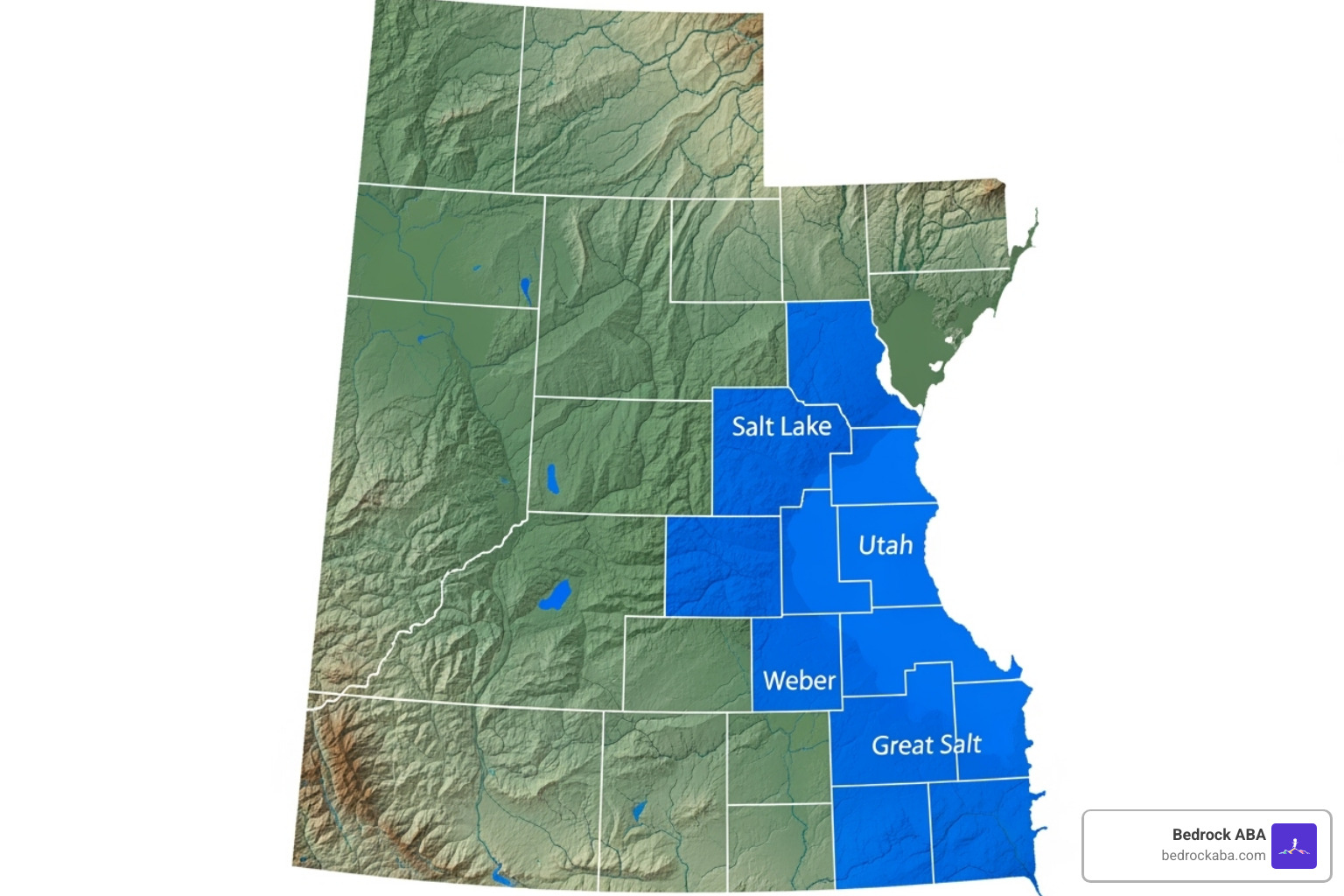
Finding the right ABA therapy utah services starts with understanding the landscape. The availability of services often follows population centers, but families in smaller communities still have options.
The Wasatch Front has the highest concentration of providers. Cities like Salt Lake City, Provo, Ogden, Sandy, and Orem offer multiple choices, which can mean shorter waitlists. However, even in these areas, waitlist times can vary dramatically, from immediate openings to waits of a year or more. It’s wise to get on multiple waitlists early.
Rural areas in Utah face different challenges with fewer local providers. In these cases, telehealth services and providers willing to travel can be invaluable resources.
At Bedrock ABA, we are committed to serving families across Salt Lake County, Utah County, and Wasatch County, ensuring every child has access to quality care.
Where is ABA Therapy Provided in Utah?
Modern ABA therapy utah is flexible and can be delivered in various settings to meet children where they are.
-
In-Home Therapy: A popular option where children learn new skills in their own environment. This approach allows for direct parent involvement and helps children generalize skills naturally. Learn more at In-Home ABA Therapy in Utah.
-
Clinic-Based Therapy: These dedicated spaces are designed for learning, with specialized equipment and opportunities for peer interaction in a sensory-friendly environment.
-
School-Based Support: Therapists work in schools to help children apply skills in real classroom situations, collaborating with teachers to promote academic and social success.
-
Community Settings: Therapy can happen anywhere life does—at a park, grocery store, or library. This real-world practice helps children use their new skills everywhere.
-
Telehealth Options: Video-based sessions provide a convenient way for families in remote areas or with transportation challenges to access parent training, supervision, and direct therapy.
For families in the Salt Lake City area, find more information at ABA Therapy Salt Lake City.
Costs and Insurance Coverage for ABA Therapy in Utah
Paying for ABA therapy utah is a major concern for parents, but Utah has made significant progress in ensuring access to care.
Utah’s Senate Bill 95, effective January 1, 2020, was a game-changer. This expanded autism insurance mandate removes age and hour caps for state-regulated plans, meaning therapy should be covered based on medical necessity.
Medicaid provides another crucial pathway. The Medicaid Autism Waiver specifically supports children with autism. We are proud to be in-network with Utah Medicaid to ensure broad access to our services.
Private insurance plans from carriers like Aetna, Anthem, Selecthealth, UnitedHealthcare, and Cigna typically include ABA coverage. Our team can help you steer in-network and out-of-network benefits.
Scholarship programs like the Carson Smith Scholarship and the Utah Fits All Scholarship offer additional financial support for families to access private services, including ABA therapy.
Every insurance plan is different. We strongly recommend verifying your specific benefits before starting services. Our team is here to help you steer the insurance verification and prior authorization process. Find more details at ABA Therapy Utah Insurance Coverage.
How to Find and Choose the Best Provider for Your Family
Finding the right ABA therapy utah provider is about finding a partner who truly understands your child and family. A systematic approach can make this journey manageable.
You are the expert on your child. The goal is to find a provider whose clinical expertise, values, and approach align with your family’s needs. Start by creating a shortlist of local providers using online directories, pediatrician referrals, or recommendations from other families. Then, begin asking thoughtful questions to get a feel for each one.
The “best” provider isn’t just about a short waitlist; it’s the one who sees your child as a whole person and partners with your family for the long term.
For more guidance, check out: Autism Therapy Near Me.
What to Look for in a Quality ABA Provider

When evaluating ABA therapy utah providers, look for these key characteristics:
-
Proper Credentials: The program must be supervised by a Board Certified Behavior Analyst (BCBA). Direct therapy is typically provided by Registered Behavior Technicians (RBTs) under close BCBA supervision. Don’t hesitate to ask about credentials and experience.
-
Licensing and Experience: Verify the provider is licensed to operate in Utah. Look for clinical teams with a solid track record, especially with children of a similar age and with similar needs to your own.
-
Neurodiversity-Affirming Approach: The best providers respect your child’s unique wiring. They focus on building skills that improve quality of life rather than trying to make a child appear “normal.” They celebrate strengths while helping them steer the world successfully.
-
Family-Centered Care: Quality providers see the whole family as part of the team. They should offer flexible scheduling, involve you in setting goals, and provide robust parent training so you can reinforce skills at home. This parent partnership is critical for making faster, more lasting progress.
Look for providers who emphasize dignity, respect, and individuality. Learn more about the professionals involved at: The Role of a Certified ABA Therapist in Providing Therapy.
The Step-by-Step Vetting Process
Once you have a shortlist of ABA therapy utah providers, use this structured process to make a confident decision.
-
Schedule Consultations: Most providers offer free initial consultations. Use this time to explain your child’s needs and gauge their approach. Do they listen carefully and seem genuinely invested?
-
Tour Facilities: If they offer clinic-based services, ask for a tour. The environment should feel welcoming, engaging, and safe. Trust your gut feeling.
-
Observe a Session: If possible, ask to observe a session (with privacy protections). This gives you a direct look at their therapeutic style and how therapists interact with children.
-
Check Reviews and References: Look at online reviews and ask for testimonials from current families. Look for consistent feedback about communication, therapist dedication, and a collaborative approach.
-
Understand Their Philosophy: Dig into their core beliefs. Do they prioritize your child’s autonomy and dignity? Do they collaborate with other providers like speech or occupational therapists?
Key questions to ask potential providers include:
- What is your therapy philosophy and approach to care?
- What are your staff’s qualifications and experience?
- How do you create individualized treatment plans and involve parents?
- What assessment tools do you use to measure progress?
- What are your scheduling options, service settings, and current waitlist time?
- Which insurance plans do you accept?
- How do you handle challenging behaviors and ensure consistency of care?
The Enrollment Process: From First Call to First Session
Taking the first step toward ABA therapy utah can feel like a big leap, but a structured enrollment process makes it straightforward and supportive. Each step is designed to build a strong foundation for your child’s success, ensuring they receive the most effective, personalized care possible.
This process eliminates guesswork, so you’ll know what to expect as we work together to create the best outcome for your child and family.
See a detailed overview of our process here: Process.
Initial Intake and Assessment

Effective ABA therapy utah begins with a deep understanding of your child. This initial phase creates a complete picture of their unique strengths, challenges, and needs.
-
Initial Contact: The process starts when you fill out our online contact form or call us. We’ll discuss your child’s basic needs and answer your immediate questions.
-
Insurance Verification: Our support team will work directly with your insurance provider to verify your coverage for ABA services, determine potential out-of-pocket costs, and handle any prior authorization requirements.
-
BCBA Assignment and Assessment: Once insurance is approved for an assessment, a Board Certified Behavior Analyst (BCBA) is assigned to your child. The BCBA will observe your child in their natural environment (home, school, or community) to understand their behavior and communication styles.
-
Caregiver Interviews: Your insights are invaluable. The BCBA will talk with you about your child’s history, abilities, and interests, as well as the goals that matter most to your family.
-
Standardized Tools: The BCBA may use assessments like the ABLLS, VB-MAPP, or Vineland to identify specific areas for growth. These are not tests to pass or fail but tools to guide the treatment plan.
Meeting the BCBA who will oversee your child’s care is a crucial step, as this person becomes your primary clinical partner.
Developing and Starting the Treatment Plan
After the assessment, your BCBA transforms that information into a personalized roadmap for success.
-
Individualized Treatment Plan: A detailed, customized plan is created with specific, measurable goals custom to your child’s learning style and your family’s priorities.
-
Collaborative Goal Setting: You have a strong voice in identifying the most important skills to target, whether it’s communication, social skills, or daily independence.
-
Assembling the Therapy Team: We carefully match Registered Behavior Technicians (RBTs) to your child and family. These RBTs work directly with your child under the close supervision of your BCBA.
-
Scheduling and Beginning Therapy: We work with you to create a consistent schedule for in-home, clinic, or community sessions. Once the plan is in place and authorized by insurance, therapy begins. Your BCBA will continuously monitor progress and adjust the plan as needed to ensure the best outcomes.
We also provide comprehensive family support and parent training to empower you to reinforce skills at home. Learn more about our approach at: ABA Therapy for Children.
Frequently Asked Questions about ABA Therapy in Utah
When families first explore ABA therapy utah, they have many questions. Here are answers to some of the most common ones to help you move forward with confidence.
How many hours of ABA therapy does my child need?
The recommended number of therapy hours is unique to each child and depends on their age, specific goals, and learning style. After a thorough assessment, your Board Certified Behavior Analyst (BCBA) will recommend the appropriate intensity.
-
Comprehensive Programs typically involve 25-40 hours per week. Research shows this intensity, often for one to three years, leads to the most significant gains in language, cognitive skills, and social abilities, especially for younger children.
-
Focused Treatment Plans may involve 10-25 hours per week. This approach is often effective for older children or those working on a smaller number of specific goals, such as social skills or managing particular behaviors.
Therapy hours may be adjusted over time as your child makes progress and their needs change.
What is the typical waitlist time for ABA services in Utah?
Waitlists are a frustrating reality when seeking ABA therapy utah. The time can vary dramatically by provider, location, and current demand.
Wait times can range from no wait to 24 months or more. The landscape is constantly changing, so it’s important to ask providers for their current estimated wait time when you contact them.
A practical tip: Get on the waitlists for multiple reputable providers. This increases the chances of getting your child the help they need as soon as possible. While you wait, ask providers for resources you can use at home.
How are parents involved in the therapy process?
Your involvement is essential to your child’s success. In quality ABA therapy utah programs, you are a key member of the therapy team.
-
You are the expert on your child: Your knowledge of your child’s interests, strengths, and challenges is critical for creating an effective and personalized treatment plan.
-
Parent training is a priority: Your BCBA will teach you specific strategies to use at home. This empowers you to handle challenging moments and reinforce new skills, which helps your child generalize what they learn in therapy to everyday life.
-
You help set the goals: You collaborate with the clinical team to identify the goals that will make the biggest difference for your child and family, ensuring therapy is focused on what matters most.
-
Communication is collaborative: Expect regular updates and progress reports. The best outcomes occur when parents and therapists work as true partners, celebrating victories and solving problems together.
Learn more about this collaborative approach at Positive Behavior Support.
Conclusion: Taking the Next Step for Your Child in Utah
This guide has walked you through the essentials of finding the right ABA therapy utah provider. It’s about finding a partnership that will help your child learn, grow, and flourish.
You’ve learned how this evidence-based approach can build critical skills in communication, social connection, and daily independence. Thanks to Senate Bill 95, Utah families have expanded access to these vital services, with flexible options like in-home and clinic-based therapy to fit your needs.
The best provider will have proper credentials (BCBAs and RBTs), a neurodiversity-affirming philosophy, and a commitment to family-centered care. The goal is to find a team that listens to you, celebrates your child’s strengths, and works alongside you to achieve meaningful progress.
At Bedrock ABA, we are passionate about giving each child the skills they need to succeed and lead a happy, productive life. Our mission is to provide personalized, flexible care that grows with your child.
Your child’s journey is unique. Trust your instincts as a parent—you know them best. When you’re ready to take the next step, we’re here to help.
Contact Us today to start a conversation about your child’s needs.
You can also Learn more about ABA therapy services in Utah to see how we tailor our approach for each family.