


The Path to Better Social Connections Through ABA
ABA therapy for social skills is an evidence-based approach that helps children with autism develop meaningful social connections by breaking down complex social behaviors into manageable steps, using positive reinforcement, and practicing skills across different settings.
Key Benefits of ABA Therapy for Social Skills:
– Teaches fundamental social interactions like eye contact, greetings, and turn-taking
– Improves communication abilities through structured practice
– Helps children recognize and respond to social cues
– Builds confidence in peer interactions
– Uses data-driven methods to track real progress
– Customizes goals to each child’s unique needs and abilities
For many parents of children with autism, watching their child struggle with making friends or navigating social situations can be heartbreaking. Social skills don’t always develop naturally for children with autism, but with the right support, remarkable progress is possible.
Applied Behavior Analysis (ABA) offers a systematic, proven approach to teaching these crucial skills. Unlike general social skills classes, ABA therapy breaks down complex social behaviors into small, teachable components and uses positive reinforcement to help children master each step.
The 2024 research shows that even short-term ABA programs (eight one-hour sessions) can lead to significant improvements in social skills scores, demonstrating how effective these techniques can be when applied consistently.
I’m Mayer Kulefsky, Director of Operations at Bedrock ABA, where we’ve helped hundreds of children develop critical social skills through personalized ABA therapy for social skills programs that focus on real-world application and family involvement.
Understanding ABA & the Social Skills Gap
When we talk about Applied Behavior Analysis (ABA), we’re referring to a scientific approach that helps us understand and improve human behavior. The beauty of ABA lies in its positive reinforcement strategy—celebrating and rewarding the behaviors we want to see more of, while gently redirecting challenging ones. For children with autism, ABA therapy for social skills creates a structured pathway to learn social behaviors that might not develop naturally on their own.
Many children on the autism spectrum face significant challenges with social communication and interaction. This isn’t because they don’t want to connect with others—quite the opposite! The challenge stems from difficulty interpreting the unspoken social rules that typically developing children seem to absorb effortlessly.
Research published in the National Library of Medicine confirms what many families have experienced firsthand: intensive, consistent ABA therapy significantly improves outcomes for children with autism, with notable gains in social functioning.
Children experiencing social skills gaps often struggle with reading facial expressions, understanding tone of voice, starting conversations, taking turns, sharing interests, building friendships, and recognizing others’ emotions. ABA therapy for social skills tackles these challenges by breaking complex social behaviors into smaller, manageable pieces that can be taught step by step.
Why Social Skills Matter for Children with Autism
Social skills aren’t just nice-to-have abilities—they’re essential building blocks for a fulfilling life. For children with autism, developing these skills opens doors in ways that truly matter.
When children strengthen their social abilities, we often see remarkable improvements in emotional regulation. They experience less anxiety in social situations, develop greater self-confidence, express their needs more clearly, and show fewer challenging behaviors.
Friendships and family relationships also blossom as social skills improve. A child who learns to take turns, share interests, and understand others’ perspectives can form meaningful connections with peers.
In the classroom, strong social skills contribute directly to academic success. Children who can interact positively with teachers and classmates, work in groups, follow classroom routines, and ask for help when needed simply have more opportunities to learn and grow in school settings.
Perhaps most importantly, the social skills developed through ABA therapy lay groundwork for long-term independence. Looking ahead to adulthood, these abilities become crucial for employment, independent living, community participation, and self-advocacy.
ABA Therapy for Social Skills: Target Skills & Individualized Goal-Setting
When it comes to ABA therapy for social skills, one size definitely doesn’t fit all. At Bedrock ABA, we believe that effective therapy starts with understanding each child’s unique social profile – their strengths, challenges, and personal learning style.
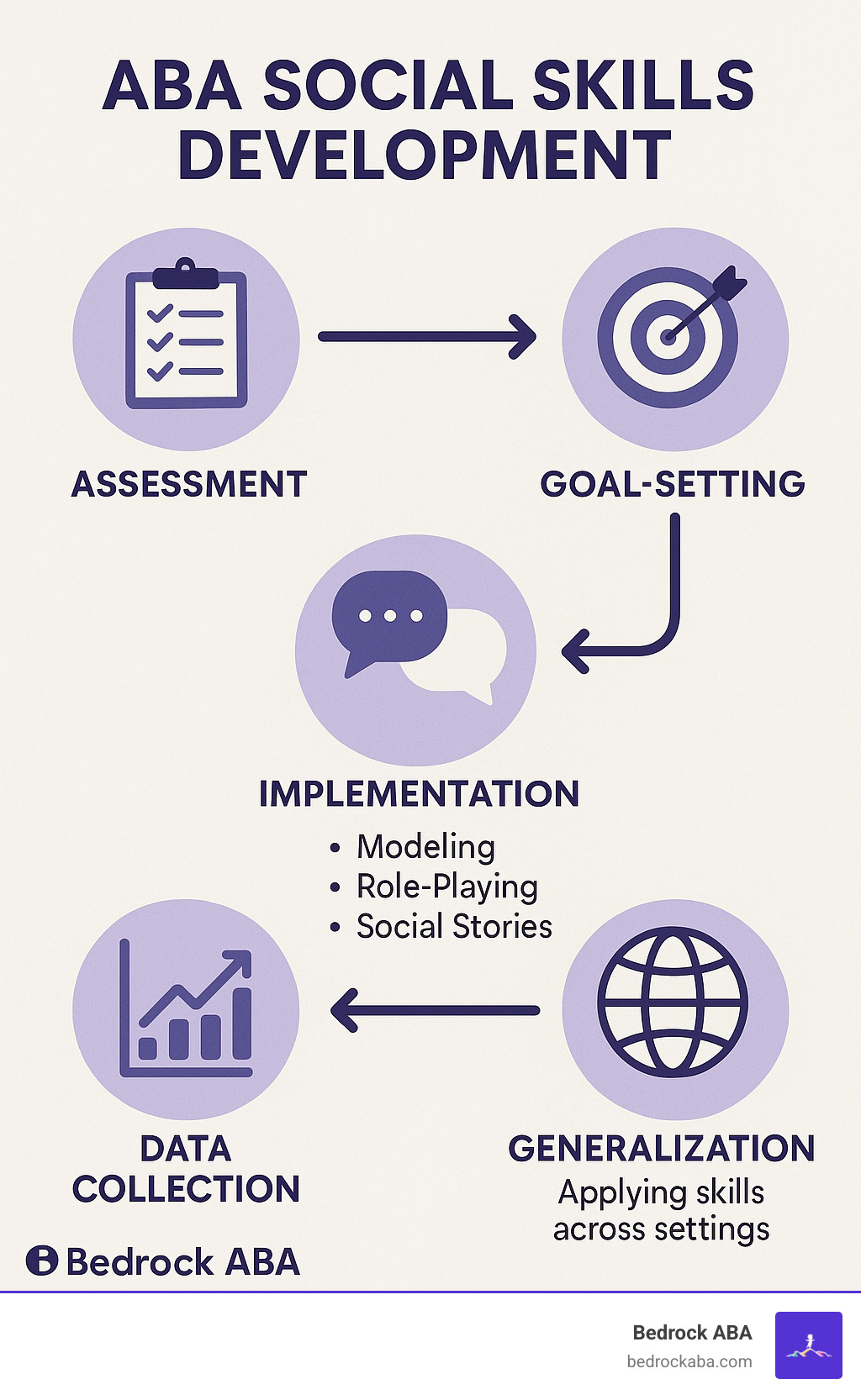
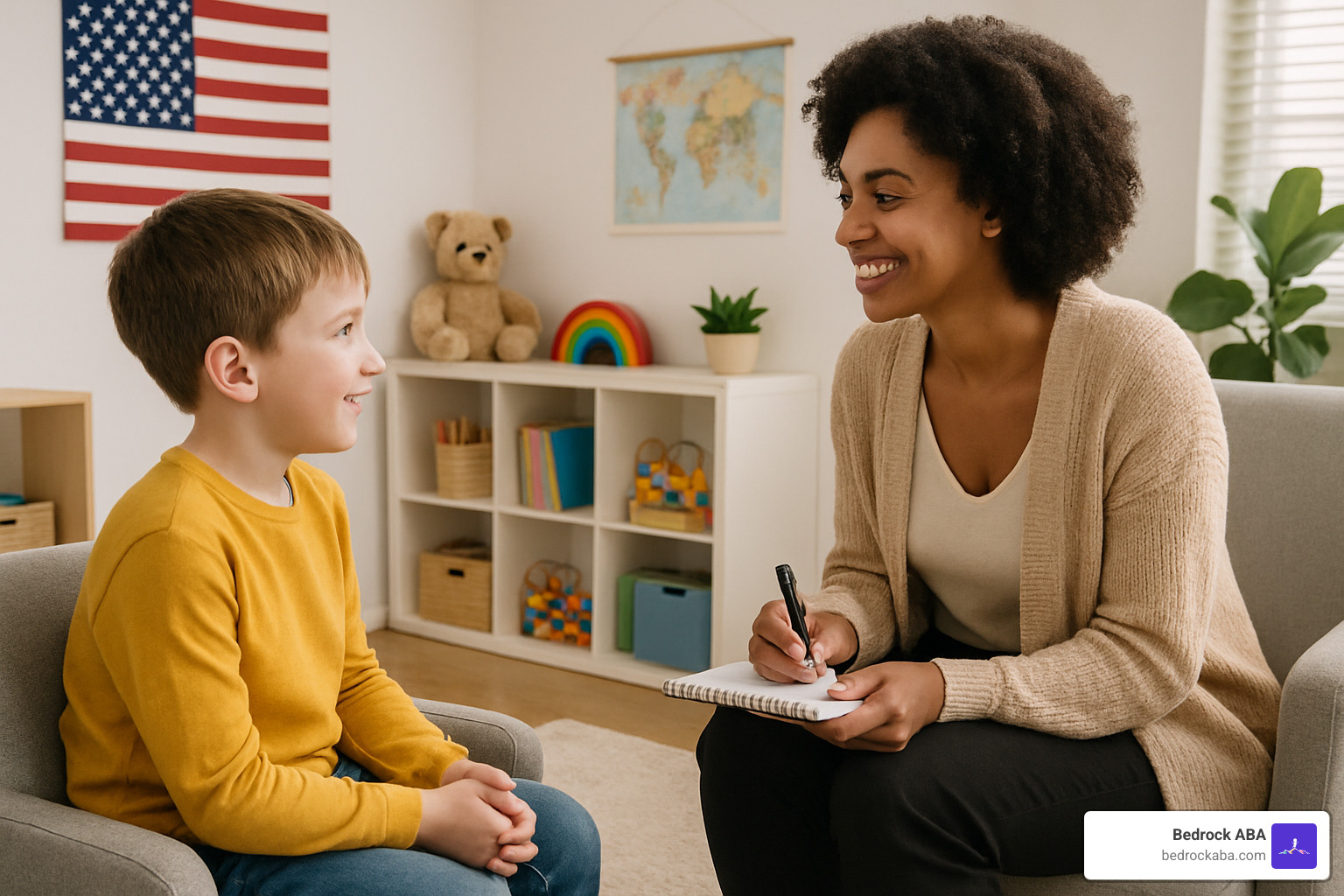
Our journey together begins with a comprehensive assessment using trusted tools that give us a clear picture of your child’s current social abilities. We might use the Social Skills Improvement System (SSIS), Vineland Adaptive Behavior Scales, or specialized autism assessments like the ABLLS-R or VB-MAPP. We also spend time simply observing your child in natural settings.
These assessments help us identify which social skills need support compared to typical developmental milestones for your child’s age. From there, we partner with you to create meaningful goals that will make the biggest difference in your child’s daily life.
We’re big believers in SMART goals – ones that are Specific, Measurable, Achievable, Relevant, and Time-bound. Instead of vague targets like “get better at socializing,” we might focus on “will initiate greetings with peers by saying ‘hi’ and using the peer’s name in 4 out of 5 opportunities during recess.”
Want to learn more about our comprehensive approach? Visit our detailed guide to ABA services for children.
Beginner Skills in ABA Therapy for Social Skills
When we first start working on social skills, we focus on building a strong foundation:
- Making requests – We help children learn to ask for things they want using words, pictures, or gestures
- Responding to greetings – Acknowledging when someone says hello and answering simple questions
- Basic sharing and turn-taking – Introducing the concept that social interaction involves give and take
- Joint attention – The ability to share focus on something with another person
- Basic eye contact – Helping children become comfortable looking at their communication partner
Each small victory in these areas deserves celebration. Every time your child masters one of these foundational skills, they’re building confidence and opening doors to more complex social connections.
Advanced Goals in ABA Therapy for Social Skills
As children grow more comfortable with basic social interactions, we gradually introduce more sophisticated skills:
- Perspective-taking and empathy – Recognizing that others have different thoughts, feelings, and preferences
- Conflict resolution – Identifying problems, generating solutions, and expressing feelings appropriately
- Conversation skills – Starting conversations, staying on topic, taking turns, and ending discussions politely
- Collaborative play – Working with others toward shared goals and handling competitive situations
- Understanding subtle social cues – Recognizing facial expressions, body language, and personal space boundaries
These advanced skills develop gradually with consistent practice across different settings.
Laying the Groundwork: Prerequisite & Foundational Abilities
Before diving into social skills training, we need to make sure certain building blocks are in place:
- Imitation skills – The ability to copy actions, movements, and gestures
- Receptive language understanding – Following directions and comprehending questions
- Waiting and delayed gratification – Building tolerance for natural delays in social interactions
- Transition skills – Moving between activities smoothly and adapting to new environments
- Attention span and focus – Maintaining engagement during social exchanges
These foundational abilities create the necessary platform for successful social development. For a deeper dive into how these skills develop, check out our article on Key Principles Behind ABA Therapy: Reinforcement, Behavior, and Learning.
ABA Therapy for Social Skills: Evidence-Based Teaching Techniques
When children learn social skills through ABA therapy for social skills, they benefit from methods that have been tested and refined over decades.
Discrete Trial Training (DTT) teaches new skills in short, focused bursts with immediate reinforcement.
Natural Environment Teaching (NET) brings those same skills into everyday play and routines.
Behavioral Skills Training (BST) adds clear instructions, live demonstration, guided practice, and feedback.
A 2020 review in the National Library of Medicine highlights how pairing these strategies with peer-mediated practice dramatically improves social outcomes. At Bedrock ABA, BCBAs blend these tools to match each child’s interests and learning style.
Modeling & Role Play
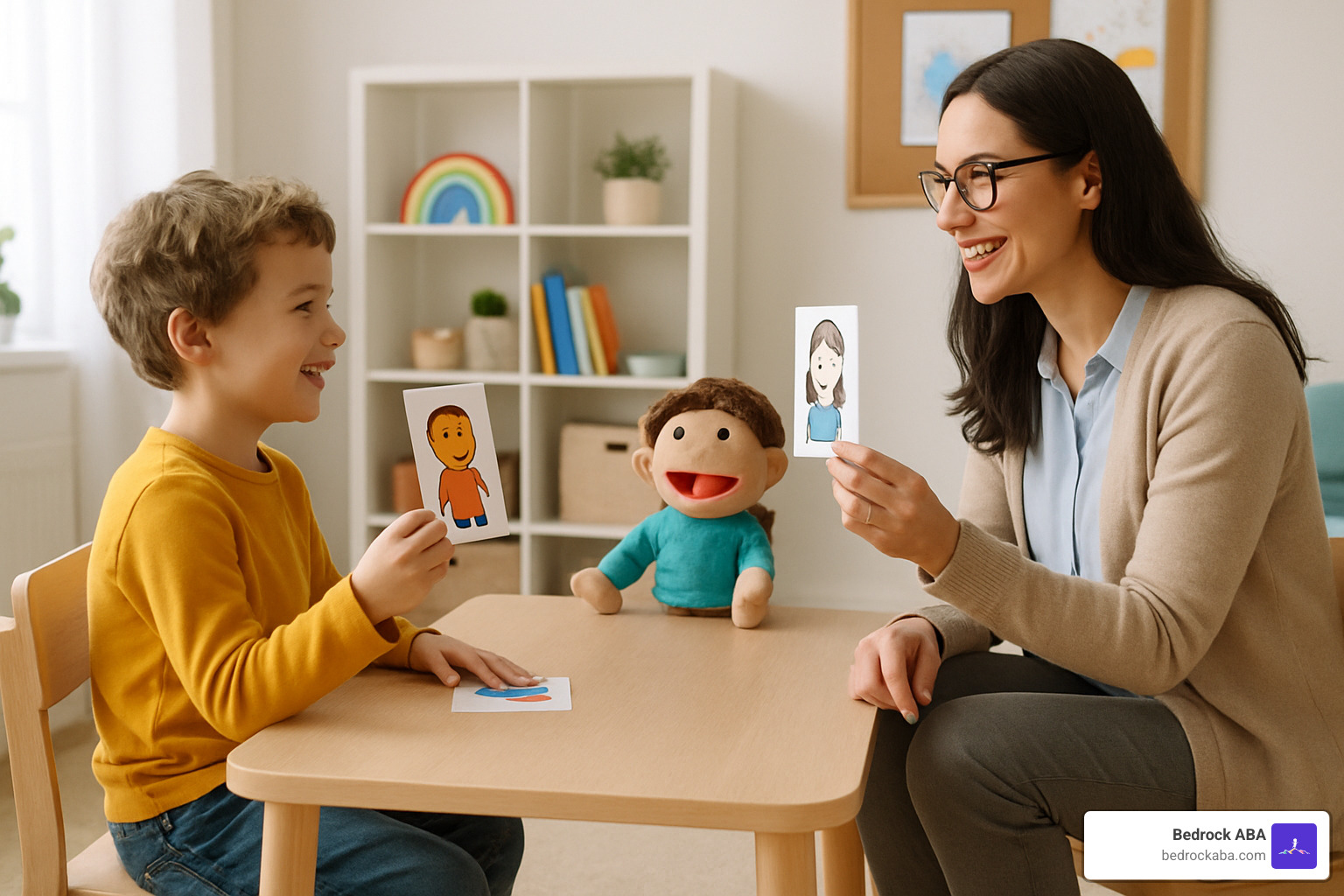
Children often need to see a social behavior before trying it. Therapists model a greeting, the child practices, and we reinforce any step in the right direction. Scripted role play acts like social “training wheels” that we fade as confidence grows.
Social Stories™
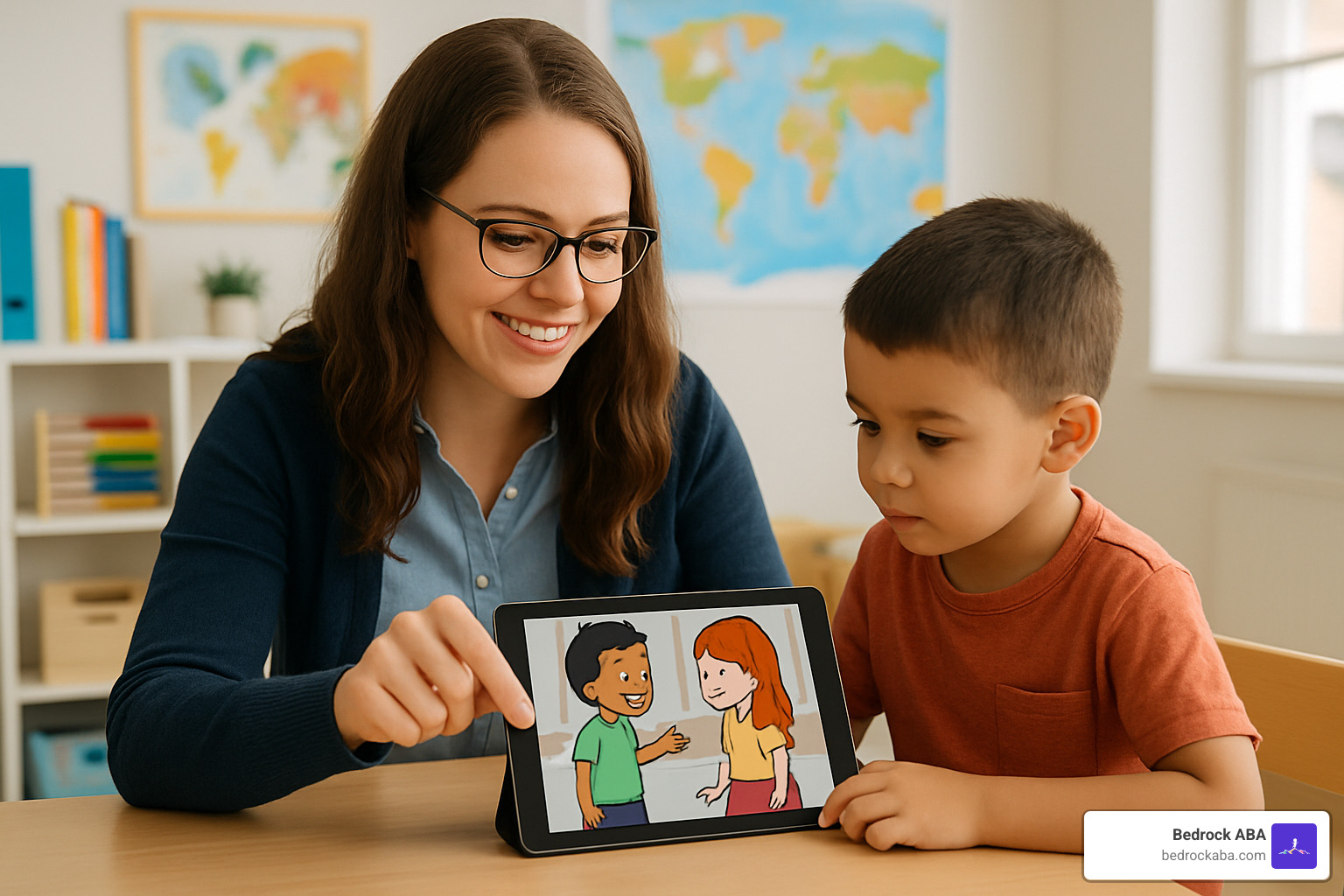
Custom Social Stories explain social “rules” in simple language and pictures, lowering anxiety and preparing children for new situations. Parents can keep copies on a phone or tablet so the story is always at hand. More tips appear in our guide to ABA therapy for parents.
Video Modeling & Tech Supports
Short clips of peers (or edited footage of the child) performing a skill correctly tap into most kids’ love of screens while giving clear, replayable examples. Interactive apps that label emotions or turn-taking add another layer of practice.
One-to-One vs. Group Sessions
| Setting | Best Use | Structure |
|---|---|---|
| 1:1 with therapist | Teach brand-new skills, troubleshoot specific problems | Highly structured |
| Small group | Practice give-and-take with peers, generalize skills | Semi-structured, natural consequences |
Most Bedrock ABA clients start with more 1:1 time and transition to groups as their confidence builds.
Tracking Progress & Generalizing Skills to Real-World Settings
Teaching a skill is only half the goal; your child must use it in class, on the playground, and at family events. We make that happen through data, practice in varied places, and close teamwork with caregivers.
Data That Drives Decisions
- Frequency – how often a child starts a conversation
- Duration – length of back-and-forth exchange
- Latency – time from greeting to response
- ABC notes – what led up to the behavior and what happened after
Clear graphs show when a skill is solid and when it needs review.
Making Skills Stick
We quickly move practice from the therapy room to school, home, parks, and community outings by:
- Changing locations and practice partners
- Fading prompts and replacing token rewards with natural praise
- Running quick “maintenance checks” so mastered skills don’t fade
Family, School & Community Collaboration
Parents get simple, doable strategies—think greeting the cashier or taking turns during a board game. We also coordinate with teachers to align IEP goals and share what works, ensuring the child hears the same cues everywhere.
When peers understand how to include a child, social growth skyrockets. We help set up structured play dates, class activities, and after-school clubs so new skills turn into real friendships.
Choosing a Quality ABA Social Skills Program
A strong program is more than a logo—it’s certified professionals using data-driven methods and partnering with families.
• Led by Board Certified Behavior Analysts (BCBAs) with social-skills experience
• Consistent therapists and reasonable supervision ratios (≈1 BCBA per 8–12 clients)
• Clear explanations of methods, progress reports you can understand
• Flexible delivery—home, clinic, telehealth—to fit your schedule and needs
• Transparent discussion of insurance and out-of-pocket costs
For background on provider roles, see The Role of a Certified ABA Therapist.
Smart Questions to Ask
- How many therapy hours do you recommend, and why?
- What assessment tools measure social growth?
- How is progress shared with parents?
- What training will my family receive for at-home follow-through?
Red Flags
- Vague claims without data
- Minimal parent involvement
- Identical goals for every child
- Focus on compliance over meaningful interaction
- Outdated or aversive practices
Trust your instincts—quality ABA should feel supportive, individualized, and transparent.
Frequently Asked Questions about ABA Therapy & Social Skills
How long does it take to see social-skill improvements?
When parents ask me about timelines for progress with ABA therapy for social skills, I always emphasize that every child’s journey is unique. While I wish I could give a simple answer, the reality is that improvement depends on several important factors.
Your child’s starting point plays a huge role. Some children begin therapy with some foundational skills already in place, while others may be starting from the very beginning. The complexity of the skills we’re working on matters too—learning to make eye contact typically develops more quickly than mastering the back-and-forth of conversation.
The good news is that most families notice small but meaningful changes within the first few weeks of consistent therapy. For more complex social skills—like joining group play or resolving conflicts with peers—we’re usually looking at months rather than weeks of dedicated practice.
At Bedrock ABA, we make sure you can see concrete evidence of your child’s progress through our systematic tracking methods. Social skills develop gradually—we’re building a foundation brick by brick, not constructing the whole building overnight.
Can social skills learned in ABA transfer to school and playgrounds?
This question touches on something we call “generalization” in the ABA world—can your child use their new skills beyond our therapy sessions?
Intentional practice across settings is absolutely essential. At Bedrock ABA, we don’t just teach skills in our clinic; we create opportunities to practice in the environments where your child needs these skills most.
Consistency between environments makes a tremendous difference. When parents, teachers, and therapists all use similar language, prompts, and reinforcement strategies, children learn much more quickly that these skills apply everywhere.
Peer involvement cannot be overlooked. Social skills are, by definition, interactive—they need practice with real peers. We arrange structured interactions with typically developing children, gradually shifting from therapist-supported exchanges to more natural peer interactions.
With thoughtful planning and collaboration between everyone in your child’s life, the skills learned in therapy can absolutely transfer to those crucial real-world settings where they matter most.
What if my child resists social interaction during therapy?
It’s completely natural to worry if your child seems resistant to social interaction during ABA therapy for social skills. This resistance often stems from very understandable causes. For some children, social interaction feels unpredictable or overwhelming. Others may have had negative experiences in the past that make them cautious.
At Bedrock ABA, we take a gentle, respectful approach to building social motivation:
- We focus on building genuine rapport and trust before placing social demands
- We work to understand the root causes of resistance
- We use gradual exposure to social situations
- We find the right motivation by incorporating special interests
With patience and creativity, we typically see resistance transform into genuine engagement over time. The key is respecting your child’s experience while gently expanding their comfort zone.
Conclusion & Next Steps
When it comes to helping children with autism connect with others, ABA therapy for social skills offers so much more than just techniques—it offers hope. By breaking down those seemingly mysterious social interactions into clear, teachable moments and creating plenty of opportunities to practice in a supportive environment, we’ve seen countless children blossom socially in ways their parents once thought impossible.
At Bedrock ABA, we know your child isn’t just another case—they’re unique, with their own personality, interests, and learning style. That’s why we don’t believe in cookie-cutter approaches. Instead, we blend solid behavioral science with genuine care to create programs as individual as your child. With our presence throughout Salt Lake City and surrounding Utah communities, quality ABA therapy is within reach for more families who need it.
The science speaks for itself. Recent research from 2024 shows that even brief ABA interventions—just eight structured sessions—can lead to measurable improvements in social functioning. And when children receive consistent, longer-term support, the results can be truly transformative.
If you’re considering ABA therapy for social skills for your child, taking that first step might feel overwhelming. We’re here to make it easier. Our experienced team of BCBAs would love to talk with you about your child, answer your questions, and help you figure out if our approach would be a good fit for your family.
Ready to move forward? Here’s how to get started:
- Reach out for a free, no-pressure consultation where we’ll get to know your child’s needs
- Learn about our thorough assessment process that helps us create a truly personalized plan
- Speak with our billing specialists who can help steer insurance coverage
- Connect with other parents who understand exactly what you’re going through
- Begin your family’s journey toward better social connections and confidence
Developing social skills isn’t an overnight process—it’s a journey. Some days will bring amazing breakthroughs, while others might feel like you’re taking steps backward. That’s all part of the process, and we’ll be right beside you through every victory and challenge.
For more information about our comprehensive approach to ABA therapy, visit Bedrock ABA. Let’s take that first step together toward helping your child build meaningful connections that will enrich their life for years to come.