


The Critical Window for Development
Early intervention ABA is a specialized Applied Behavior Analysis therapy for children under 3 with autism spectrum disorder (ASD). Here’s what you need to know:
Key Components:
- Timing: Most effective when started between 18-30 months of age
- Intensity: Typically 25-40 hours per week for maximum benefit
- Approach: Combines developmental and behavioral strategies
- Focus: Targets communication, social skills, and daily living abilities
- Family involvement: Parents and caregivers play an active role in therapy
Why It Works:
- Takes advantage of brain plasticity during critical early years
- Can lead to significant improvements in IQ, language, and social skills
- Research shows 50% of children reach average intellectual functioning
- Some children (around 20%) may move off the autism spectrum entirely
The second year of life is a critical window when your child’s brain rapidly develops new connections. Early intervention can reshape how your child learns and connects with others. Research shows that children receiving intensive early intervention make dramatically better progress than those who start later, with over 30% achieving “optimal outcomes” compared to only 3-8% of those without early support.
As Mayer Kulefsky, director of operations at Bedrock ABA, I’ve witnessed how early intervention ABA transforms developmental trajectories. My experience has shown that with access to quality early intervention, children consistently exceed expectations and reach milestones many thought impossible.
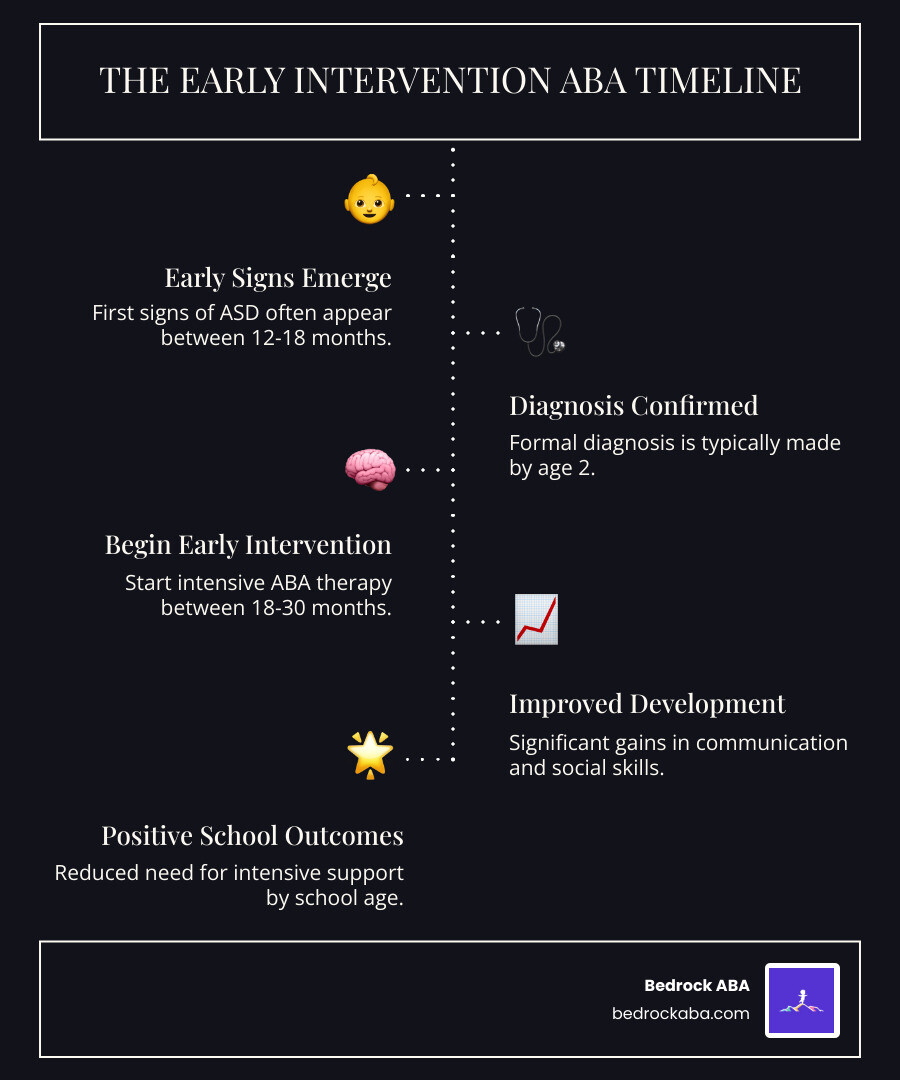
Why Starting Early Matters: The Science Behind Early Intervention
Every parent’s journey begins with noticing something different about their child. Understanding why early intervention ABA makes such a profound difference starts with recognizing these early signs and appreciating the science behind a young child’s developing brain.
Recognizing the Early Signs of Autism
The path to supporting your child often begins with trusting your parental instincts. Research shows 80% of parents identify potential issues by age two. These observations are the first crucial step toward getting your child the support they need.
Key signs to discuss with your pediatrician include:
- Lack of eye contact during interactions.
- No response to name by 9-12 months.
- Delayed speech milestones, such as no babbling by 12 months, no single words by 16 months, or no two-word phrases by 24 months.
- Limited gestures like pointing, showing, or waving by 12 months.
- Repetitive behaviors like hand flapping, rocking, or spinning.
- Sensory sensitivities with unusual reactions to sounds, textures, or other stimuli.
- Difficulty with social cues and reading facial expressions.
- Limited interest in others, preferring objects to people.
- Difficulty with change in routines or surroundings.
- Loss of skills, such as a regression in speech or social abilities, which requires immediate attention.
If you notice these signs, don’t wait. Autism can sometimes be diagnosed before age 2. For a comprehensive look, the American Academy of Pediatrics offers detailed information on common early symptoms of ASD. You can also learn how ABA therapy for toddlers can help.
The Power of Neuroplasticity in Young Brains
Your child’s brain during these early years is constantly building new pathways. This ability to adapt and change is called neuroplasticity, and it’s why early intervention ABA is so transformative.

A young brain is like wet clay—malleable and ready to be shaped. This adaptability is strongest during the critical period before preschool (around 2-3 years). During this time of rapid brain growth, treatments have the best chance of creating long-term positive effects.
By taking advantage of this natural neuroplasticity, early intervention ABA helps children develop foundational skills in communication and social interaction when their brains are most receptive. To understand more, you can explore what brain plasticity means for your child’s development.
The Evidence Supporting Early Intervention ABA
The effectiveness of early intervention ABA is supported by decades of rigorous research showing remarkable outcomes for children who start early.

The groundbreaking 1987 Lovaas study demonstrated that intensive ABA therapy helped around 50% of children achieve average intellectual and educational functioning, with significant positive changes that lasted into adulthood.
More recent research validates these findings. Studies consistently show children in early intervention achieve improved IQ scores, better language and social skills, and reduced challenging behaviors. These gains build a foundation for meaningful relationships and greater independence.
The long-term benefits are significant. Children who receive early intervention ABA often require reduced support later in life, achieving greater independence in school and beyond. This improves their quality of life and reduces long-term costs for families. Current research shows that around 20% of children receiving intensive early intervention may move off the autism spectrum, while many others show significant improvements.
The scientific consensus is clear: early diagnosis and intervention have major long-term positive effects. For the latest findings, review more recent studies on early intervention, and learn about our approach in our guide to ABA therapy for autism.
A Deep Dive into Early Intervention ABA Therapy
Now that we understand the “why” behind early intervention, let’s explore what early intervention ABA therapy looks like. Understanding this evidence-based approach can help you feel more confident about taking the next steps.
What is ABA Therapy and How Does it Work?
Applied Behavior Analysis (ABA) is the science of learning and behavior. It’s a systematic way to understand how children learn and use that knowledge to help them grow. Modern ABA is a compassionate, child-centered approach focused on building skills.
Its beauty lies in positive reinforcement. When your child demonstrates a new skill, they receive something meaningful, like praise or a favorite toy, which builds confidence and motivation.
ABA is also a data-driven approach. We carefully track progress to see what’s working and what needs adjustment, ensuring therapy is as effective as possible.
Every child receives an individualized treatment plan designed by a Board Certified Behavior Analyst (BCBA) based on their unique strengths and your family’s goals. Before addressing challenging behaviors, a Functional Behavior Assessment helps us understand the “why” behind them, allowing us to teach better ways for your child to meet their needs.
At Bedrock ABA, we believe learning should feel natural. Our teams work creativity into everyday interactions, making ABA strategies part of your family’s routine. For a deeper understanding, read our article on What is ABA Therapy and How Does it Work?.
Key ABA Techniques Used with Young Children
Working with young children requires special techniques that meet them where they are developmentally. Our therapists blend different approaches to create engaging learning experiences that feel like play.

- Discrete Trial Training (DTT) breaks complex skills into small, manageable steps. Each success is celebrated to build momentum, and we weave this technique naturally into play.
- Natural Environment Teaching (NET) happens in the real world, like your living room or the playground. This helps skills stick because they’re practiced in meaningful situations.
- Pivotal Response Treatment (PRT) focuses on key areas like motivation and self-initiation, which can lead to widespread improvements in communication and social skills.
- Functional Communication Training gives children better ways to express their needs, such as pointing to a picture instead of having a tantrum. This reduces frustration while building essential skills.
Our approach emphasizes play-based learning, embedding goals into games and activities your child enjoys. This child-led approach helps skills generalize beyond therapy sessions. The Early Start Denver Model (ESDM) exemplifies this integrated approach. Learn more in our guide to Play-Based ABA Therapy.
How ABA Builds Essential Life Skills
Early intervention ABA takes a comprehensive approach, targeting the foundational skills your child needs for independence and happiness.
- Communication skills are a primary focus. We meet children at their level, whether that means teaching them to point and use pictures or helping them have back-and-forth conversations.
- Social and play skills are taught explicitly to help children learn to share, take turns, and read social situations, preparing them for friendships. Our guide on ABA Therapy Social Skills explores this further.
- Daily living skills, like getting dressed and brushing teeth, build independence and confidence.
- Reducing challenging behaviors focuses on prevention and replacement. We help children learn to regulate their emotions and express their needs effectively, preventing difficult behaviors from becoming ingrained. Our approach to ABA Therapy for Emotional Regulation provides more insight.
Through consistent positive reinforcement, we help children build confidence alongside skills, supporting long-term success in school, relationships, and the community.
Navigating Your Options: Understanding Early Intervention ABA Services
Figuring out support services for your child can feel overwhelming, but you don’t have to do it alone. Understanding how early intervention ABA fits into the bigger picture can help you make informed decisions.
Early Intervention ABA Services and Support
“Early intervention” refers to a broad network of services for children under three with developmental delays, often supported by Part C of the Individuals with Disabilities Education Act (IDEA). Early intervention ABA is a specialized tool in this larger toolkit.
While general early intervention provides broad support, ABA therapy digs deeper into the science of learning. It’s especially powerful for children with autism due to its targeted and comprehensive approach to communication, social interaction, and daily living skills. It’s designed to address the core challenges of ASD, like social difficulties and communication barriers.
At Bedrock ABA, we believe in collaboration with other professionals. We don’t work in isolation. Your child may also benefit from speech, occupational, or physical therapy. We see these as complementary services. For example, a speech therapist may work on pronunciation while our ABA team focuses on motivating your child to use those words to communicate. This collaborative approach ensures your child receives well-rounded support.
Our services are flexible and family-centered. We offer in-person and remote options and involve parents as active participants. Teaching you effective strategies ensures consistency and maximizes your child’s progress. Understanding your rights under the Individuals with Disabilities Education Act (IDEA) can be empowering. Learn more in our guide on ABA Therapy Early Intervention.
How to Know if Your Child Needs Early Intervention ABA
Deciding if your child needs early intervention ABA can be stressful, but taking action early is rarely something parents regret. The journey often starts with a feeling that something is different about your child’s development.
Developmental milestones are helpful guideposts. If your child isn’t hitting key milestones for their age or has lost skills they once had, it’s time for a pediatrician consultation. Share specific examples of what you’ve noticed. Your pediatrician may recommend a diagnostic evaluation with a specialist.
Autism can often be diagnosed accurately before a child turns 2, allowing intervention to start during the critical window of brain development. However, you don’t have to wait for a formal diagnosis to seek help. If you see concerning behaviors, consulting with an ABA provider can offer valuable insights.
Trusting your parental intuition is crucial. Research shows parents are often the first to notice developmental differences. You know your child best, and your observations are vital for professionals making an accurate assessment. The CDC’s autism screening information offers helpful tools to guide your conversations with healthcare providers.
The bottom line is that sooner is almost always better. Seeking an evaluation isn’t about labeling your child—it’s about ensuring they have every opportunity to reach their full potential.
Frequently Asked Questions about Early Intervention ABA
We understand that choosing early intervention ABA brings up many questions. We’re here to provide honest, evidence-based answers to help you make the best decision for your family.
How many hours of therapy are recommended for young children?
Research shows that intensive therapy, typically 25 to 40 hours per week, leads to the best outcomes for young children. This recommendation is based on the original Lovaas study model and confirmed by more recent research.
This intensity capitalizes on early brain neuroplasticity, providing the consistent, repeated practice needed to learn new skills and prevent challenging behaviors from becoming ingrained. However, we focus on quality over quantity. A BCBA will work with your family to determine the right intensity for your child’s unique needs. The goal is to provide enough meaningful learning opportunities to change your child’s developmental path without causing stress.
Can early ABA therapy help my child “catch up” to their peers?
Yes, early intervention ABA can lead to remarkable developmental gains. Research shows that approximately 50% of children who receive intensive early ABA therapy reach average ranges in intellectual and educational functioning. This means significant improvements in IQ, language, and daily living skills.
Studies also indicate that around 20% of children make such substantial progress that they may move off the spectrum as they grow older. We see children make significant gains, from learning to speak to engaging socially with classmates, preparing them for mainstream classrooms. However, we always focus on individual potential and progress. Our goal is to help your child reach their highest possible level of independence and happiness.
What is the role of parents and family in the therapy process?
At Bedrock ABA, you’re the most important part of the team. Your involvement directly impacts your child’s progress. We practice family-centered care, designing everything around your family’s unique needs and routines.

Parent training is a cornerstone of our approach. We teach you effective strategies to reinforce learning throughout your daily routines. Collaboration with therapists happens through regular meetings to discuss progress and adjust strategies. We want you to feel confident and empowered.
Reinforcing skills at home is where the real magic happens. When children practice new skills in their natural environment with the people they love, those skills become meaningful and lasting. Your active participation helps your child generalize skills to daily life.
Conclusion: Take the First Step to Open up Your Child’s Potential
The path ahead may feel uncertain, but you’re not alone. We’ve seen how early intervention ABA leverages the incredible neuroplasticity of the early years to help children make remarkable progress. Research confirms that this is a powerful, science-backed method for building the communication, social, and daily living skills that will serve your child for life.
These moments—the first word, a spontaneous hug, asking for help—become the foundation for everything that follows. You are the most crucial part of your child’s team. Your intuition brought you here, and your love will carry them forward.
At Bedrock ABA, we believe in personalized care that honors your child’s individual strengths. Our commitment to family-centered support means we work with your entire family to create an environment where growth can flourish.
Trust your instincts. If you have concerns about your child’s development, the time to act is now. The critical window of early childhood is full of possibilities. Don’t let another month slip by wondering “what if.” Take that first step toward opening up your child’s potential.
Learn more about our ABA therapy process and find how we can support your family on this journey.