


Why ABA Certification Matters for Quality Care
ABA certification is the credentialing system ensuring behavior analysts have the training, education, and skills for effective Applied Behavior Analysis therapy. Key points include:
- Four main certification levels: RBT (entry-level), BCaBA (assistant), BCBA (independent practitioner), and BCBA-D (doctoral designation).
- Overseen by the BACB: The Behavior Analyst Certification Board sets global standards.
- Varying requirements: From 40 hours of training for RBTs to master’s degrees and 2,000 supervised hours for BCBAs.
- Family protection: Certification ensures your child receives evidence-based care from qualified professionals.
Understanding these certifications helps you find the right therapist, as the certification level directly impacts the scope of services a professional can provide. ABA therapy is proven effective, but only when delivered by properly trained professionals. The Behavior Analyst Certification Board (BACB) exists to maintain these standards and protect families from unqualified providers.
As Mayer Kulefsky, director of operations at Bedrock ABA, I’ve seen how proper ABA certification ensures families receive the individualized, high-quality care their children deserve. Our experience shows that certified professionals consistently deliver better outcomes for children with autism and developmental disorders.
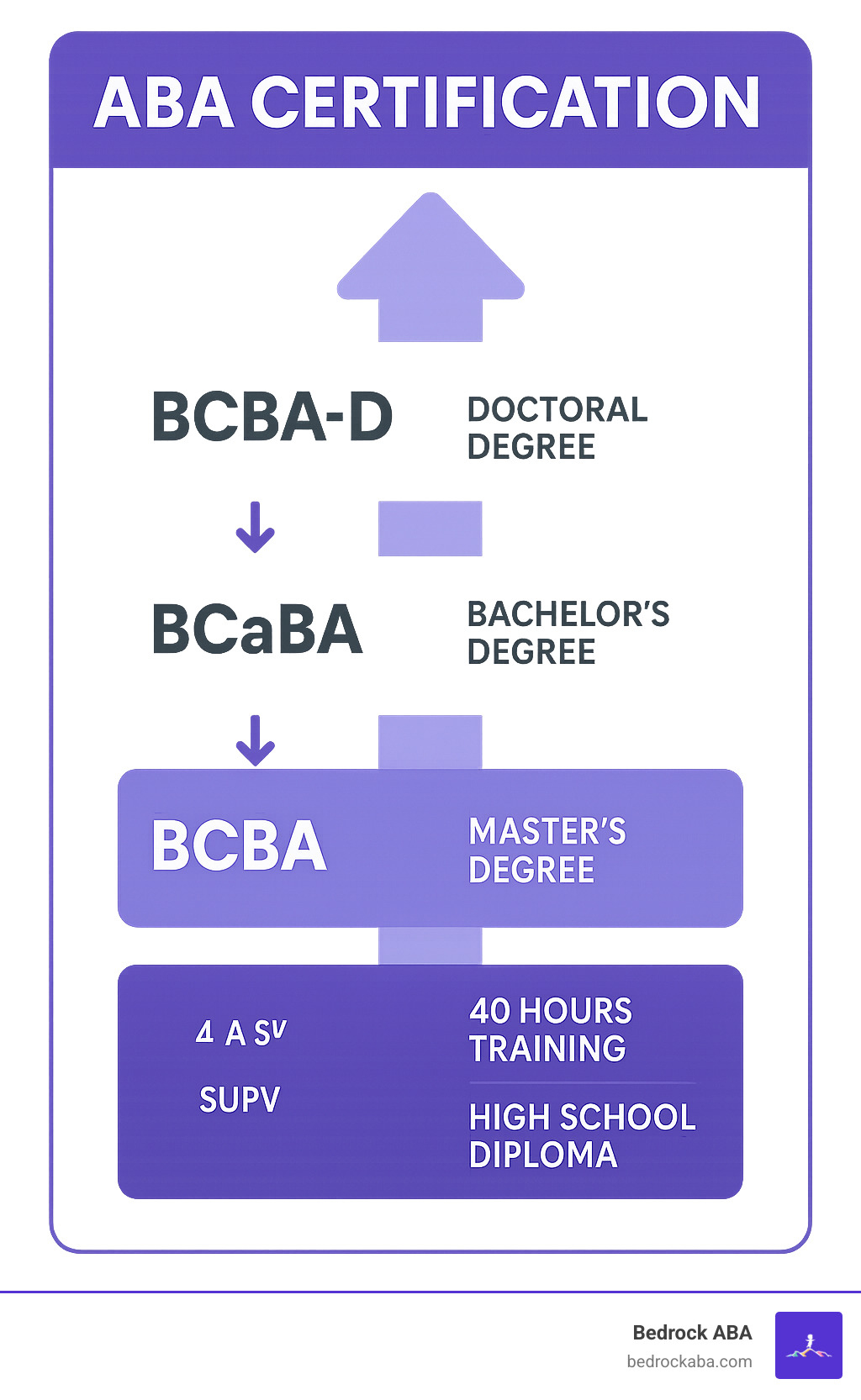
Simple aba certification word guide:
Understanding Applied Behavior Analysis (ABA) and the Role of Certification
Applied Behavior Analysis, or ABA, is the science of learning and behavior. It helps us understand why people act the way they do and how to help them learn new skills. ABA uses this understanding to increase helpful behaviors, like communication, and decrease challenging behaviors that hinder growth.
ABA is an evidence-based practice backed by decades of research and recognized as a best practice treatment by the US Surgeon General and the American Psychological Association. Scientific research on ABA effectiveness shows that intensive ABA therapy can lead to significant improvements for children with autism. However, these results depend on qualified professionals. ABA certification ensures the person working with your child has the necessary expertise for safe and effective care. You can learn more in our guide on What is ABA Therapy and Why It’s Beneficial for Children with Autism?.
The Core Principles of ABA Therapy
ABA therapy is built on core principles like positive reinforcement, where a positive outcome following a behavior makes it more likely to happen again. Therapists use the ABC model to understand behavior:
- Antecedent: What happens right before the behavior.
- Behavior: The action itself.
- Consequence: What happens immediately after.
By analyzing these components, therapists make data-driven decisions to adjust therapy. The goals are skill acquisition (building new abilities) and behavior reduction (decreasing challenging behaviors), all within a program that is individualized for your child.
The Behavior Analyst Certification Board (BACB)
The Behavior Analyst Certification Board (BACB) is the nonprofit organization that provides global credentialing for ABA professionals. Its mission is to set standards and protect consumers. The BACB ensures that anyone with an ABA certification has met rigorous educational and ethical requirements, so you can be confident in their qualifications. This means you don’t have to guess if a therapist is qualified—the BACB has already verified it. Learn more at About the BACB.
The Tiers of ABA Certification: From RBT to BCBA-D
ABA certification levels work together to create a strong foundation for quality care. Higher-level professionals supervise and guide those at entry levels, ensuring your child receives consistent, high-quality care from a collaborative team.

Registered Behavior Technician (RBT)
RBTs are the professionals who spend the most direct time with your child, implementing therapy plans designed by their supervisors. To become an RBT, a candidate needs a high school diploma, 40 hours of training, and must pass a competency assessment and exam. Under the ongoing supervision of a BCBA or BCaBA, RBTs collect data and provide the consistent support that helps children build new skills. More on RBT certification details their responsibilities.
Board Certified Assistant Behavior Analyst (BCaBA)
The BCaBA is the next level of ABA certification, requiring a bachelor’s degree, specialized coursework, and supervised fieldwork. BCaBAs can analyze data, modify programs, and supervise RBTs, all while working under the supervision of a BCBA. They bridge the gap between direct implementation and high-level program design. BCaBA requirements outline the specific standards.
Board Certified Behavior Analyst (BCBA)
The BCBA is the independent practitioner who can design, implement, and supervise comprehensive ABA programs. These professionals hold a master’s degree, have completed extensive supervised experience, and passed a rigorous national exam. BCBAs are the clinical leaders who conduct assessments, design individualized treatment plans, and supervise the entire therapy team. The Role of a Certified ABA Therapist in Providing Therapy explores their significant impact.
Board Certified Behavior Analyst – Doctoral (BCBA-D)
The BCBA-D is not a separate certification but a designation for BCBAs who have earned a doctoral degree in a relevant field. They have the same practice rights as BCBAs but their designation recognizes advanced academic achievement. BCBA-Ds are often involved in research, university teaching, or specialized clinical work, contributing to the advancement of the field. BCBA-D designation details explain the requirements for this recognition.
Your Roadmap to Earning Your BCBA: The Premier ABA Certification
Becoming a Board Certified Behavior Analyst (BCBA) is a meaningful journey that requires dedication but leads to a rewarding career helping children and families. Each step prepares you to provide life-changing therapy.

Step 1: Meeting the Educational and Experience Requirements
The path to ABA certification as a BCBA begins with a master’s degree in psychology, education, or behavior analysis. This degree must include a Verified Course Sequence (VCS), which consists of 315 hours of approved graduate-level classes covering essential ABA concepts. The next step is completing 2,000 hours of supervised fieldwork, where you apply your knowledge in real-world settings under the guidance of a BCBA. This experience typically takes 1-2 years. You can find detailed requirements on the BCBA eligibility pathways page.
Step 2: The BCBA Application and Examination Process
After completing your education and fieldwork, you can apply for the BCBA exam online through your BACB account for a $245 fee. The exam, administered by Pearson VUE, has 150 multiple-choice questions covering practical scenarios and ethical dilemmas. The BACB provides a BCBA/BCaBA Task List that outlines the topics covered. If you don’t pass on the first try, you have multiple opportunities to retake it.
Step 3: Maintaining Your ABA Certification as a BCBA
Earning your ABA certification is just the beginning. To maintain your BCBA credential, you must renew it every two years. This involves completing continuing education units (CEUs), including specific ethics training, and paying renewal fees. This commitment to ongoing professional development ensures you stay current with the latest research and best practices, demonstrating a commitment to excellence and providing the best possible care.
Life as a Certified ABA Professional
Earning your ABA certification opens the door to a fulfilling and rewarding career with strong job security and diverse opportunities. It’s a credential that allows you to make a real difference in people’s lives.
Career Paths and Opportunities with an ABA Certification
The job market for certified ABA professionals is thriving, with a 23% increase in job openings between 2021 and 2022 alone. Your ABA certification allows you to work in various settings:
- Specialized clinics like Bedrock ABA
- Schools as a Behavior Consultant or Special Education Teacher
- Home-based therapy
- Hospitals and medical settings
- Corporate environments for organizational behavior management
You can also pursue leadership roles like Clinical Director or Program Manager. The demand for skilled ABA professionals is growing, including in Utah. You can explore local openings in our guide to ABA Therapy Jobs in Utah.
Ethical Standards and Regulatory Oversight
Certified ABA professionals are held to the highest ethical standards, guided by the BACB Ethics Code for Behavior Analysts. This code emphasizes client dignity, confidentiality, competence, and responsible conduct. It ensures that all interventions are client-centered and focus on meaningful outcomes. The field is also increasingly regulated at the state level to protect the public, often requiring licensure in addition to certification. This trend toward greater professionalization and accountability builds public trust and ensures high standards of care.
For Clients: Finding and Evaluating ABA Services
For parents, understanding ABA certification is the best way to find quality care. This system helps you identify qualified providers who deliver safe and effective services.

When searching for a provider:
- Verify credentials on the public BACB Registry.
- Contact your insurance provider to understand your benefits for ABA services.
- Ask about staff qualifications and ABA certification levels, as well as supervision ratios.
- Inquire about their approach to setting and re-evaluating treatment goals, ensuring it’s data-driven and individualized.
- Ask about parent training and involvement, as the best programs partner with families.
- Confirm their commitment to ethical practice and client safety.
Frequently Asked Questions about ABA Certification
How long does it take to get a BCBA certification?
After completing a bachelor’s degree, earning a BCBA certification typically takes 3 to 4 years. This includes about 2 years for a master’s degree and another 1 to 2 years to complete the 2,000 hours of supervised fieldwork. The exact timeline can vary based on your program and whether you accumulate hours on a full-time or part-time basis. While it’s a significant time investment, it prepares you for a career where you can genuinely change lives.
What is the difference between certification and licensure?
This is a common point of confusion. Here’s a simple breakdown:
- Certification: An ABA certification from the BACB is a professional credential that verifies you have met national standards for knowledge and competence. It is recognized internationally.
- Licensure: This is legal permission from a state government to practice in that specific state. Licensure requirements vary by state and often include holding a BACB certification as a prerequisite.
In short, certification proves you are qualified, while licensure gives you legal permission to practice in a particular location. Many states now require both, which improves consumer protection.
Can ABA therapy be adapted for different needs and settings?
Yes, adaptability is a core strength of ABA therapy. At Bedrock ABA, every child receives an individualized treatment plan custom to their unique strengths, challenges, and family goals. ABA is effective across various settings, including home-based therapy, school-based services, and community settings to help generalize skills. We also offer telehealth options for flexible care. The principles of ABA can be adapted for all ages, from young children to adolescents, as highlighted in our guide to ABA Therapy for Teens. Our certified professionals are skilled at modifying techniques to meet each person where they are.
Conclusion
The journey to ABA certification is a commitment to changing lives. Whether you are pursuing a career in this field or seeking services for your child, understanding the certification process is key to ensuring quality care.
At Bedrock ABA, we see daily how certified professionals transform outcomes for children and their families. The path to certification, from RBT to BCBA-D, is achievable and creates a comprehensive support system for a child’s development. Each level is vital, and these professionals work together to help individuals reach their full potential.
For families, understanding ABA certification empowers you to advocate for your child and find providers who will partner with you. For professionals, it’s the start of a rewarding career dedicated to evidence-based practice and continuous learning.
Learn more about our ABA therapy services in Utah and find how our certified team can support your family’s unique journey.