


Why Daily Living Skills Matter for Your Child’s Independence
Daily living skills are the essential, practical abilities children need to manage their everyday tasks and care for themselves independently. These skills form the bedrock of self-sufficiency, ranging from the most basic self-care routines, like brushing teeth, to highly complex activities, such as managing a budget or preparing a family meal.
Mastering these skills is about more than just checking off a developmental milestone; it’s about building a life of dignity, confidence, and opportunity.
A Closer Look at Daily Living Skills:
- Basic Activities of Daily Living (ADLs): These are the fundamental skills related to personal care. They include dressing, bathing, eating, toileting, and maintaining personal hygiene. These are the first building blocks of independence.
- Instrumental Activities of Daily Living (IADLs): These are more complex skills needed to live independently within a community. They encompass cooking, shopping, money management, using transportation, and performing household chores.
- Age-Appropriate Development: The journey of acquiring these skills is a gradual progression. It starts with a one-year-old learning to self-feed and evolves to an eighteen-year-old mastering budgeting, job skills, and household management.
- The Core Benefits: The rewards of mastering these skills are profound. They lead to increased independence, a stronger sense of confidence, higher self-esteem, and a significantly improved overall quality of life for both the child and their family.
Every parent cherishes watching their child take those first steps toward independence—whether it’s a toddler proudly using a spoon or a teenager navigating their first job interview. For children with autism and other developmental differences, this journey often requires extra patience, specialized strategies, and highly structured support to bridge the gap between potential and performance.
Research consistently shows that proficiency in daily living skills is a powerful predictor of future independence, self-esteem, and overall happiness. The earlier a child begins to learn and practice these skills, the greater their capacity for living a self-sufficient and fulfilling life as an adult. This isn’t just a short-term goal; it has lifelong implications. In fact, studies indicate that a staggering 20.7% of adults aged 85 or older require assistance with basic daily activities—a statistic that underscores the critical importance of building a strong foundation of these skills from an early age.
However, the path isn’t always smooth or straightforward. Many parents feel overwhelmed, isolated, and uncertain as they try to teach skills that seem to come naturally to other children. You might find yourself wondering if your child is on track, how to break down a seemingly simple task like tying shoes into manageable steps, or what to do when progress stalls and frustration mounts for both you and your child.
I’m Mayer Kulefsky, director of operations at Bedrock ABA. In my role, I’ve had the privilege of helping expand specialized daily living skills programs for children with autism and developmental disorders across multiple states. Through years of partnering with families, I’ve witnessed how the right, individualized approach can transform not just a child’s capabilities, but the entire family dynamic, reducing stress and fostering a more positive and empowered home environment.
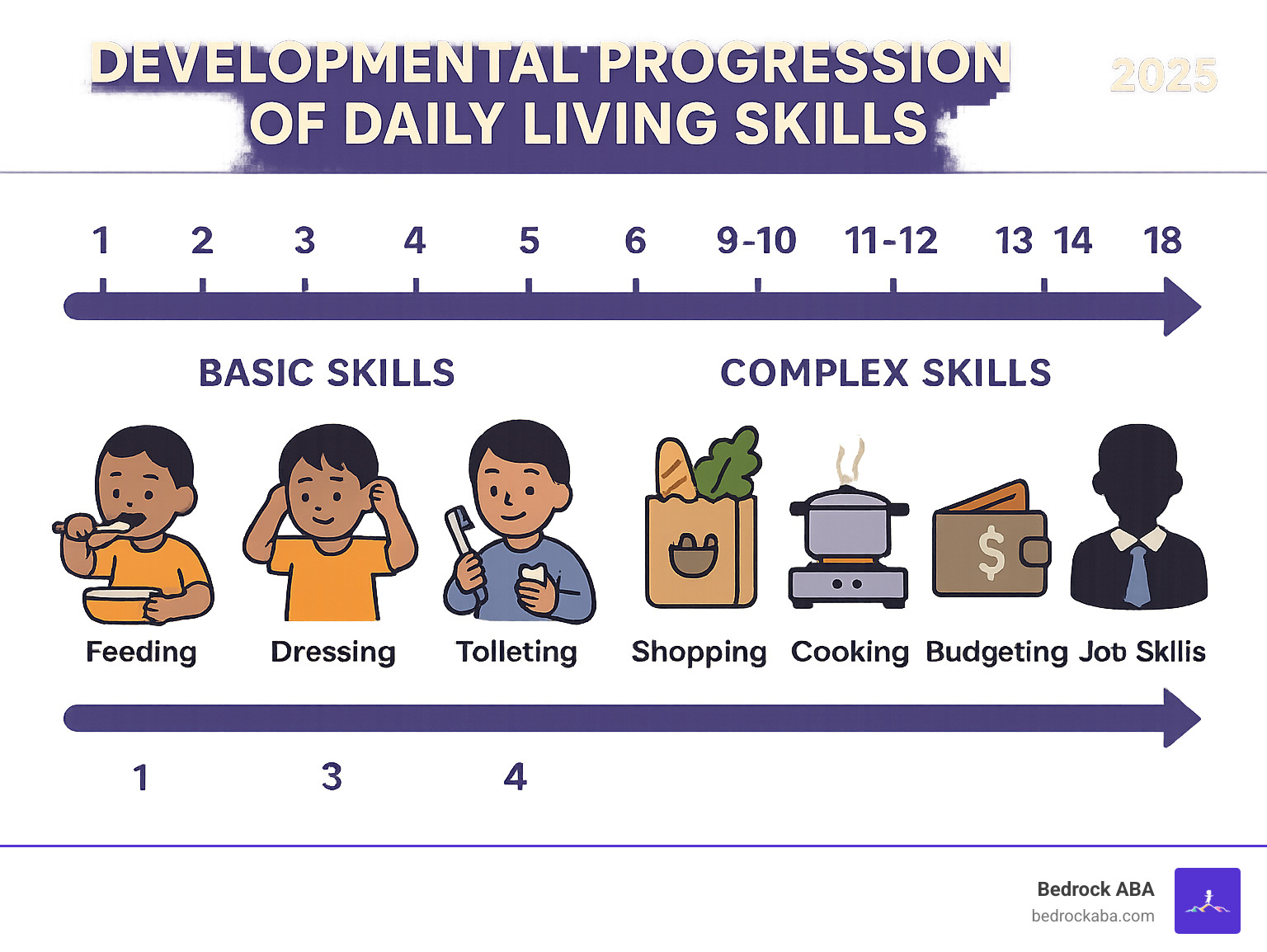
The Two Pillars of Independence: ADLs and IADLs
When we talk about daily living skills, it helps to think of them as two main pillars that support your child’s journey toward independence. These pillars—Activities of Daily Living (ADLs) and Instrumental Activities of Daily Living (IADLs)—work in tandem to create the foundation for a fulfilling, self-sufficient life. One cannot stand strong without the other.
ADLs are the basic building blocks—the fundamental self-care tasks your child needs to manage their body and personal needs. Think of a toddler learning to feed themselves with a spoon or a preschooler mastering the art of buttoning their shirt. These skills are intimate and personal, forming the essential foundation that all other independent activities build upon. Without a solid grasp of ADLs, tackling more complex tasks becomes incredibly challenging.
IADLs represent the next level of independence—the more complex activities that allow your child to interact with their environment and function independently within their community and home. These skills require more planning, organization, problem-solving, and cognitive flexibility. Picture a teenager learning to budget their allowance to save for a video game or preparing a simple meal for the family. IADLs are about navigating the world.
Understanding this distinction is crucial for parents and caregivers. It helps you set realistic expectations, celebrate small victories, and create appropriate learning goals that match your child’s current developmental stage, ensuring they are challenged but not overwhelmed.
| Category | Description | Examples |
|---|---|---|
| Activities of Daily Living (ADLs) | Basic self-care tasks essential for daily functioning | Eating and self-feeding, dressing independently, personal hygiene (brushing teeth, washing hands), toileting, bathing, basic mobility |
| Instrumental Activities of Daily Living (IADLs) | Complex community-living skills requiring planning and problem-solving | Meal preparation and cooking, household chores (laundry, cleaning), money management and budgeting, transportation (using public transit), communication skills, safety awareness |
Basic Activities of Daily Living (ADLs)
ADLs cover the essential self-care tasks that keep your child healthy, clean, and comfortable throughout their day. These skills, which include dressing, grooming, toileting, eating, personal hygiene, and mobility, typically begin developing in the toddler and preschool years. However, the timeline can vary significantly, especially for children with developmental differences who may need extra support and structured teaching to master these fundamental abilities. Each ADL presents its own set of learning opportunities and potential challenges.
- Dressing and Grooming: This involves more than just putting on clothes. It includes choosing weather-appropriate outfits, managing fasteners like buttons and zippers, and understanding the sequence of getting dressed. Grooming tasks like brushing hair and teeth involve fine motor control and tolerance for different sensory inputs.
- Toileting: Mastering toileting is a major milestone that involves recognizing bodily signals, using the toilet correctly, and managing clothing and hygiene afterward. It requires patience, consistency, and often, a structured toileting plan.
- Eating and Personal Hygiene: Self-feeding progresses from using fingers to skillfully using utensils. Personal hygiene, such as handwashing, is a cornerstone of health and requires understanding the process and importance of being thorough.
Scientific research on ADL assessment has long established standardized ways to measure these skills, highlighting their importance in clinical and home settings. Early and consistent practice, guided by proven strategies, significantly improves long-term outcomes.
Instrumental Activities of Daily Living (IADLs)
IADLs represent the more sophisticated skills that empower your child to participate fully in family and community life. These skills, including household chores, meal preparation, money management, transportation, communication, and safety awareness, typically emerge during the school-age years and continue to develop through adolescence. They require a higher level of cognitive ability, as your child must plan, solve problems, and adapt to new situations.
- Household Chores and Meal Preparation: Contributing to household tasks like laundry or setting the table fosters a sense of responsibility. Meal preparation can start simple, like making a sandwich, and progress to following a recipe, which involves sequencing, measuring, and kitchen safety.
- Money Management: This critical skill begins with understanding coins and progresses to creating a budget, making purchases, and saving for goals. It is a direct link to independent living in adulthood.
- Transportation and Safety: Learning to steer the community, whether by walking safely to a friend’s house or eventually using public transit, is a key IADL. It involves planning, safety awareness, and knowing what to do in unexpected situations.
For many children, especially those who struggle with social interactions, developing these practical life skills is closely linked to building social competence. Applying skills in real-world settings often requires social navigation. ABA therapy for social skills can provide integrated support, helping children build practical and social abilities simultaneously.
Foundational Skills for Mastering Daily Living Skills
Before a child can successfully button a shirt or make a sandwich, they need a set of foundational abilities that underpin all learning. Difficulties in these core areas are often the root cause of struggles with daily living tasks.
- Fine and Gross Motor Skills: Fine motor skills are the small muscle movements in the hands and fingers needed for buttoning, zipping, writing a list, or using utensils. Gross motor skills involve the larger muscles used for walking, balancing to get dressed, or carrying a laundry basket.
- Executive Functioning: This is the brain’s management system. It includes working memory (holding steps in mind to complete a task), inhibitory control (not getting distracted while brushing teeth), and cognitive flexibility (adapting when a preferred food isn’t available). Weak executive functioning can make multi-step tasks feel impossible.
- Sensory Processing: This is how the brain interprets information from the senses. A child with sensory sensitivities might find the sound of a vacuum overwhelming, the texture of a toothbrush distressing, or the tag on a shirt unbearable. These sensitivities can be significant barriers to performing daily tasks.
- Problem-Solving Skills: As tasks become more complex, the ability to troubleshoot is crucial. If a child spills milk while pouring a bowl of cereal, they need to be able to identify the problem and figure out how to solve it (i.e., get a towel and wipe it up). This requires logical thinking and sequencing.
Play-based ABA therapy is an excellent approach for building these foundational skills. By embedding learning opportunities in natural, fun activities, children can develop motor, cognitive, and sensory abilities in an engaging way that doesn’t feel like work, setting them up for success in all areas of life.