


Why Daily Living Skills ABA Makes All the Difference
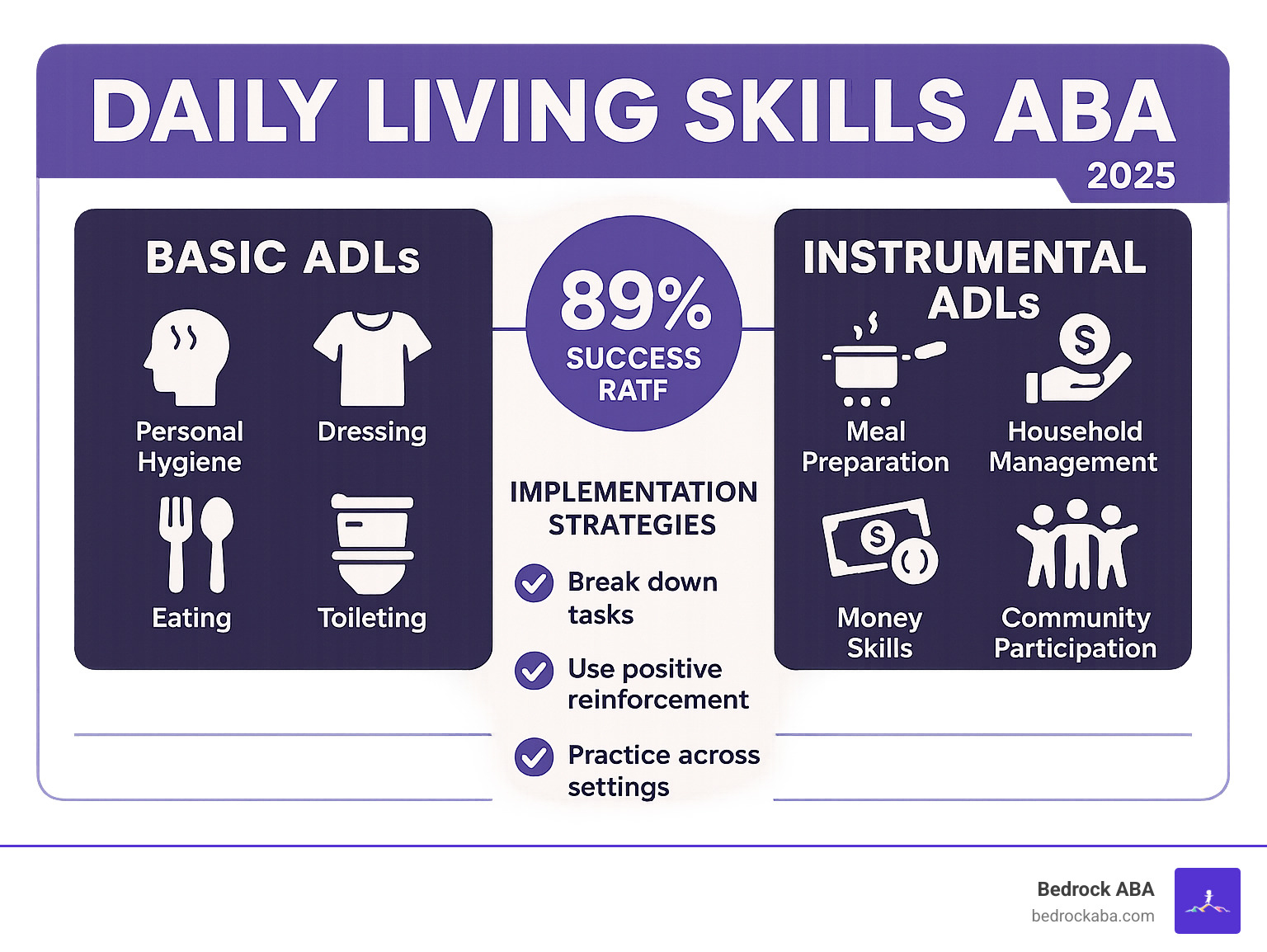
Daily living skills aba therapy helps children with autism master essential life tasks through proven, step-by-step methods. ABA can teach:
- Basic Daily Living Skills (BADLs): Personal hygiene (brushing teeth, bathing), dressing, toileting, and mealtime skills.
- Instrumental Daily Living Skills (IADLs): Meal preparation, household chores, money management, and community participation.
Research shows that 89% of individuals who receive early intensive ABA intervention demonstrate significant improvements in daily functioning. The key is ABA’s systematic approach: breaking complex tasks into small steps, using positive reinforcement, and practicing skills across different environments.
Many parents find that a skill mastered in therapy doesn’t always transfer to the morning routine at home. This gap between structured learning and real-world application is exactly what evidence-based ABA strategies are designed to bridge. ABA embeds learning into meaningful daily routines where skills actually matter.
As Mayer Kulefsky, director of operations at Bedrock ABA, I’ve seen how systematic daily living skills aba interventions transform not just children’s capabilities, but entire family dynamics. The right approach can turn daily challenges into opportunities for growth.
Easy daily living skills aba word list:
The Foundation: Understanding Daily Living Skills and Why They Matter
Daily living skills are the tasks that help us take care of ourselves and steer our world. For children with developmental disabilities like autism, mastering these skills is about open uping their potential for a more independent, fulfilling life. When a child learns to brush their teeth or prepare a snack, their face lights up with pride. This sense of accomplishment boosts their increased confidence and self-esteem in ways that extend far beyond that single skill.
We organize daily living skills into two main categories:
- Basic ADLs (BADLs) cover fundamental self-care tasks like bathing, dressing, eating, personal hygiene, and toileting. These are the foundation for more complex skills.
- Instrumental ADLs (IADLs) involve more complex tasks for independence at home and in the community, such as meal preparation, household chores, money management, and using transportation.
Statistics show that approximately 75% of individuals with ASD require ongoing support with daily living skills. This highlights how crucial effective teaching strategies are. With the right support through specialized intervention for ADLs, we can open doors to greater independence and reduce family stress.
How ABA Therapy Teaches Daily Living Skills
Applied Behavior Analysis (ABA) uses a systematic, scientific approach to teach daily living skills aba. Instead of guessing what might work, we use evidence-based practices built on principles of learning and behavior. The beauty of ABA lies in its individualized approach; plans are customized to each child’s unique strengths, challenges, and family priorities.
ABA excels at breaking down complex skills into manageable steps. For example, making a sandwich involves dozens of smaller actions. By teaching each component systematically, we build confidence. Positive reinforcement keeps the process engaging, as we celebrate every success to motivate continued learning. Finally, ABA is data-driven. We track progress and adjust our strategies in real-time to ensure our methods are effective.
The Initial Assessment: Creating a Personalized Roadmap
Before therapy begins, a comprehensive assessment creates a personalized roadmap. This process is crucial for effective daily living skills aba therapy.
We start with direct observation to understand how a child handles tasks in their natural environment. Caregiver interviews provide invaluable insight into which skills would make the biggest difference in the family’s daily life. We also use standardized tools like the Vineland Adaptive Behavior Scales to get a detailed picture of current abilities.
Finally, we collaborate to set measurable goals, such as “independently complete tooth brushing routine within 3 minutes for 8 out of 10 opportunities.” This specificity allows us to track progress effectively and ensures our therapy plans are relevant to each child’s life.
5 Core ABA Hacks for Building Independence
Teaching daily living skills aba relies on five powerful, research-backed techniques. These systematic instruction methods are a toolkit for building real independence by meeting your child where they are and guiding them forward with confidence.
Hack 1: Break It Down with Task Analysis
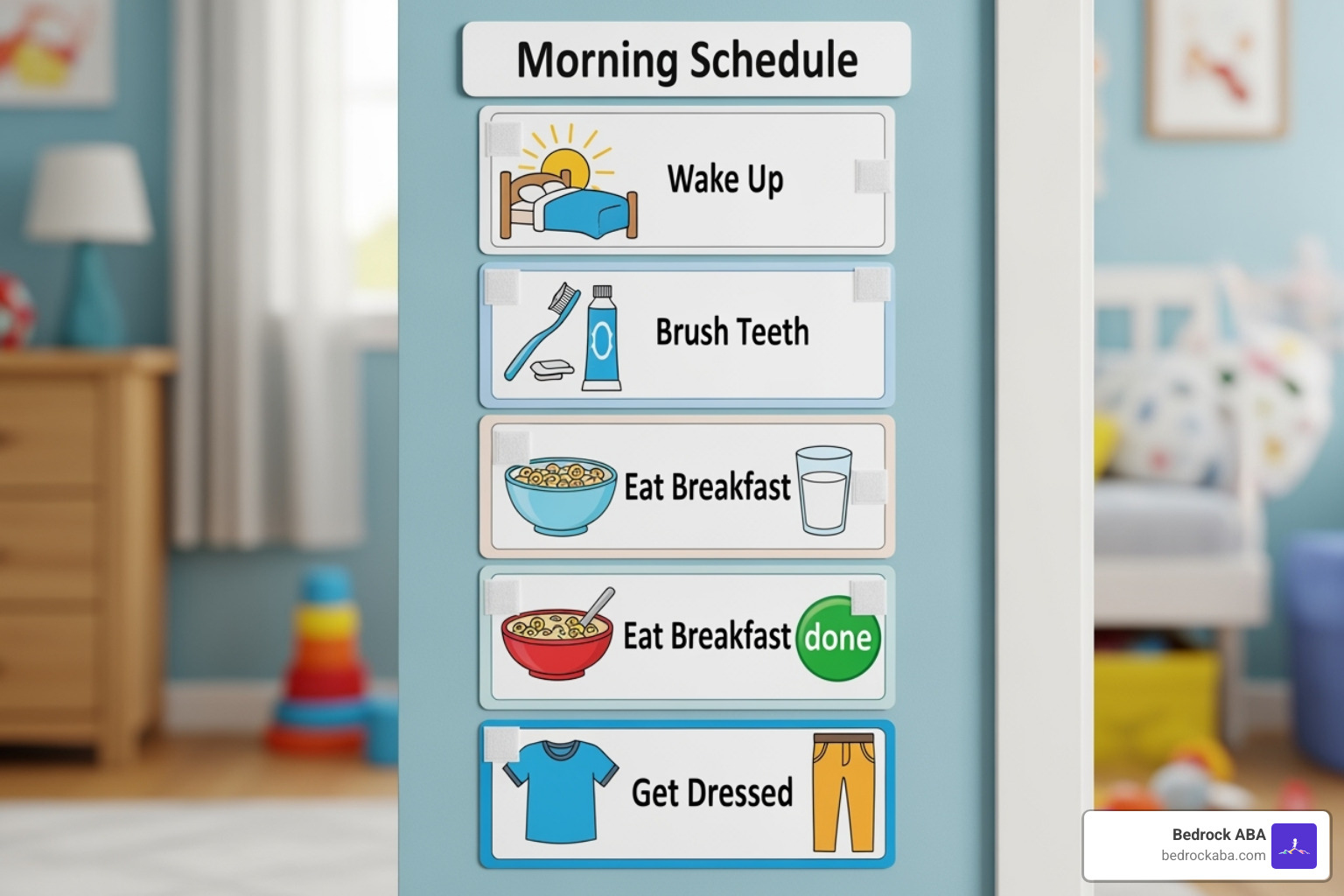
Task analysis takes any complex skill and breaks it into small, manageable steps. Instead of an overwhelming instruction like “make lunch,” a child gets a clear roadmap. For brushing teeth, this means teaching each of the eleven distinct steps, from getting the toothbrush to putting it away. This approach, called “chaining,” links individual steps together until they become a smooth skill. Task analysis combined with systematic instruction improves skill acquisition rates by up to 65%.
Hack 2: Guide and Fade with Prompting
Prompting provides temporary support to ensure success, then gradually disappears as independence grows. We use a prompting hierarchy, starting with more support and systematically reducing it. Prompts can be physical (hand-over-hand guidance), verbal (spoken reminders), visual (picture cards), or gestural (pointing). The magic is in prompt fading—the systematic removal of these supports as skills strengthen. This prevents dependency and builds genuine confidence.
Hack 3: Power Up with Positive Reinforcement
Positive reinforcement celebrates genuine achievements in ways that motivate continued learning. The key is finding what motivates each child, whether it’s enthusiastic praise, a token system, tangible rewards like stickers, or preferred activities like extra game time. By providing meaningful recognition immediately after a skill is demonstrated, as detailed in positive reinforcement in ABA, we create a positive learning environment where children feel successful and excited to tackle new challenges.
Hack 4: Make It Stick with Generalization
Generalization ensures a child can use their new skills across different environments, with different people, and using various materials. We don’t just want perfect performance in the therapy room; we want skills that work everywhere. To achieve this, we intentionally practice skills in varied settings (clinic, home, community), with different people (therapists, parents, siblings), and with different tools. Community-based ABA instruction is especially powerful, as research shows 92% of participants demonstrate improved performance in natural environments when skills are taught with generalization in mind.
Hack 5: Track Progress with Data
We don’t teach daily living skills aba without tracking progress. Data collection provides the objective measurement that guides every decision. We track how often a skill is performed independently, the level of prompting needed, and which steps remain challenging. This data allows us to monitor progress objectively, adjust strategies when needed, and celebrate milestones in a concrete way. Every data point represents a child moving closer to independence.
Putting It Into Practice: Examples of Daily Living Skills ABA Can Teach
The beauty of daily living skills aba lies in its real-world application. When children master these skills, they build confidence, independence, and a foundation for lifelong success. Here’s how ABA transforms everyday challenges into achievements.

Basic Self-Care Skills (BADLs)
These foundational skills are the cornerstone of personal independence.
- Personal hygiene: Skills like brushing teeth, bathing, and hand washing are taught using task analysis and visual schedules. Positive reinforcement, like playing a favorite song, makes the routine enjoyable.
- Dressing skills: We tackle everything from choosing appropriate clothes to mastering buttons and zippers, starting with easier items and building up to more challenging ones.
- Toileting routines: This significant milestone involves recognizing cues, managing clothing, and hygiene. Consistent routines and immediate reinforcement help children master this crucial step.
- Eating and mealtime skills: We teach the mechanics of using utensils and the social aspects of dining, helping children participate confidently in family meals.
Instrumental Home & Community Skills (IADLs)
These complex skills open doors to greater community participation.
- Meal preparation: We teach children to follow a recipe using clear, visual steps. Kitchen safety is explicitly taught, emphasizing safe handling of tools and appliances. Individuals receiving this instruction show 78% greater independence in meal preparation.
- Household chores: Skills like making the bed and cleaning are broken down with task analysis, helping children contribute to the household and build a sense of responsibility.
- Money management: This starts with identifying coins and bills and progresses to making small purchases in real-world settings, building a foundation for future financial skills.
- Community and safety skills: We teach essential skills like how to cross streets safely and ask for help from trusted adults. More complex skills like using public transportation are broken down into manageable steps, opening up tremendous possibilities for independence.
The Team Effort: How Parents and Caregivers Can Support Progress
Teaching daily living skills aba is a team effort, bringing together therapists and families. While therapy provides the structured foundation, the real magic happens when families become active partners. Your child spends most of their time with you, making those everyday moments perfect for practice.
This collaborative approach works. Families report 88% satisfaction with ABA-based interventions, largely because they feel empowered to support their child’s progress at home. When everyone uses consistent strategies, children learn faster.
Your Role as a Reinforcement Partner
Through parent training, we share the same strategies our therapists use so you can reinforce skills during daily routines.
- Consistent prompting: Using and fading prompts the same way we do in therapy accelerates learning.
- Modeling behavior: Narrate tasks as you do them to make the steps clear. For example, “First, I get the toothpaste. Now, I put a little on the brush.”
- Celebrating small wins: A simple “You did that all by yourself!” can be incredibly motivating.
- Creating practice opportunities: Ensure your child has a chance to practice a skill each day, even if it’s just one step of a larger routine.
Overcoming Common Problems in Daily Living Skills ABA
Challenges are a normal part of learning, but with the right strategies, we can work through them together.
- Sensory sensitivities: If a child dislikes the texture of toothpaste, we don’t just push through. We adapt by trying different flavors or a softer brush.
- Motivation issues: If a child isn’t interested in a task, we use preference assessments to find what does motivate them and weave it into the learning process.
- Behavioral challenges: ABA helps us understand the root cause of challenging behaviors and teach positive alternatives to make routines calmer and more successful.
When something isn’t working, we analyze our data, adjust our strategies, and find a better path forward.
ABA vs. Other Approaches
While many methods teach life skills, daily living skills aba offers a unique, science-based approach that is completely individualized.
- Data-Driven Decisions: We track progress objectively and adjust our approach based on real evidence, rather than guessing what works.
- Individualization: Every plan is customized to the child’s specific needs, strengths, and challenges, unlike one-size-fits-all curricula.
- Systematic Instruction: We break skills down into manageable steps and teach them methodically for more predictable success.
- Generalization Focus: We ensure skills learned in therapy transfer to real-life settings like home, school, and the community.
The Long-Term Payoff: Lifelong Benefits of Mastering ADLs
While families often start daily living skills aba therapy with immediate goals, the real magic is the foundation being built for lifelong independence and confidence. The benefits extend far beyond the skills themselves; we’re giving children the tools to steer the world with greater autonomy.
Research shows that 82% of individuals maintain their learned skills even two years after completing intensive intervention, and 67% continue to acquire new skills on their own. This isn’t just about convenience; it’s about fundamentally changing a person’s life trajectory by enabling them to manage personal care, contribute to the household, and participate in their community.
Increased Independence and Confidence
There’s something powerful about a child being able to say, “I can do this myself!” Self-reliance becomes a cornerstone of their daily experience, replacing the need for constant help. This sense of accomplishment builds momentum for tackling new challenges. In fact, studies show that 74% of individuals report increased confidence and self-esteem related to their growing independence. This newfound self-assurance spills over into social, academic, and family life, as a child who feels capable in one area approaches other challenges with more courage.
Preparation for Future Environments
We are always focused on the bigger picture. The skills learned through daily living skills aba are building blocks for future success.
- School readiness: Children who can manage their belongings and follow routines are better positioned to focus on learning.
- Success in social settings: Practical skills like managing one’s appearance and participating in group activities help children form positive relationships.
- Vocational skills development: The ability to follow instructions, complete tasks, and manage time are foundational skills for workplace readiness.
- Potential for independent living: Skills from meal prep to money management significantly expand the possibilities for where and how a person can live as they grow older.
We aren’t just teaching isolated tasks. We’re building a toolkit for life, creating pathways to greater autonomy and opening doors to a more independent, confident, and fulfilling future.
Frequently Asked Questions about Daily Living Skills ABA
As someone who’s worked with hundreds of families, I understand how important it is to get clear answers to your questions about daily living skills aba therapy.
How are goals for daily living skills chosen in ABA therapy?
Goals are chosen collaboratively. The process starts with a comprehensive assessment of your child’s current abilities and developmental stage. Most importantly, we listen to your family’s priorities to determine which skills will have the most significant impact on independence and quality of life. Goals evolve as your child grows, ensuring they remain meaningful and challenging.
How long does it take to learn a new daily living skill with ABA?
Every child learns at their own pace. The timeline depends on the skill’s complexity, the child’s individual abilities, and the consistency of practice at home and in therapy. While learning to wash hands might take a few weeks, mastering meal preparation could take several months. Our data-driven approach allows us to constantly monitor progress and adjust teaching strategies to ensure effectiveness.
Can ABA help with complex community skills like using public transport?
Absolutely. ABA is highly effective for teaching complex, multi-step skills. We use task analysis to break down the entire process—from reading a schedule to getting off at the right stop—into manageable steps. We start by teaching these skills in a controlled setting before gradually generalizing to the actual community environment. This systematic approach builds confidence and helps ensure complex community skills become truly functional and independent.
Conclusion
Every child deserves the confidence to handle what their day brings, from brushing their teeth to making a snack. At Bedrock ABA, we’ve seen countless children light up after mastering a task they once found overwhelming. We aren’t just teaching skills; we’re building the blocks of independence that transform families.
The journey of mastering daily living skills aba requires patience and persistence, and we are committed to celebrating every small victory with your family. These moments represent so much more than completed tasks—they represent growing confidence and self-reliance.
The structured, systematic support of ABA empowers individuals to participate more fully in their families, schools, and communities. Our family-centered approach ensures you are a partner in the process, creating consistency that amplifies progress and makes skills a natural part of daily life.
If you’re ready to see how personalized ABA therapy can open up your child’s potential for greater independence, we’re here to support you. Together, we can build the foundation for a more confident and fulfilling future.