


Why Social Skills Matter for Children with Autism
ABA therapy for social skills helps children with autism learn essential abilities like starting conversations, sharing, and making friends. Using structured, evidence-based techniques, this approach breaks down complex social interactions into manageable steps and uses positive reinforcement to build confidence and create lasting change.
Key ways ABA therapy builds social skills:
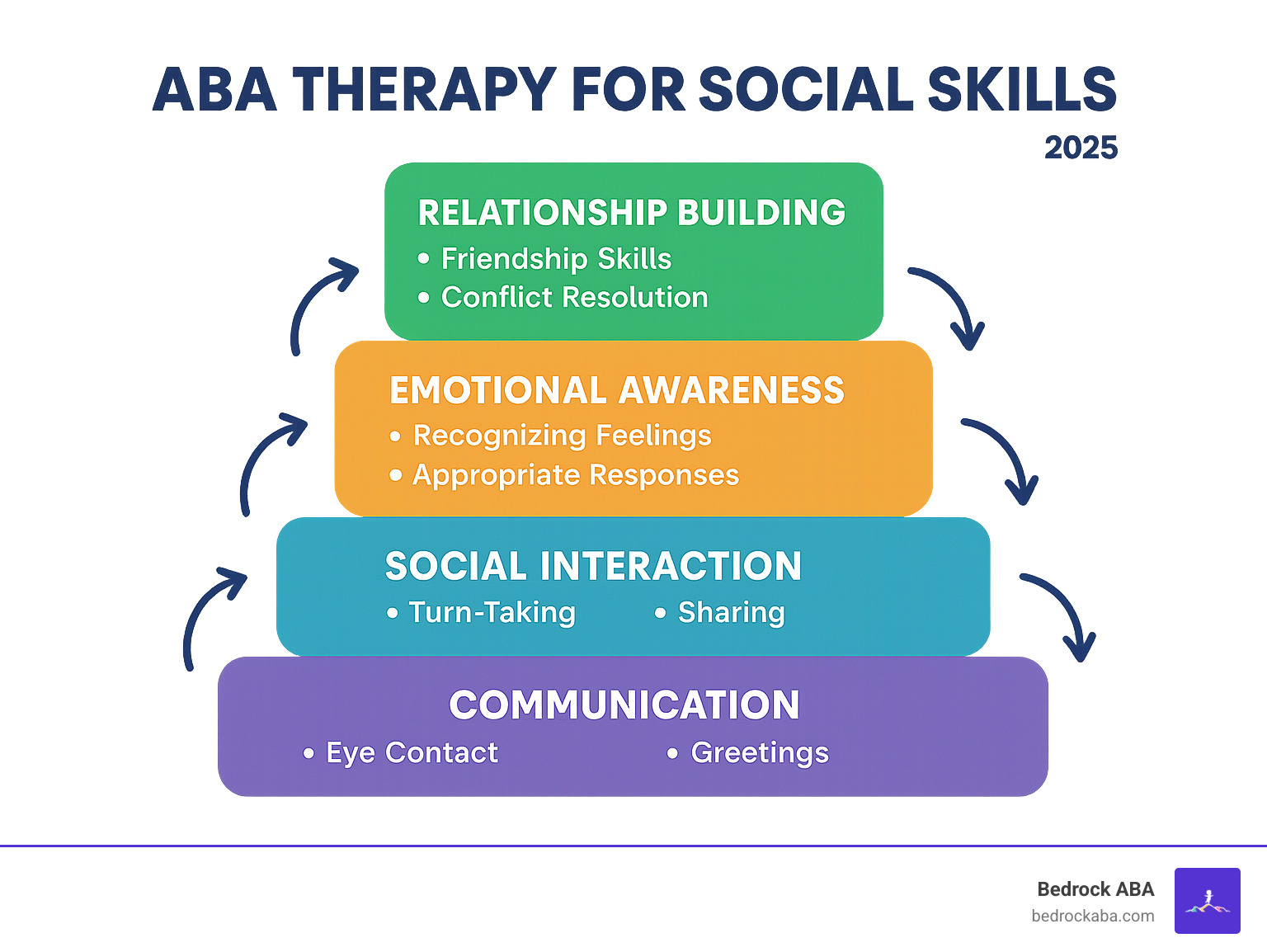
- Communication skills – Teaching verbal and non-verbal communication and understanding social cues
- Social interaction – Learning to initiate conversations, take turns, and engage with peers
- Emotional regulation – Managing feelings and responding appropriately
- Friendship building – Developing skills to form and maintain relationships
- Real-world application – Practicing skills at home, school, and in the community
For many children with autism, the social world is confusing, and interactions that come naturally to others require explicit teaching. Research shows that intensive ABA therapy improves social functioning, helping children learn these crucial life skills in a supportive environment.
As Mayer Kulefsky, director of operations at Bedrock ABA, I’ve seen how ABA therapy for social skills transforms a child’s ability to connect with others. Through our individualized approach across North Carolina and Utah, we help families steer the journey from social challenges to meaningful connections.
Similar topics to aba therapy for social skills:
Why Social Skills are Crucial and How ABA Can Help
Social skills are the invisible threads that connect us to the world, powering friendships, conversations, and empathy. For all children, these skills are building blocks for forming peer relationships, enjoying cooperative play, and achieving academic success.

For children with autism, navigating social situations can be challenging. Understanding social cues like facial expressions or tone of voice doesn’t always come naturally, and non-verbal communication can be particularly difficult to interpret. This is where ABA therapy for social skills becomes a game-changer. Instead of hoping these skills develop on their own, ABA takes a scientific, structured approach to teaching them.
ABA’s effectiveness lies in its individualized assessment process. Therapists identify specific social skills that need attention and create a custom plan. The data-driven approach ensures progress is tracked and the plan is adjusted as needed. Scientific research on social skills interventions confirms that this methodical approach leads to real, lasting improvements.
The Importance of an Individualized ABA Plan
No two children are alike, which is why custom goals are at the heart of what we do at Bedrock ABA. We build on each child’s unique strengths and use them as the foundation for growth. Collaborative goal setting with families ensures that goals are realistic and meaningful.
The process begins with a Functional Behavior Assessment (FBA) and other skill-based assessments to understand how a child interacts, what motivates them, and where they get stuck socially. As children grow, we focus on adapting to progress, celebrating victories, and adjusting challenges. When a child masters one skill, we move on to the next, honoring their individual pace.
How ABA Therapy for Social Skills Addresses Core Challenges
ABA therapy makes social learning manageable by breaking down complex interactions into smaller, teachable moments. Instead of a broad goal like “make friends,” we might start with “say hello when someone waves.” Each small skill builds on the last, creating a solid foundation.
Structured learning provides a safe space for children to practice without fear. When a child succeeds, positive reinforcement—like praise or a favorite activity—motivates them to try again. Over time, this process helps in building confidence and reduces the social anxiety that can make interactions feel overwhelming. Studies show this approach leads to significant improvements in social and communication skills and meaningful reductions in social anxiety. You can learn more about autism through Information on Autism Spectrum Disorder.
The result is that children who once felt lost in social situations begin to find their place, make genuine connections, and experience the joy of meaningful relationships.
Core Techniques Used in ABA Therapy for Social Skills
At Bedrock ABA, our therapists use a toolkit of proven techniques to help children build meaningful relationships. Two foundational concepts guide our work: task analysis and Behavioral Skills Training (BST). Task analysis involves breaking down complex social interactions into smaller, manageable steps. BST is our systematic teaching approach: we explain, model, practice, and provide feedback.
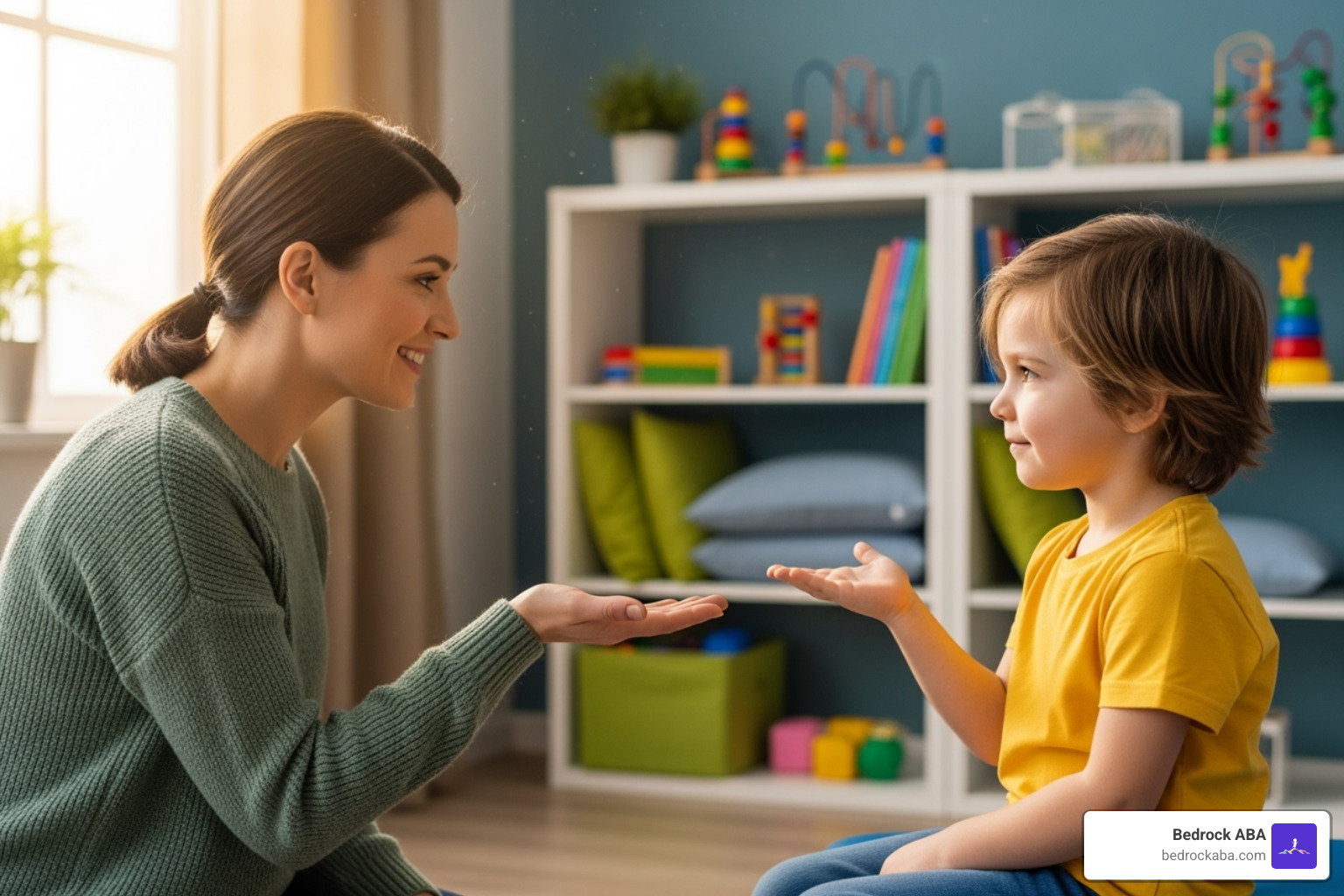
We focus on a wide range of skills, including initiating conversations, taking turns, sharing, understanding social cues, making and keeping friends, expressing emotions, and resolving conflicts.
Breaking Down Skills: DTT and Task Analysis
When a social skill feels overwhelming, we use Discrete Trial Training (DTT) and task analysis. DTT breaks down behaviors into bite-sized pieces in a calm, one-on-one setting, using clear instructions and positive reinforcement. The Antecedent-Behavior-Consequence (ABC) model helps us understand what triggers a behavior and what happens afterward, allowing us to set up situations that encourage positive social interactions. For example, instead of just telling a child to “join a game,” we break it down into steps: observe, find an opening, ask to play, and respond to the answer. Each step is practiced until it feels natural. Research on task analysis shows how effective this systematic approach is.
Learning in the Moment: Natural Environment Training (NET)
Real social interactions happen in everyday life, which is where Natural Environment Training (NET) comes in. We seize “teachable moments” that pop up naturally. A disagreement over a toy at the park becomes a chance to practice negotiating and taking turns. Snack time can be an opportunity to practice sharing. This play-based approach makes learning feel fun and helps children practice skills in the real environments where they’ll use them.
Seeing is Believing: Modeling and Role-Playing
Modeling and role-playing are powerful tools for learning. Therapists or peers demonstrate desired social behaviors for children to observe and copy. We also use video modeling, creating short videos of a skill being performed correctly. Children can even star in their own videos, which is a great confidence booster. Role-playing allows children to practice these new skills—like introducing themselves or resolving a disagreement—in a safe, supportive environment with gentle feedback before trying them in real-life situations.
Visual Tools for Success: Social Stories and Visual Schedules
Many children with autism are visual learners, so tools like social stories and visual schedules are game-changers. Social stories are short, personalized narratives that describe a social situation, what to expect, and how to respond, reducing anxiety by making unfamiliar events predictable. You can learn more about the creator of Social Stories.
Visual schedules use pictures or words to show the sequence of activities, which is especially helpful in group settings. A clear roadmap helps children participate more smoothly and reduces the stress of uncertainty.
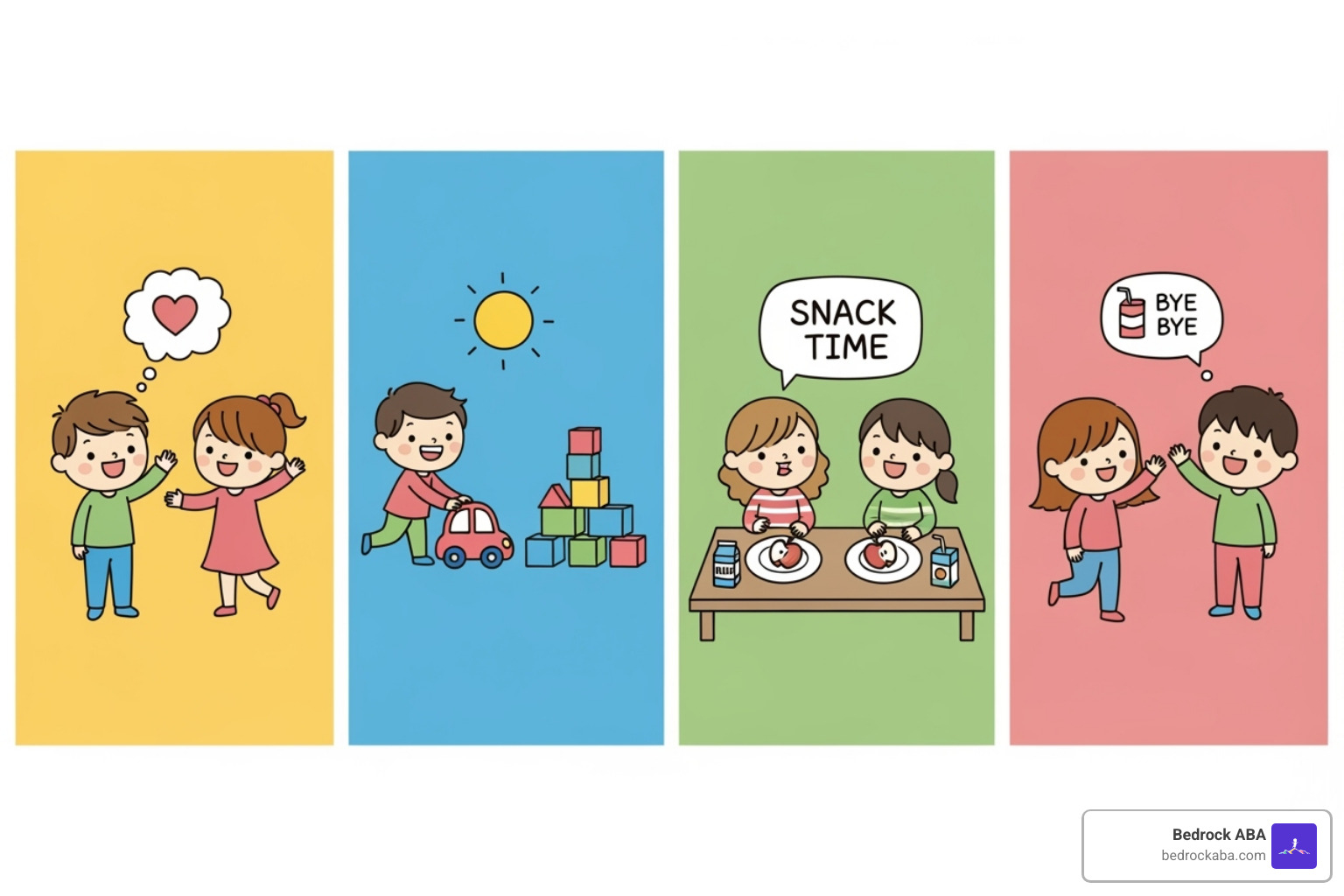
These visual supports turn uncertainty into understanding, giving children the confidence to steer their social world.
The Proof is in the Progress: Evidence and Long-Term Benefits
ABA therapy for social skills is a scientifically proven approach backed by decades of research. Recognized as an evidence-based best practice by the US Surgeon General and the American Psychological Association, its effectiveness is well-documented. Studies consistently show that intensive ABA programs lead to significant improvements in social, communicative, and adaptive skills.

The long-term benefits are profound, leading to improved communication, increased self-confidence, the ability to build meaningful friendships, and better social integration in all areas of life. Children who once felt overwhelmed at social events begin to participate with joy. For a deeper look at the research, A meta-analysis on ABA effectiveness provides a comprehensive overview.
The Role of Positive Reinforcement
Positive reinforcement is a key ingredient in ABA. When a child successfully uses a social skill, we encourage desired behaviors through meaningful recognition. This might be social praise (“Great job asking to play!”) or tangible rewards like a favorite sticker. The goal is building motivation and helping children associate social interactions with positive feelings. This approach transforms learning into a positive experience that children look forward to. The role of positive reinforcement in skill acquisition is well-supported by research.
From Therapy to the Real World: Promoting Generalization
Our job isn’t done until a child can use their social skills everywhere. Practicing skills across settings is crucial for this generalization. At home, this could mean practicing conversation at the dinner table. At school, it might involve working cooperatively on a group project. In the community, it could be ordering food at a restaurant. Involving different people—family, teachers, and peers—is also vital, as it teaches children to be flexible social partners. The ultimate goal is ensuring skills are durable and functional, making a real-world difference in a child’s life.
The Team Approach: Involving Parents and Embracing Modern ABA
At Bedrock ABA, we know successful ABA therapy for social skills is a team sport. We view parents and caregivers as active, empowered partners in the therapeutic process. After all, you are the experts on your child!

Our approach centers on parent training, equipping families with the same strategies we use in therapy. This creates consistency and helps skills transfer into everyday life. When parents reinforce skills at home, progress accelerates.
Modern ABA has evolved, and we accept a child-centered therapy approach that prioritizes compassionate care. We listen to autistic individuals and advocates, constantly refining our methods to ensure therapy is effective, positive, and joyful for each child.
How Parents Can Support Social Skills Development at Home
Parents can make a huge difference at home. Here’s how:
- Create social opportunities: Organize playdates, visit parks, and join community activities to give your child chances to practice.
- Model appropriate behavior: Children are great imitators. Let them see you greeting neighbors, listening actively, and sharing generously.
- Use praise and encouragement: Offer specific, enthusiastic feedback when your child attempts a social skill. This builds confidence and motivation.
- Collaborate with the therapy team: Maintain open communication with your ABA therapist. Sharing successes and challenges creates a powerful support network. Research confirms the power of parental involvement in ABA.
A Modern, Compassionate Approach to ABA Therapy for Social Skills
We take criticisms of older ABA forms seriously. Our modern approach is built on ethical practices and deep respect for each child.
- Focus on the child’s happiness: We believe therapy should feel good. We build on interests—if a child loves trains, we use trains to practice sharing.
- Use assent-based learning: We prioritize the child’s enthusiastic agreement to participate, rather than demanding compliance. We listen when a child says “no.”
- Adhere to ethical practices: Our team focuses on positive reinforcement and child-led engagement, respecting each child’s dignity.
Our goal is to foster authentic engagement and independence, ensuring therapy is a positive, transformative journey for the whole family.
Frequently Asked Questions about ABA for Social Skills
What types of social skills can ABA therapy teach?
ABA can teach a wide range of skills, from foundational behaviors like making eye contact and reciprocating greetings to more complex abilities. These include initiating and maintaining conversations, understanding non-verbal cues, showing empathy, resolving conflicts, and navigating unwritten social rules. Programs are always individualized to meet each child’s specific needs and developmental level.
How long does it take to see progress with ABA therapy?
The timeline for progress varies for every child. It depends on factors like their individual goals, the intensity of therapy, and consistency at home. While there’s no magic timeline, ABA’s data-driven approach means we constantly monitor progress and adjust strategies. Consistent, high-quality ABA therapy for social skills often leads to noticeable and meaningful improvements.
Is ABA therapy only for children with autism?
While ABA is highly effective for children with autism, its principles can help anyone who needs to learn new skills. Applied Behavior Analysis is a science of learning that can be adapted to support children with ADHD, OCD, ODD, and other developmental or behavioral challenges. At Bedrock ABA, we meet each child where they are, helping them grow and thrive regardless of their diagnosis.
Conclusion
The journey of social connection begins with a single step. For children with autism, what seems like a simple step can feel like a mountain. ABA therapy for social skills transforms those mountains into manageable hills, one skill at a time.
Through this evidence-based approach, we watch children blossom from quiet observers into active participants. By breaking down complex interactions and celebrating every success, we help them build confidence and find joy in connecting with others. Social skills are not just about following rules; they are about opening doors to a richer, more independent life.
At Bedrock ABA, our commitment to flexible, family-centered care means we meet you where you are, with in-person and remote options across Utah and North Carolina. We use a compassionate approach that honors each child’s unique personality, making therapy a positive experience.
If you’re ready to help your child build these essential life skills, we’re here to guide you. Together, we can create a foundation for lasting friendships and a lifetime of social success.