


Understanding ABA Analysis Behavior: Your Quick Guide
Applied Behavior Analysis (ABA) is a scientific approach that studies and modifies behavior through systematic assessment and intervention. If you’re searching for information about “aba analysis behavior,” here’s what you need to know:
- Definition: ABA is a therapy based on the science of learning and behavior that applies behavioral principles to improve socially significant behaviors.
- Core Components: Uses the ABC model (Antecedent-Behavior-Consequence) to understand what triggers behaviors and what reinforces them.
- Applications: Most known for autism therapy, but also used in education, organizational management, health, substance abuse treatment, and more.
- Effectiveness: Recognized as an evidence-based best practice by the US Surgeon General and American Psychological Association with over 20 studies supporting its efficacy.
- Implementation: Typically involves 25-40 hours per week for 1-3 years, with best results when started before age 4.
ABA therapy works by understanding behavior as a product of its environment. Rather than labeling behaviors as “good” or “bad,” aba analysis behavior looks at what purpose the behavior serves for the individual and how environmental factors influence it.
The foundation of ABA is rooted in behaviorism, developed in the early 20th century by psychologists like B.F. Skinner, and later adapted for autism intervention by Dr. Ivar Lovaas in the 1960s. Since then, it has evolved significantly, emphasizing positive reinforcement over punishment and incorporating naturalistic teaching methods.
For families considering ABA therapy, it’s important to understand that it’s highly individualized and data-driven. Every intervention plan is custom to the specific needs and abilities of the person receiving therapy, with ongoing measurement and adjustment based on progress.
I’m Mayer Kulefsky, director of operations at Bedrock ABA, where I’ve dedicated my career to implementing effective aba analysis behavior programs that improve the lives of individuals with autism and developmental disorders across multiple states including Utah and North Carolina.
What Is Applied Behavior Analysis?
Applied Behavior Analysis (ABA) is a scientific approach that helps us understand why people behave the way they do and how we can help them learn new skills or change challenging behaviors. At its heart, aba analysis behavior looks at the relationship between our environment and our actions—focusing on what we can observe rather than guessing what might be happening inside someone’s mind.
Think of ABA as being like a detective who carefully observes patterns and connections. Instead of labeling behaviors as simply “good” or “bad,” ABA therapists ask: “What purpose does this behavior serve?” and “How can we create better outcomes?”
ABA builds on two important learning theories that help explain how we all learn:
-
Operant conditioning, developed by B.F. Skinner, shows us that behaviors followed by something rewarding tend to increase, while those followed by something unpleasant tend to decrease. This is why praise works better than punishment when teaching new skills!
-
Classical conditioning, first described by Ivan Pavlov (yes, the one with the dogs and bells), explains how we form associations between different events in our environment.
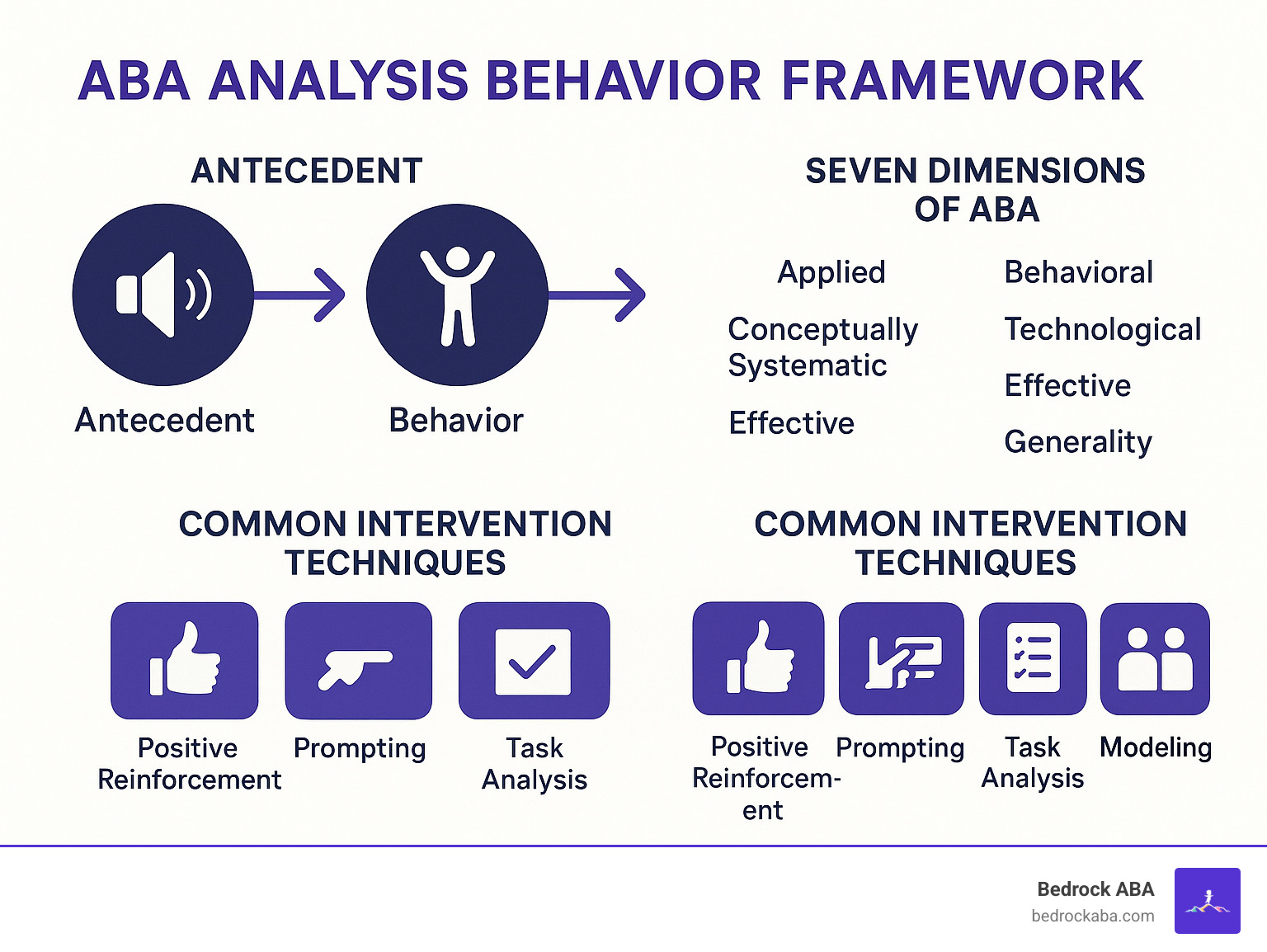
The cornerstone of aba analysis behavior is the three-term contingency, often called the ABC model: Antecedent (what happens before), Behavior (what the person does), and Consequence (what happens after). This simple but powerful framework helps us understand that behaviors don’t happen in isolation—they’re influenced by what happens before and after.
Origins & Evolution
The story of aba analysis behavior begins in 1913 when John B. Watson published a paper arguing that psychology should focus on observable behavior rather than invisible mental processes. This was at the time!
B.F. Skinner took these ideas further with his concept of radical behaviorism. His famous experiments with rats and pigeons in “Skinner boxes” showed how reinforcement could predictably increase behaviors. While it might seem strange to learn from rats, these principles apply remarkably well to human learning too.
The field became more formalized in the 1960s with the creation of scientific journals like JEAB (Journal of the Experimental Analysis of Behavior) and JABA (Journal of Applied Behavior Analysis), giving researchers places to share their findies.
A major breakthrough came when Dr. Ivar Lovaas applied these behavioral principles to help children with autism in the 1960s. His groundbreaking 1987 study showed that 47% of children receiving intensive ABA therapy achieved typical functioning levels—offering hope to many families.
Modern aba analysis behavior has evolved significantly since those early days. Today’s approach emphasizes:
– Building skills through positive reinforcement rather than eliminating behaviors through punishment
– Teaching in natural environments rather than clinical settings
– Focusing on outcomes that truly matter in everyday life
– Respecting each person’s dignity and choices
– Making decisions based on careful data collection and analysis
Key Principles Explained
Understanding a few key principles will help you grasp how aba analysis behavior works in practice:
Reinforcement is the process of increasing a behavior by providing a meaningful consequence. Positive reinforcement adds something desirable (like praise, a favorite toy, or a special activity), while negative reinforcement removes something unpleasant (like taking away a difficult task). At Bedrock ABA, we strongly favor positive reinforcement strategies because they build skills while keeping therapy engaging and enjoyable.
Punishment decreases behaviors and comes in two forms: positive punishment (adding something unpleasant) and negative punishment (taking away something desirable). Modern aba analysis behavior approaches use punishment sparingly if at all, as research shows it often creates anxiety and avoidance. We focus instead on teaching alternative, appropriate behaviors.
Extinction happens when a previously reinforced behavior no longer produces the expected result. For example, if a child’s tantrum used to result in getting a toy but now produces no reaction, the tantrums will likely decrease over time. This can be challenging in the short term (behaviors often get worse before getting better), but effective in the long run.
Motivating operations are environmental factors that temporarily change how much someone values a particular reinforcer. If you’re hungry, food becomes more rewarding. If you’ve just eaten a big meal, food loses its appeal. Understanding these motivations helps us time our teaching for maximum effectiveness.

Want to learn more about reinforcement and how it helps children learn? Check out our detailed guide on key principles behind ABA therapy: reinforcement, behavior and learning.
Seven Core Dimensions & Scientific Foundations
When you hear about aba analysis behavior, you might wonder what makes it truly scientific. The answer lies in seven core dimensions first outlined by Baer, Wolf, and Risley back in 1968. Think of these as the quality standards that separate real ABA from techniques that just look like ABA.
The seven dimensions ensure that every intervention is:
Applied – We focus on behaviors that actually matter in real life, not just behaviors that are interesting to study. At Bedrock ABA, we target skills that help children thrive at home, school, and in their communities.
Behavioral – We work with actions we can see and measure, not abstract concepts. This means tracking specific behaviors like “initiates conversation with peers” rather than vague goals like “improves social skills.”
Analytic – We demonstrate clear connections between our interventions and behavior changes. When a child makes progress, we can show exactly how our approach led to that improvement.
Technological – We describe our procedures clearly enough that another therapist could replicate them. No magic or mystery—just well-documented techniques that can be consistently applied.
Conceptually systematic – Our interventions aren’t random tactics but are firmly rooted in established principles of behavior science. This gives us a framework for understanding why techniques work.
Effective – Simply put, our interventions make a meaningful difference. If a strategy isn’t creating significant improvement, we adjust our approach based on the data.
Generality – The skills we teach stick around over time, transfer to different settings, and extend to related behaviors. A child who learns to request items at therapy should be able to do so at home and school too.
These dimensions aren’t just theoretical concepts gathering dust in research journals. They’re the scientific research on dimensions that guide our daily work with children and families.
Why the Dimensions Matter for Quality
When parents entrust their child’s development to us at Bedrock ABA, they deserve the highest quality care. The seven dimensions provide the foundation for that quality in several important ways:
Accountability matters because families deserve to know their child’s therapy is based on science, not opinion. When we design a program to help a child learn to communicate, we’re accountable for showing how each element of that program aligns with these dimensions.
The technological dimension ensures replication across therapists and settings. This means your child receives consistent intervention whether they’re working with their primary therapist or someone covering during vacation time. It also means successful strategies can be shared with parents, teachers, and other caregivers.
Perhaps most importantly, aba analysis behavior relies on data-driven decisions. We don’t guess whether an intervention is working—we know, because we measure it. When a child is learning to request help, we track exactly how often they do so independently, with prompts, or not at all. This data tells us when to celebrate progress and when to adjust our approach.
Measurement & Data Collection Essentials
The heart of aba analysis behavior is precise measurement. Without good data, we’re just guessing about progress. Here’s how we track behavior change:
We use primary measures like frequency (counting how many times a behavior happens), duration (timing how long it lasts), and latency (measuring how quickly a child responds after a question or instruction). These direct measures give us a clear picture of behavior as it happens.
We also use derivative measures that help us understand patterns over time. Celeration shows us the rate of change—is progress accelerating, staying steady, or slowing down? Percentage measures tell us how often a child demonstrates a skill when given the opportunity. And trials-to-criterion helps us track how many practice opportunities a child needs before mastering a new skill.
One of our most valuable tools is ABC data collection. By recording what happens right before a behavior (Antecedent), the behavior itself, and what follows (Consequence), we can identify patterns and functions. This helps us understand why behaviors occur and how to address them effectively.
| Measure Type | Examples | Best Used For |
|---|---|---|
| Primary | Frequency, duration, latency | Direct observation of discrete behaviors |
| Derivative | Percentage, trials-to-criterion | Complex skills, instructional programs |
| ABC Data | Antecedent-Behavior-Consequence charts | Identifying behavior functions |
This scientific approach to measurement isn’t cold or clinical—it’s actually what allows us to be truly compassionate. When we know exactly where a child is struggling and what’s helping them succeed, we can provide the most effective, individualized support possible. That’s the beauty of aba analysis behavior when practiced with heart and scientific integrity.
ABA Analysis Behavior in Real Life Settings
When people hear about aba analysis behavior, they often picture clinical settings or therapy rooms. But the beauty of these principles is how seamlessly they apply to everyday life and diverse environments. Behavior analysis is remarkably versatile – it works wherever people interact with their environment.
The most recognized application is in autism intervention, where children typically receive 25-40 hours of therapy weekly over several years. This intensive approach has strong scientific backing – a 2018 Cochrane meta-analysis found that children with stronger receptive language skills responded well to just 2.5–20 hours weekly of naturalistic ABA approaches, while those with developing language skills benefited most from about 25 hours of discrete trial training each week.
But aba analysis behavior reaches far beyond autism support. These principles are changing multiple fields:
In education, teachers use behavior analysis to create more effective classroom management systems, teach academic skills systematically, and support positive student interactions. In workplaces, organizational behavior management improves safety protocols, boosts productivity, and improves customer service experiences.
Health professionals apply these same principles to help patients stick with medication regimens, maintain exercise routines, and develop healthier eating habits. Animal trainers rely on positive reinforcement techniques rooted in behavior analysis. Even environmental sustainability efforts use behavioral principles to encourage recycling, energy conservation, and eco-friendly choices.

aba analysis behavior for Autism Early Intervention
For children with autism, early intervention using aba analysis behavior principles has transformed countless lives. Several evidence-based approaches have evolved over time, each with unique strengths:
Discrete Trial Training (DTT) breaks complex skills into manageable steps taught through repeated learning opportunities. Each brief teaching moment follows a clear pattern: the therapist presents a clear instruction, the child responds, and the therapist provides immediate feedback and reinforcement for correct responses. Modern DTT has evolved beautifully – today’s approach emphasizes positive reinforcement and supportive guidance rather than the more rigid methods of decades past.
Pivotal Response Training (PRT) takes a more naturalistic approach by targeting “pivotal” developmental areas like motivation and self-management. Unlike more structured approaches, PRT harnesses a child’s natural interests and occurs in everyday environments. When a child shows interest in a toy car, for instance, a therapist might use that moment to practice communication skills, reinforcing even partial attempts with access to that motivating toy.
The Early Start Denver Model (ESDM) blends ABA principles with developmental and relationship-based approaches. This play-based model cleverly targets multiple skills simultaneously within each fun activity, making learning feel like play.
At Bedrock ABA in Utah, we carefully blend elements from these approaches based on each child’s unique needs and learning style. We believe effective therapy should be both evidence-based AND enjoyable – children learn best when they’re having fun!
aba analysis behavior Beyond Childhood
While early intervention gets much attention, aba analysis behavior principles remain powerful throughout life. For teens and adults, applications continue to evolve in exciting ways:
In workplace settings, Organizational Behavior Management (OBM) helps companies create safer, more productive environments. Behavior analysts might redesign safety protocols to prevent accidents, implement performance management systems that actually work, or create training programs based on proven behavioral principles.
For those struggling with substance use, contingency management programs offer tangible reinforcers (like vouchers or privileges) for maintaining sobriety or treatment adherence – a practical application of reinforcement principles that shows impressive results.
Even in gerontology, aba analysis behavior makes a meaningful difference. Practitioners develop programs to increase social engagement among elderly residents, maintain self-care skills for those with dementia, and train caregivers in supportive interaction strategies.
These diverse applications show that behavior analysis isn’t just for children or specific diagnoses – it’s a flexible framework that addresses human behavior across all stages of life.
Conducting a Functional Behavior Assessment
At the heart of effective aba analysis behavior is the Functional Behavior Assessment (FBA). This detective-like process helps us understand why behaviors occur by examining their underlying purpose or function.
A thorough FBA typically includes conversations with parents, teachers, and when possible, the individual themselves. We observe behavior in natural environments – at home, school, or community settings – to see patterns in real time. By collecting detailed ABC data (Antecedent-Behavior-Consequence), we identify what triggers behaviors and what consequences might be maintaining them.
Based on this information, we develop hypotheses about behavior functions. Is the person trying to escape something uncomfortable? Gain attention? Access preferred items or activities? Or perhaps the behavior itself provides sensory stimulation?
Once we understand the “why” behind behavior, we can develop truly effective interventions that:
– Modify environments to prevent challenging behaviors before they start
– Teach alternative, more appropriate ways to meet the same needs
– Adjust how others respond to reinforce positive behaviors
At Bedrock ABA, our comprehensive FBAs ensure we’re addressing root causes, not just surface behaviors. We believe that understanding comes before intervention – when we know why a behavior occurs, we can develop compassionate, effective strategies for change that respect the individual’s needs and dignity.
Techniques, Ethics, and Controversies
Modern aba analysis behavior uses a rich toolkit of positive techniques that help people learn new skills and reduce challenging behaviors in respectful ways.
At the heart of today’s ABA is positive reinforcement – providing rewards that motivate someone to repeat helpful behaviors. What works as reinforcement varies widely from person to person. One child might be thrilled with bubbles while another might work hard for extra iPad time. At Bedrock ABA, we take time to find what truly motivates each individual we work with.
When teaching complex skills, we often use shaping – a gentle process of reinforcing steps that get progressively closer to the goal. Think of teaching a child to say “water” by first celebrating when they say “wa,” then “wat,” and finally the complete word. This builds confidence through success at each stage.
For multi-step activities like brushing teeth or making a sandwich, we use chaining to break down complex routines into manageable pieces. First, we conduct a task analysis to identify exactly which steps make up the skill. Then we teach each component systematically, celebrating small victories along the way.
As skills become stronger, we implement schedule thinning – gradually reducing how often we provide reinforcement. This helps behaviors continue naturally without needing constant external rewards, preparing individuals for real-world success.
The ethical practice of aba analysis behavior has evolved significantly over the decades. Today’s practitioners follow the Ethics Code for Behavior Analysts, which emphasizes:
- Putting the client’s best interests first (beneficence)
- Avoiding potential harm (nonmaleficence)
- Respecting individual choice and self-determination
- Ensuring fairness and justice in all interactions
- Using the least restrictive approaches possible
I believe it’s important to acknowledge that ABA has faced meaningful criticism, particularly from the neurodiversity movement. Early ABA practices sometimes focused too heavily on making autistic individuals appear “normal” rather than accepting neurological differences. Historically, some programs used aversive techniques that today’s ethical standards would never permit.
In response to these valid concerns, aba analysis behavior has transformed to emphasize:
- Meaningful client participation in goal-setting
- Respecting individual autonomy and choice
- Focusing on quality of life outcomes
- Using positive approaches that minimize restrictions

Debunking Misconceptions
As someone who works in this field every day, I often hear misconceptions about ABA that I’m eager to address.
“ABA is just about forcing compliance” – This couldn’t be further from today’s reality. Modern aba analysis behavior focuses on teaching meaningful skills that improve independence and quality of life. While learning to follow important safety instructions might be one goal, the broader aim is developing functional communication and self-determination skills that empower individuals to express their needs and preferences.
“ABA relies heavily on punishment” – Contemporary ABA strongly emphasizes positive approaches. At Bedrock ABA, we build programs around reinforcement strategies that celebrate success. Punishment procedures are rarely appropriate, require specific justification when used, and always include plans for their eventual elimination.
“ABA is only for autism” – While widely recognized for its effectiveness with autism, aba analysis behavior principles apply to many areas of human behavior. The same science helps improve workplace safety, promotes healthy habits, and even supports environmental conservation efforts.
“ABA tries to ‘fix’ autism” – Ethical practitioners respect neurodiversity while teaching skills that help individuals steer their environment successfully. Rather than trying to “cure” autism, we focus on reducing barriers to participation and enhancing quality of life based on each person’s unique goals and strengths.
At Bedrock ABA, we accept a balanced approach that honors individual differences while providing evidence-based interventions that improve independence and well-being.
Evidence Base & Research Gaps
The scientific support for aba analysis behavior is substantial, though like any field, it continues to evolve. A comprehensive 2018 Cochrane meta-analysis concluded that ABA-based interventions can significantly improve communication, cognitive skills, and adaptive behavior in children with autism.
Multiple meta-analyses have demonstrated positive outcomes in several key areas:
– Children develop stronger language and communication skills
– Social interactions improve in quality and frequency
– Challenging behaviors decrease in intensity and frequency
– Daily living skills show meaningful gains
– Academic performance often improves substantially
However, I believe it’s important to acknowledge where research could be strengthened. Some areas needing further investigation include:
– Long-term outcomes beyond the early intervention years
– Methodological improvements in some studies
– Greater transparency about potential conflicts of interest (a 2019 study found that 84% of ABA studies in top journals had undisclosed conflicts, with only 2% disclosure)
These gaps highlight the need for continued rigorous research in aba analysis behavior, with greater transparency and methodological rigor. As practitioners at Bedrock ABA, we stay current with emerging research and continually refine our approaches based on the latest evidence and best practices.
You can learn more about the balancing act of ABA therapy in our detailed article on ABA Therapy Pros and Cons.
Certification, Careers & Future Directions
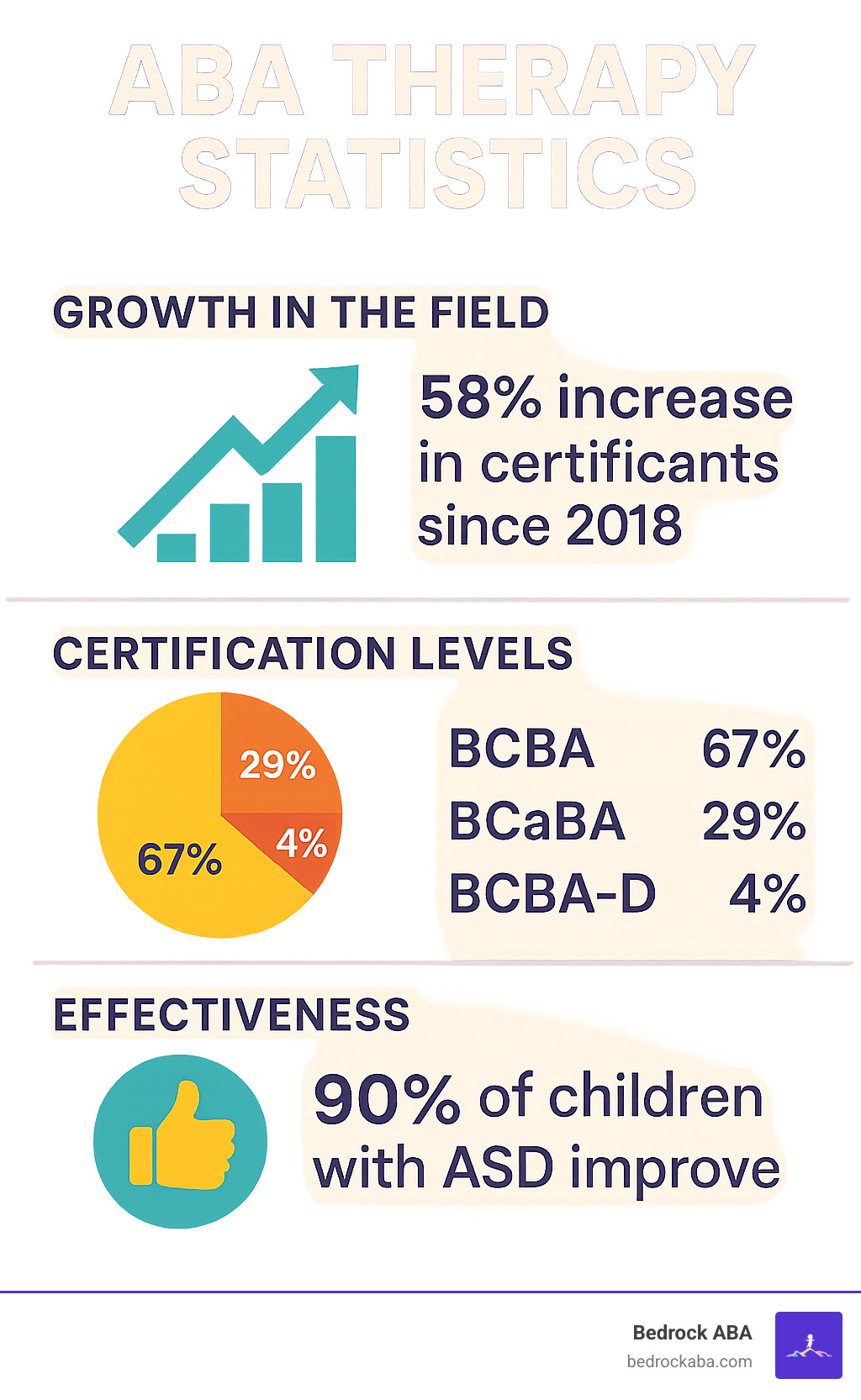
The world of aba analysis behavior is experiencing remarkable growth—with ABA program offerings surging by 113% since 2016 and degree completions skyrocketing by 249%. This expansion isn’t just a trend; it reflects the growing recognition of ABA’s effectiveness and the increasing demand for qualified professionals who can deliver these life-changing services.
If you’re considering joining this rewarding field, several certification pathways can launch your career:
The Registered Behavior Technician (RBT) serves as the entry point for many. This role requires 40 hours of training, a competency assessment, and ongoing supervision. RBTs work directly with clients, implementing behavior plans designed by more senior team members—making this position perfect for those who love hands-on work with children and families.
With additional education, you might become a Board Certified Assistant Behavior Analyst (BCaBA). This certification requires a bachelor’s degree, specialized coursework in behavior analysis, supervised fieldwork, and passing a national exam. BCaBAs provide valuable services while working under BCBA supervision.
The Board Certified Behavior Analyst (BCBA) represents the gold standard in the field. These professionals have completed a master’s degree, extensive coursework in aba analysis behavior, 1500-2000 hours of supervised experience, and passed a comprehensive national exam. BCBAs design programs, supervise implementation, and often lead clinical teams.
For those pursuing the highest level of education, the Board Certified Behavior Analyst-Doctoral (BCBA-D) designation recognizes BCBAs who also hold doctoral degrees, often working in research, teaching, or leadership positions.
The future of aba analysis behavior looks bright and innovative. Telehealth services are expanding access to families in rural and underserved areas who previously couldn’t connect with qualified providers. We’re seeing greater emphasis on cultural competence and truly individualized programming that respects diverse backgrounds and needs. Technology is changing the field too, with AI-driven data tools making analysis more efficient and revealing patterns human observers might miss.
At Bedrock ABA in Utah, we accept these advancements while staying true to our core mission of providing warm, personalized care to every family we serve. Our team keeps one foot in innovation and one foot firmly planted in the human connection that makes therapy effective.

Becoming a Behavior Analyst
So you’re intrigued by a career in aba analysis behavior? The journey is rigorous but incredibly rewarding. Most behavior analysts follow this path:
Your foundation begins with education—typically completing a master’s degree in behavior analysis, psychology, education, or a related field. The key is ensuring your program includes the specific coursework in behavior analysis required by the certification board.
Next comes fieldwork, where theory meets practice. You’ll need to accumulate 1500-2000 hours of supervised experience working with real clients under the guidance of a qualified BCBA supervisor. This hands-on training is where many practitioners fall in love with the field, seeing how aba analysis behavior principles transform lives.
The examination phase tests your knowledge through a comprehensive certification exam administered by the Behavior Analyst Certification Board (BACB). This rigorous assessment ensures all certified analysts meet the same high standards of knowledge and ethical practice.
Many states, including Utah, require an additional step of licensure, which may involve requirements beyond BACB certification. This state-level oversight helps maintain quality standards for families receiving services.
Finally, the learning never stops. Continuing education requirements ensure you stay current with evolving best practices and research developments throughout your career.
Government data shows that about 67 percent of ABA professionals hold master’s degrees, while four percent have pursued even higher education through post-graduate certifications or doctoral degrees. The career offers tremendous versatility—from clinical work with children to organizational consulting, educational program development, and beyond.
Challenges on the Horizon
Despite its promising growth, the aba analysis behavior field faces important challenges that require thoughtful solutions:
Access equity remains a significant concern. Families in rural and underserved communities often struggle to find qualified providers within a reasonable distance. While telehealth services (like those we offer at Bedrock ABA) are helping bridge this gap, technological barriers and inconsistent regulations can still limit access for those who need it most.
Insurance coverage has improved dramatically in recent years, with most states now mandating some level of coverage for ABA therapy. However, many families still steer a maze of high deductibles, coverage caps, and authorization problems that can delay or interrupt vital services. We work closely with families to help them understand and maximize their benefits.
The move toward integrative approaches requires behavior analysts to collaborate seamlessly with speech therapists, occupational therapists, educators, and medical professionals. This interdisciplinary teamwork benefits clients but demands additional skills and coordination from providers.
Perhaps most pressing is the challenge of sustainability in our workforce. High turnover rates among RBTs can disrupt therapy continuity for children who thrive on consistency. At Bedrock ABA, we’re tackling this head-on through competitive compensation, meaningful professional development opportunities, and clear career advancement pathways for our team members.
We believe in being part of the solution to these challenges—offering flexible service models, comprehensive staff training, and advocating for improved insurance coverage throughout Utah and beyond. Our goal is simple: making effective aba analysis behavior services accessible to every family who needs them.
Frequently Asked Questions about aba analysis behavior
What is the difference between ABA and behavior modification?
When people ask about aba analysis behavior versus behavior modification, I like to use this analogy: behavior modification is like casual cooking at home, while ABA is professional culinary practice with precise recipes and techniques.
Behavior modification refers to general techniques anyone might use to change behavior—like a parent using a sticker chart to encourage tooth brushing or a teacher giving extra recess time for completed homework. It’s informal and doesn’t necessarily follow scientific protocols.
Aba analysis behavior, on the other hand, is a comprehensive scientific discipline with specific requirements:
- It adheres to the seven dimensions we discussed earlier (applied, behavioral, analytic, etc.)
- It involves systematic data collection and detailed analysis
- It’s implemented by trained, certified professionals
- It targets behaviors that are truly meaningful to improving someone’s life
So while your neighbor might say they’re using “behavior modification” with their kids, true aba analysis behavior involves professional assessment, precise measurement, and implementation by qualified practitioners following evidence-based protocols.
How many hours of ABA does a child really need?
This is one of the most common questions we hear from families at Bedrock ABA, and the honest answer is: it depends on the individual child. There’s no one-size-fits-all prescription for aba analysis behavior therapy.
Research gives us some general guidelines:
– Early intensive intervention programs often involve 25-40 hours weekly
– Children with stronger language skills may benefit from as little as 2.5-20 hours of naturalistic approaches
– Children with more limited language skills typically need around 25 hours of more structured intervention
When we determine the right number of hours for a child in our Utah program, we consider multiple factors:
First, we look at comprehensive assessment results to understand the child’s specific needs. We consider their age and developmental level—younger children often benefit from more intensive intervention. We also take into account family priorities and capacity—therapy should improve family life, not overwhelm it.
We factor in the child’s other commitments like school or daycare attendance, and carefully consider the nature and severity of their challenges. Most importantly, we regularly reassess and adjust hours as the child progresses, always aiming for the least restrictive intervention necessary for meaningful growth.
The goal isn’t to maximize therapy hours—it’s to provide just the right amount of support to help each child thrive.
Does ABA work for adults with anxiety or OCD?
Yes! While many people associate aba analysis behavior exclusively with autism in children, these principles are remarkably effective for adults with anxiety disorders and OCD.
Take James, for example (name changed for privacy). He came to us with severe contamination OCD that prevented him from leaving his home. Using ABA-based Exposure and Response Prevention (ERP), we systematically helped him face anxiety-provoking situations while preventing compulsive hand-washing. By applying extinction and reinforcement principles, James gradually regained his ability to engage in community activities.
ABA-based approaches for anxiety and OCD include:
Exposure and Response Prevention (ERP) systematically exposes individuals to anxiety-triggering situations while preventing avoidance or compulsive responses. This well-established OCD treatment directly applies core behavioral principles.
Acceptance and Commitment Therapy (ACT) combines behavioral techniques with mindfulness strategies to help individuals accept difficult thoughts while committing to meaningful actions aligned with their values.
Functional analysis helps identify specific triggers and maintaining factors for anxiety responses, allowing for targeted interventions based on each person’s unique patterns.
The beauty of aba analysis behavior is that its principles are universal—they apply to human behavior regardless of age or diagnosis. While adults with anxiety or OCD typically don’t need the same intensity of services as children with developmental disorders, the underlying science remains just as effective.
At Bedrock ABA, we’re passionate about expanding access to behavior analytic approaches across different populations and needs. The science of behavior is truly for everyone.
Conclusion
The journey through aba analysis behavior reveals a remarkably versatile framework that has transformed countless lives across different populations and settings. What began as theoretical behaviorism has blossomed into today’s compassionate, evidence-based practice that honors individuality while fostering meaningful growth.
Here at Bedrock ABA, we take immense pride in our family-centered services throughout Utah. When families in Salt Lake City and surrounding communities come to us, they find more than just therapy – they find partners who combine scientific precision with genuine care for each child’s unique journey.
What makes aba analysis behavior truly powerful is its foundation in observable, measurable change. The seven dimensions ensure our work remains accountable and effective, while our modern approach emphasizes dignity, choice, and outcomes that matter in real life. Gone are the days of rigid programs focused on “normalizing” children – today’s ABA celebrates neurodiversity while removing barriers to happiness and independence.
I’ve seen how the ABC model transforms understanding of challenging behaviors. When parents realize their child’s meltdowns serve a communication purpose rather than simple defiance, their whole perspective shifts. This insight doesn’t just change behavior – it strengthens relationships and builds compassion.
While autism intervention remains our most recognized application, the principles of aba analysis behavior extend into countless areas of human experience. From classrooms to corporate offices, from fitness goals to environmental conservation, the science of behavior speaks to universal human experiences.
Ethical practice remains at our core. We constantly assess, measure, and adjust based on data, always keeping your child’s preferences and autonomy at the center of our work. Cookie-cutter approaches have no place in quality ABA – each intervention is as unique as your child.
If you’re considering ABA therapy in Utah, I invite you to reach out to our Bedrock ABA team. Let’s have a conversation about your child’s specific needs and how our certified professionals might support your family’s goals. We understand that ABA works best as part of a holistic approach that considers your entire family system and collaborates with other professionals in your child’s life.
Aba analysis behavior is ultimately about possibility – helping each child develop the skills they need to engage joyfully with their world in their own way. By blending scientific principles with heartfelt care, we create pathways for growth that honor who your child is while opening doors to who they might become.
Your family’s journey matters to us. Whether you’re just beginning to explore ABA or looking for a more personalized approach, we’re here to walk alongside you with expertise, compassion, and unwavering support.