


Finding Quality Private ABA Therapy in Your Community
Private aba therapy near me searches have increased dramatically as more families seek personalized, flexible behavioral therapy for their children with autism. If you’re looking for immediate answers, here are the fastest ways to find quality private ABA providers:
Quick Search Methods:
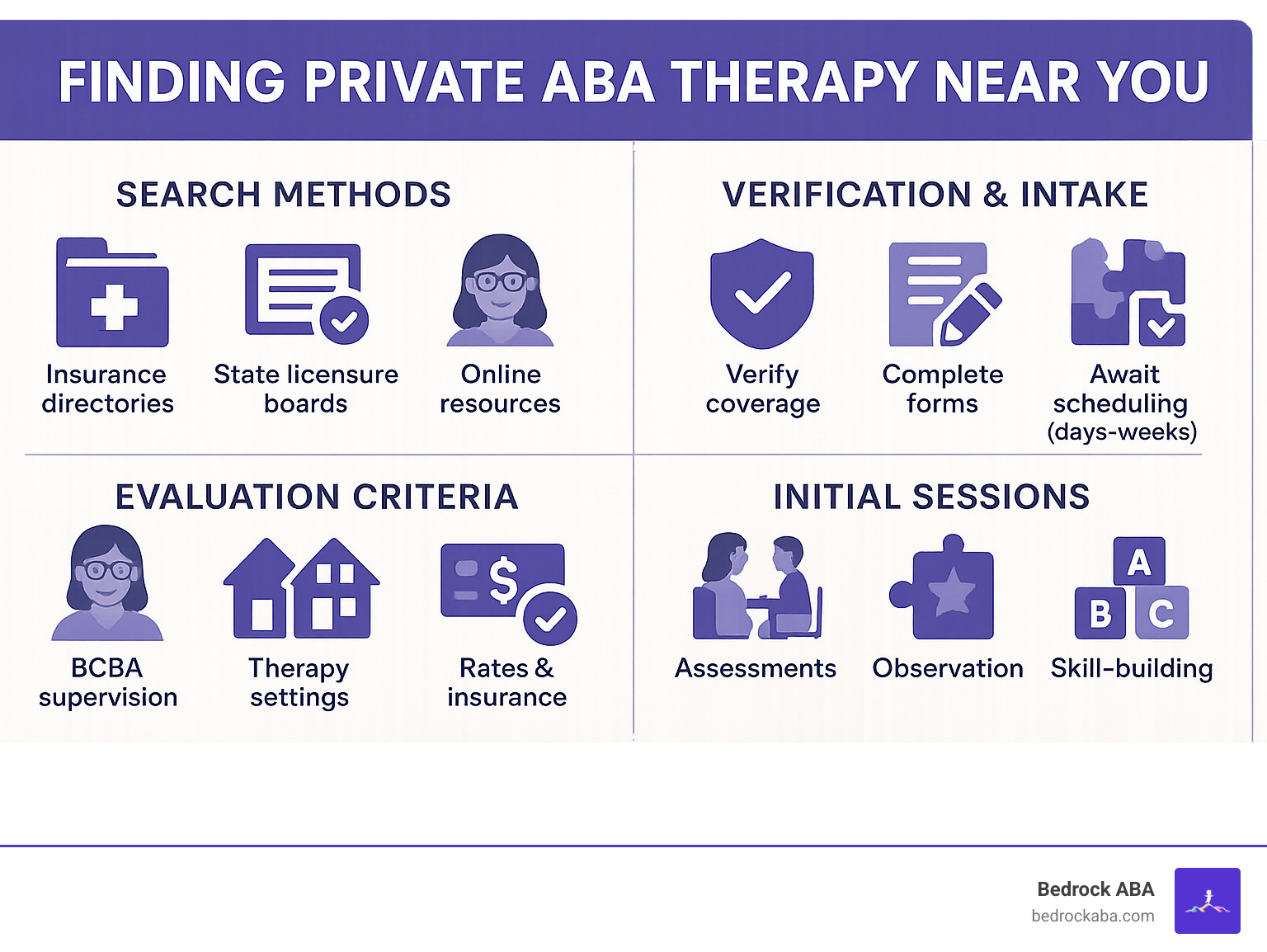
– Insurance directories – Check your plan’s provider network online
– State licensure boards – Search certified BCBAs in your area
– Care.com – Browse 2,036 ABA therapists with 4.7/5 average rating
– Pediatrician referrals – Ask your child’s doctor for local recommendations
– School districts – Request private provider lists from special education coordinators
What to Look For:
– Board Certified Behavior Analyst (BCBA) supervision
– In-home, clinic, or community-based options
– Average rates of $20-200/hour depending on credentials
– Insurance acceptance and quick intake process
When families search for quality ABA therapy, they often feel overwhelmed by confusing processes and long waitlists. Private providers typically offer more flexibility, faster start times, and individualized care plans compared to larger clinic networks.
I’m Mayer Kulefsky, director of operations at Bedrock ABA, where I’ve helped expand behavioral health services across multiple states including North Carolina and Utah. Through my experience overseeing private aba therapy near me services, I’ve seen how the right local provider can make all the difference for families seeking personalized, accessible care.
Private ABA Therapy 101: Definition, Benefits & Skills
Applied Behavior Analysis might sound complicated, but it’s really about helping children learn new skills and feel more confident in their daily lives. Think of ABA as a scientific approach that breaks down big goals into small, achievable steps—like teaching a child to tie their shoes by first learning to make loops, then practicing the crossing motion, until it all comes together naturally.
The research behind ABA is impressive. Over 20 studies show that children who receive 25-40 hours of intensive therapy per week for 1-3 years make significant improvements in communication, social skills, and intellectual functioning. The U.S. Surgeon General and American Psychological Association both endorse ABA as an evidence-based treatment for autism spectrum disorders.
When families search for private aba therapy near me, they’re often looking for something more flexible than traditional clinic programs. Private ABA therapy can happen in your living room, at the playground, or even through telehealth sessions. This natural environment approach means therapists can address real-world situations as they happen.
Positive reinforcement sits at the heart of effective ABA. Instead of focusing on what children can’t do, therapists celebrate every small victory with immediate rewards. This might be a high-five for making eye contact, a favorite snack for using words instead of tantrums, or extra playtime for completing a task independently.
The therapy team includes Board Certified Behavior Analysts (BCBAs) who design individualized treatment plans and Registered Behavior Technicians (RBTs) who work directly with your child. BCBAs hold master’s degrees and extensive supervised experience, while RBTs complete 40 hours of specialized training.
Data drives every decision in ABA therapy. Therapists track progress objectively, adjusting interventions based on what’s actually working rather than guesswork. This scientific approach helps families see concrete improvements and ensures therapy stays focused on meaningful goals.
Scientific research on ABA effectiveness continues to demonstrate its value as a gold standard intervention for autism spectrum disorders.
Core Benefits at a Glance
Skill acquisition happens across multiple areas that matter most to families. Communication skills develop through play-based activities and assistive technology when needed. Social confidence grows as children learn to interact with peers, share toys, and steer playground dynamics. Daily living tasks like brushing teeth, getting dressed, and using the bathroom become more independent.
Behavior reduction focuses on understanding why challenging behaviors happen rather than simply stopping them. Therapists identify triggers and environmental factors that contribute to meltdowns or aggression. They teach replacement behaviors that serve the same purpose—like using words to request help instead of hitting when frustrated.
Generalization ensures skills learned in therapy transfer to real-world situations. Children practice new abilities at home, school, and in the community. Family members learn to use consistent reinforcement strategies.
Which Children & Families Benefit Most
Toddlers with autism spectrum disorder show the most dramatic improvements when they start ABA therapy between 18 months and 5 years old. Early intervention establishes positive behavioral patterns during critical developmental windows.
Teens with adaptive needs can still benefit significantly from ABA services up to age 21. Older children focus on social skills training, academic support, and transition planning for independent living.
Parent coaching becomes a crucial component for families seeking lasting change. Parents learn to implement ABA strategies during everyday routines, reducing stress and increasing confidence. This family-centered approach ensures progress continues beyond formal therapy hours.
Finding and Evaluating Private ABA Therapy Near Me
Finding the right private aba therapy near me can feel overwhelming, especially when you’re already navigating an autism diagnosis. The good news is that with the right approach, you can find a qualified provider who truly understands your family’s needs.
Your search should start with the most reliable sources. State licensure boards maintain official databases of all certified behavior analysts in your area, showing their current license status and any disciplinary actions. This gives you confidence that you’re working with legitimate professionals.
Insurance directories are often your next best friend. Most major insurers are required to cover ABA services for children, so their online provider networks can help you find both qualified therapists and affordable options.
Peer reviews from other parents can provide insights you won’t find anywhere else. When another family shares that their therapist helped their child learn to communicate or reduced meltdowns, that’s valuable information you can trust.
Beyond online searches, school referrals often lead to hidden gems. Special education coordinators work with many local providers and know which ones collaborate well with schools.
Provider credentials matter more than fancy websites. Look for Board Certified Behavior Analysts (BCBAs) who supervise the program and Registered Behavior Technicians (RBTs) who deliver direct services. These certifications ensure your child receives evidence-based treatment.
Multidisciplinary collaboration sets great providers apart from good ones. The best ABA therapists work seamlessly with your child’s speech therapist, occupational therapist, and teachers. This team approach prevents conflicting strategies and maximizes your child’s progress.
At Bedrock ABA, we’ve seen how the right match between family and provider creates lasting positive change. Our In-Home ABA Therapy approach allows us to work with children in their most comfortable environment while building strong partnerships with parents.

Search Strategies for Private ABA Therapy Near Me
Starting your search through insurance directories makes financial sense for most families. Log into your insurance portal and search for “Applied Behavior Analysis” or “Behavioral Health” providers. Since most major insurers must cover ABA services for children under 21, this path often leads to the most affordable options.
Regional centers in your state can be goldmines of local information. These state-funded programs maintain relationships with private providers and understand the local landscape.
The Beaming Health map and similar locator tools help you visualize where providers are located relative to your home, work, and your child’s school.
School referrals deserve special attention because educators see ABA therapists in action. They know which providers show up prepared, communicate well with teachers, and help children generalize skills from therapy to classroom settings.
Checklist to Vet Private ABA Therapy Near Me
BCBA certification should be your first checkpoint. Verify that the supervising behavior analyst holds current certification through the Behavior Analyst Certification Board.
Background checks and safety screenings protect your child and give you peace of mind. Reputable providers complete these screenings for all staff members.
Experience years matter, but don’t automatically dismiss newer providers. A BCBA with two years of intensive autism experience might be more skilled than someone with ten years in a different area.
Parent training separates good programs from great ones. The best providers teach you strategies to use at home, helping your child practice skills throughout the day.
Data transparency shows professionalism and accountability. Quality providers share progress graphs, explain what the numbers mean, and adjust treatment plans based on objective results.
The therapists we work with at Bedrock ABA meet these standards while offering the flexibility busy families need. Our ABA Therapy Services in Utah demonstrate how thorough vetting creates better outcomes for children and less stress for parents.
Costs, Insurance & Access Options
Let’s talk money – because understanding ABA therapy costs shouldn’t feel like solving a puzzle. The truth is, private aba therapy near me searches often lead families to sticker shock, but there are more affordable options than you might think.
Hourly rates vary dramatically depending on who’s providing the service. A Board Certified Behavior Analyst (BCBA) typically charges $120-200 per hour for their specialized expertise in designing treatment plans and conducting assessments. However, most direct therapy happens with Registered Behavior Technicians (RBTs), who charge around $20 per hour on average – much more manageable for families needing regular sessions.
Home-based services usually fall somewhere in the middle at $100-150 per hour, while group therapy sessions can range from $50-100 per hour. Assessment and consultation sessions are typically priced at $150-300.
Insurance coverage has improved dramatically over the past decade. Most states now mandate that insurance companies cover ABA therapy, though the details vary by location. Medicaid covers medically necessary ABA for children under 21 in all states, which provides crucial access for families regardless of income level.
Private insurance requirements differ significantly by state. Some states like Florida cap annual coverage at $36,000, while North Carolina extends coverage up to $40,000 annually. The key is understanding your specific plan’s requirements – most insurers need a formal autism diagnosis and BCBA assessment before approving services.
Don’t let insurance problems discourage you. Many families find that sliding scale fees make private therapy accessible even without full coverage. Autism organizations and foundations also offer scholarships and grants for qualifying families.

Speeding Past Waitlists & Starting Quickly
Nobody wants to hear “we’ll call you in six months” when their child needs help now. The good news? Private providers often offer much faster access than large clinic networks, and there are smart strategies to get started even sooner.
Preparation is your best friend when it comes to quick starts. Gather all your child’s diagnostic reports and medical records before making calls. Complete intake paperwork as soon as providers send it.
Telehealth evaluations have revolutionized how quickly families can begin services. Many providers can conduct initial assessments virtually, sometimes within days of your first contact. Our ABA Telehealth Therapy services exemplify this approach – we can often begin supporting your family within days rather than months.
Private pay arrangements sometimes receive priority scheduling since they eliminate insurance approval delays. Even if you plan to use insurance eventually, starting with private pay can provide immediate support while working through authorization processes.
Here’s a strategy many families don’t consider: contact multiple providers simultaneously. Don’t wait for one provider to respond before reaching out to others.
Flexible scheduling can also speed up access. Providers often have evening or weekend appointments available sooner than traditional daytime slots.
From Intake to Progress: What to Expect
Starting private aba therapy near me can feel overwhelming, but understanding the journey ahead helps families feel more confident and prepared. The process from your first phone call to seeing real progress follows a thoughtful, step-by-step approach designed to set your child up for success.
Your journey begins with that first conversation. During the initial contact and screening, typically in your first week, you’ll have a warm phone consultation where we discuss your child’s unique needs and your family’s goals. We’ll verify your insurance benefits and explain exactly what’s covered, then schedule your comprehensive assessment.
The comprehensive assessment phase usually happens in weeks two and three, and this is where the real detective work begins. A Board Certified Behavior Analyst (BCBA) will conduct a thorough developmental and behavioral assessment, getting to know your child’s strengths and challenges. The functional behavior analysis helps identify what triggers certain behaviors and what patterns emerge throughout your child’s day.
What makes this process special is the family interview and goal-setting discussion. Your insights as a parent are invaluable—you know your child better than anyone.

By week four, we’re ready for treatment plan development. This is when everything comes together into an individualized behavior intervention plan custom specifically for your child. We’ll create specific, measurable goals that matter to your family’s daily life. Together, we’ll decide on the best service delivery model—whether that’s in your home, at our clinic, or through telehealth options.
Service implementation typically begins by week five, and this is when the real work—and real progress—starts happening. Regular therapy sessions begin with careful data collection on target behaviors and skills. Parent training becomes a key component because you’re your child’s most important teacher.
The journey doesn’t stop once sessions begin. Ongoing monitoring and adjustment means we’re constantly fine-tuning the approach based on what’s working. Weekly data reviews help us see patterns and progress, while monthly supervision meetings with your BCBA ensure quality and consistency.
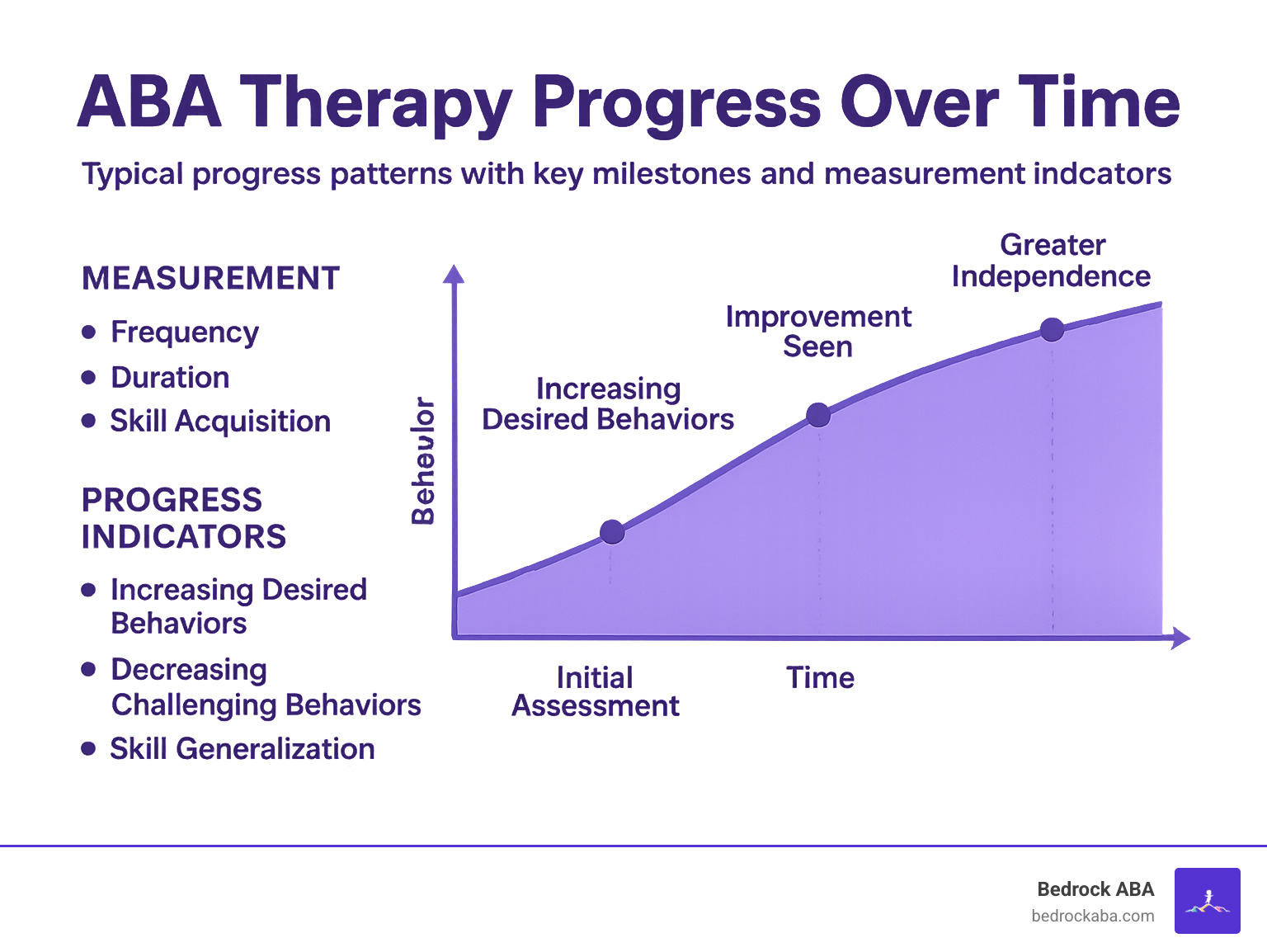
What makes progress truly meaningful goes beyond just checking boxes. Effective ABA therapy produces observable, measurable changes in your child’s behavior and skills that you can see in everyday life. We track this through objective data collection on specific target behaviors, skill acquisition curves that show learning over time, and generalization measures across different settings and people.
Therapy Settings Explained
Choosing the right setting for your child’s therapy can make all the difference in their progress and your family’s experience. Each option offers unique advantages, and many families find that combining different settings works best.
Home-based services bring therapy directly into your child’s natural environment, where real life happens. This setting shines when we’re working on daily living skills like toilet training, getting dressed, or mealtime routines. When challenging behaviors happen at home, we’re right there to help in the moment.
Clinic-based programs offer a structured environment with specialized resources you might not have at home. Your child gets access to specialized equipment and materials designed for learning. The controlled environment allows for focused skill development without the distractions of home life.
Community-based interventions take learning into the real world where your child will ultimately use their new skills. This might include school support and academic integration, community outings to practice social situations, or recreational activities and sports participation.
Many families find that hybrid models work beautifully for their unique situation. You might combine intensive home-based services with clinic groups for social skills, or pair school consultation with home programming.
The magic happens through Natural Environment Teaching (NET), which integrates learning opportunities into naturally occurring activities and routines. This approach makes skills more likely to stick and transfer to new situations because they’re learned in context rather than in isolation.
For more detailed information about different approaches and how they work in practice, visit our resource on what is ABA therapy and how does it work.
Frequently Asked Questions about Private ABA Therapy Near Me
How long until I see progress?
One of the first questions every parent asks is when they’ll start seeing real changes in their child. The honest answer? Every child’s journey is unique, but most families begin noticing positive shifts within the first few months of consistent therapy.
During the first 2-4 weeks, your child is simply getting comfortable with their new therapist and routine. Don’t worry if progress seems slow at first – this bonding period is actually crucial for everything that comes next.
Between 1-3 months, you’ll likely start seeing those exciting “lightbulb moments” – maybe your child uses a new word spontaneously or has fewer meltdowns during transitions.
At the 3-6 month mark, the improvements often become more obvious to extended family and friends. Communication skills typically flourish, social interactions become more natural, and those challenging behaviors that brought you to therapy start decreasing noticeably.
By 6-12 months, many families see their child using learned skills in completely new situations – at grandma’s house, the grocery store, or with different caregivers. This generalization is when you know the therapy is really working.
Several factors influence how quickly you’ll see progress. Age matters tremendously – younger children often show faster improvements because their brains are so adaptable. Service intensity also plays a huge role; children receiving 25-40 hours per week typically progress faster than those in lower-intensity programs.
But here’s what makes the biggest difference: your involvement as a parent. When families actively participate in therapy and use strategies at home, children’s progress accelerates dramatically.
Is private ABA covered by my insurance?
Insurance coverage for private aba therapy near me can feel like navigating a maze, but the good news is that most plans are required to cover these services. Understanding your specific benefits takes some detective work, but it’s absolutely worth the effort.
The legal landscape is on your side. The Affordable Care Act requires coverage for autism-related services, and all 50 states have some form of autism insurance mandate. Most coverage extends through age 21, giving families years of potential support.
What typically gets covered includes comprehensive behavioral assessments, individual and group therapy sessions, parent training, and ongoing progress monitoring. Essentially, the core components of quality ABA therapy are recognized as medically necessary by most insurers.
However, coverage limitations exist. Annual dollar caps range from $25,000 to unlimited depending on your state and specific policy. Some plans limit the number of visits per year, while others restrict you to certain provider networks. Pre-authorization is almost always required.
Here’s how to maximize your benefits: Start by calling your insurance company directly to verify your autism-related benefits. Ask specifically about ABA therapy coverage, annual limits, and pre-authorization requirements. Work with in-network providers whenever possible to minimize out-of-pocket costs.
Medicaid families have strong protections – all states must cover medically necessary ABA for children under 21, often with fewer restrictions than private insurance.
How do therapists measure success?
Unlike other therapies where progress might feel subjective, ABA therapy relies on hard data to track every step of your child’s journey. This scientific approach means you’ll always know exactly how your child is progressing and what’s working best.
Therapists collect different types of data depending on your child’s goals. They might count how often your child initiates communication, measure how long they can stay engaged in an activity, or track how independently they complete daily routines like brushing teeth or getting dressed.
The beauty of data collection is that it captures progress you might miss in day-to-day life. Sometimes parents feel discouraged because change seems slow, but the data reveals steady, consistent improvement that builds over time.
Your therapist tracks both sides of the equation – increasing positive behaviors while decreasing challenging ones. They’re looking for your child to communicate more, engage socially, follow instructions, and complete tasks independently.
Generalization is a key success indicator. It’s one thing for your child to use a skill with their therapist at home, but real success means using that same skill at school, with grandparents, or in the community.
You’ll receive regular updates through weekly summary reports, monthly progress graphs, and quarterly comprehensive reviews. These aren’t just numbers on a page – they tell the story of your child’s growth and help guide future treatment decisions.
The most meaningful progress often shows up in unexpected moments – when your child spontaneously hugs a sibling, asks for help instead of having a meltdown, or confidently joins a group of peers at the playground.
Conclusion
Your search for quality private aba therapy near me has led you through a comprehensive guide, and now you’re equipped with the knowledge to make the best choice for your family. The journey from that first overwhelming Google search to finding the right provider doesn’t have to feel impossible when you have a clear roadmap.
What makes private aba therapy near me searches so common is that families want something beyond cookie-cutter programs. They’re looking for providers who see their child as a unique individual, not just another case number. At Bedrock ABA, this philosophy drives everything we do—from our first conversation with families to celebrating those breakthrough moments months later.
The beauty of private ABA services lies in their flexibility and personalization. Unlike larger institutional programs, private providers can adapt quickly to your family’s changing needs. Maybe your child thrives with morning sessions at home but struggles in clinical settings. Or perhaps your teenager needs community-based support for job skills rather than traditional table-top learning.
What sets exceptional providers apart isn’t just their credentials or years of experience—though those matter tremendously. It’s their ability to make you feel heard, supported, and genuinely partnered in your child’s growth. When a BCBA takes time to explain why they’re targeting specific goals, or when an RBT celebrates your child’s small victories with the same enthusiasm you do, you know you’ve found the right fit.
The investment in quality ABA therapy extends far beyond immediate behavioral changes. Families consistently tell us that the confidence, communication skills, and independence their children develop through our services create ripple effects throughout their entire lives. Siblings feel more comfortable bringing friends home. Parents refind activities they’d given up. Children participate in community events they never could before.
Whether you’re in Salt Lake City, across Utah, or anywhere else in our service areas, the right provider will make this complex process feel manageable. They’ll handle insurance headaches, coordinate with schools, and most importantly, they’ll celebrate every milestone alongside your family.
Your child deserves ABA therapy that honors their unique strengths while addressing their specific challenges. They deserve providers who combine scientific rigor with genuine warmth, who use data to drive decisions but never lose sight of the whole child behind those numbers.
Ready to experience the Bedrock ABA difference? Contact our team to start today and find how our flexible, family-centered approach can support your journey toward meaningful, lasting progress.